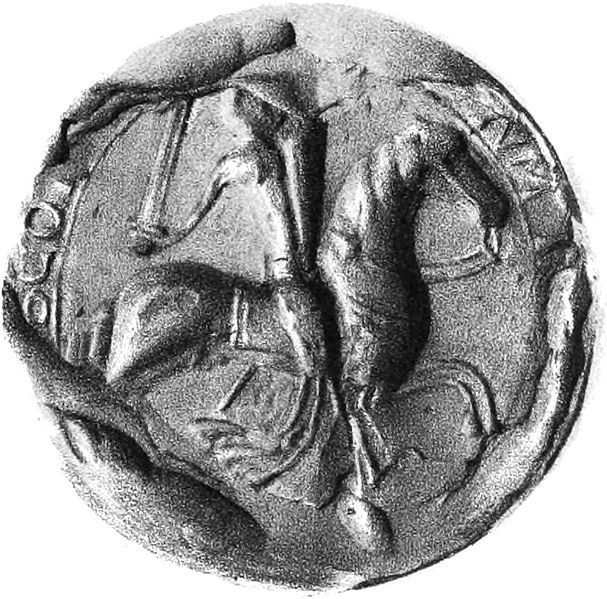
The previous sections looked at the medieval beginnings of the Robin Hood legend in the ballads and then in the play-game tradition. Now, we'll explore how the legend changed in the 16th century and the early 17th century -- with special focus on Robin Hood's appearances in Elizabethan drama.
Early on, the official opinion on Robin Hood was not favourable. Oh, in the eyes of the public, he was a hero. But according to historians and other busybodies, he was a hooligan and a murderer -- someone not to be trusted.
That soon changed. John Major remarked on how Robin Hood was the humanest of robbers, and noted that the outlaw enriched the poor with "the plunder taken from abbots". And slowly, people started to have a kinder opinion of that merry rogue. This led to the major change mentioned in the first section below.
And Major's dating of the legend was copied and repeated by others. By the time of Elizabeth I, Robin Hood was associated with King Richard I and his much-maligned brother John. Although, as you'll see below, Robin still manages to show up elsewhen from time to time.
Other changes began to happen. For example, characters from other outlaw legends like Adam Bell and Gamelyn (who shows up as in the ballads as Young Gamewell, the true name of Will Scarlet) met Robin Hood. And Robin took on even more traits of real outlaws like Fulk fitz Warin and Hereward.
And Robin Hood was given a home town, Locksley (most likely Loxley in Yorkshire).
New stories were told. New elements added to the old stories. For example, a manuscript from around 1600 tells the story of how Robin Hood became an outlaw -- a story that no one told in the early years (that we know of). In this tale, Robin was outlawed when he killed some foresters because they refused to pay up on a bet. The story is recorded in the later ballad, Robin Hood's Progress to Nottingham. This Sloane manuscript's Life of Robin Hood summarizes the pre-existing Gest, but also borrows elements from later ballads -- the earliest surviving copies appearing decades after the Sloane MS. It is the Sloane MS which contains the first reference of Loxley as Robin's birthplace.
But that wasn't the only origin story our bold outlaw was given. Not by a long chalk.
Robin ended up being very different than his medieval incarnation.
There was a curious side effect to Robin Hood's improving reputation. He was thought to be a good man and very noble. Somewhere along the line Robin Hood was went from being noble to being a noble.
Richard Grafton in his 1569 Chronicle at Large , challenged the traditional social status of Robin as yeoman.
But an olde auncient Pamphlet I finde this written of the sayd Robert Hood. This man (sayeth he) discended of a noble parentage: or rather beyng of a base stocke and lineage, was for his manhood and chiuarly aduanced to the noble dignitie of an Erle.
--Quoted in Knight, p. 40
In Grafton, Robin is outlawed after he goes into debt -- an origin that is used in later works that make Robin Hood an earl. [In the Gest , Robin also falls into debt, although that is towards the end of the tale.]
There's some debate about how authentic this "olde auncient Pamphlet" was. Stephen Knight feels Grafton was not the type to invent his sources. However, this would not have been the first time a non-existent pamphlet was used to add to a medieval legend.
But the veracity of a chronicler is not that important. Others followed Grafton, such as William Warner, who in book V of his long poem Albions England from 1586 also described Robin as an earl -- or his term, a county.
Those daies begot some mal-contents, the Principall of whome
A County was, that with a troope of Yomandry did rome,
Braue Archers and deliuer men, since nor before so good,
Those tooke from rich to giue the poore, and manned Robin Hood.
He fed them well, and lodg'd them safe in pleasant Caues and bowers,
Oft saying to his merry men, what iuster life than ours?
You might notice a familiar phrase in that passage -- that Robin took from the rich to give to the poor. Similar sentiments had been expressed before, but not quite that expression.
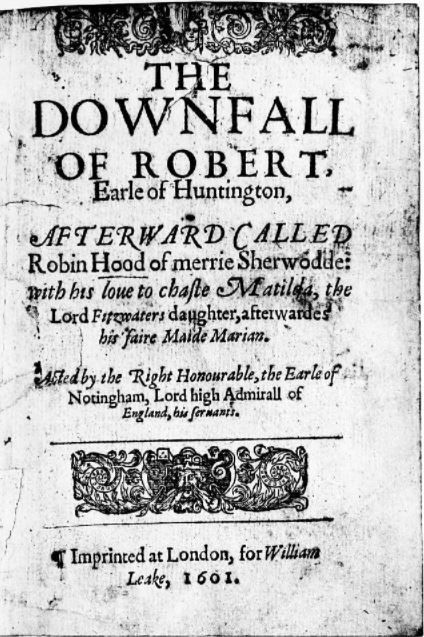
It wasn't long before playwrights also bestowed Robin with the title of earl -- Earl of Huntingdon, to be exact. (Or Huntington, to use the spelling of the original publication.)
Shakespeare's contemporary Anthony Munday (with help from Henry Chettle) made Robin the star of two Elizabethan tragedies, The Downfall of Robert, Earle of Huntington and The Death of Robert, Earle of Huntington .
I use the term "star" very loosely. Robin dies in the first act of Death . The rest of the play borrows from an Elizabethan poem where King John pursues a woman named Matilda. (Munday's plays make Marian an alias for Matilda Fitzwater, based after the semi-historical and legendary FitzWalter.)
Robin has a reduced presence in other Elizabethan plays in which he appears, and very little from the ballads are used. Knight is very critical of this trend when he writes, "the Summer Lord of the play-game and ballad has been frozen into inactive aristocracy."
To give an example of the Elizabethan Robin Hood, here is Sir Doncaster,
a bad guy from the Munday plays explaining his paper-thin motivation for
villiany.
"I hate thy cousin, Earle of Huntington,
Because so many love him as there doe,
And I myselfe am loved of so fewe.
Nay, I have other reasons for my hate;
He is a foole, and will be reconcilde
To anie foe hee hath; he is too milde
Too honest for this world, fitter for heaven.
Hee will not kill these greedie cormorants,
Nor strippe base pesants of the wealth they have;
He does abuse a thieves name and an outlawes,
And is indeede no outlawe, nor no theefe -
He is unworthy of such reverent names.
Besides, he keeps a paltry whinling girle,
And will not bed, forsooth, before he bride.
Ile stand too't, he abuses maidenhead,
That will not take it, being offered,
Hinders the common wealth of able men.
Another thing I hate him for againe:
He saies his prayers, fastes eves, gives alms, does good.
For these and such like crimes, sweares Doncaster
To work the speedie death of Robin Hoode.[The Death of Roberte, Earle of Huntington lines 307 - 327. From Robin Hood and Other Outlaw Tales, edited by Stephen Knight and Thomas H. Ohlgren]
From around the same time, Robin Hood is the earl in the more comic play Looke About You by an anonymous author.
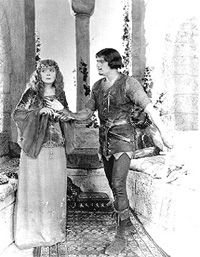
Robin's earldom is virtually ignored in most later ballads [Parker's A True Tale of Robin Hood being a major exception], but Robin keeps his earldom in movies like the 1922 Robin Hood starring Douglas Fairbanks, Sr. and the 1991 Robin Hood starring Patrick Bergin. And it inspired antiquaries to firm up the earldom given to Robin by dramatists.
And in 1746, Dr. William Stukeley combed through old family records, changed a name here, forged a whole family there, and "discovered" the quite fictitious, Robert fitz Ooth, Norman lord of Kime and pretended earl of Huntingdon. This fictional name was used by many latter writers.
There are two lost plays mentioned in the Stationers' Register. Robin Hood and Little John from 1594, which might have been an earlier version of the ballad discovered later where they first meet, or just another story of the two outlaws. Another lost play Robin Hood's Penn'orths is mentioned in the register for 1600-1601.
The play George a Greene, the Pinner of Wakefield (possibly by Robert Greene) also features Robin and his friends from the legend. It resembles the ballad The Jolly Pinder of Wakefield. Like the medieval legend, but not the Elizabethan legend, the king is named Edward in the Greene play.
Speaking of Edwards, George Peele's The Famous Chronicle of Edward I (circa 1593) has the Welsh leader Lluellen puts on a Robin Hood game of old in the personage of Robin Hood, with others as Little John, Friar Tuck and Maid Marian.
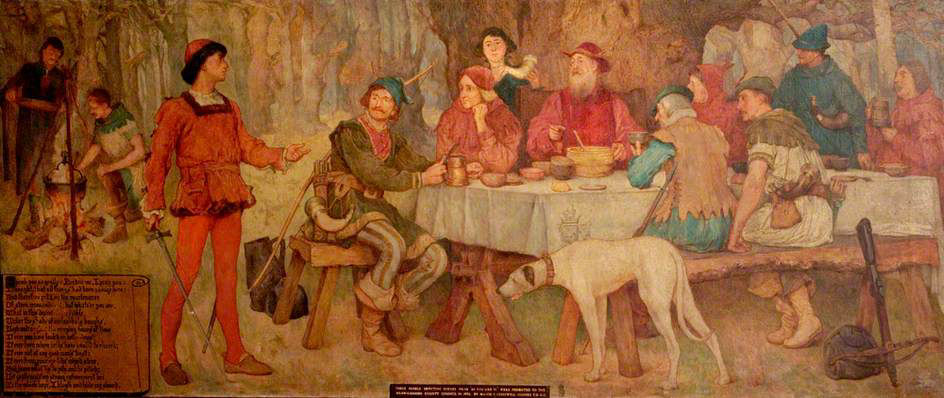
And what of William Shakespeare? Well, he referred to the Robin Hood legend. As You Like It follows in the tradition of The Tale of Gamelyn, with the old duke exiled to the Forest of Arden with a group of Merry Men who "live like the old Robin Hood of England" (Act I, scene i).
In Act IV, scene i The Two Gentlemen of Verona, an outlaw exclaims "By the bare scalp of Robin Hood's fat friar."
Falstaff namechecks Maid Marian in Act III, scene ii of Henry IV, Part 1. And Act V, scene iii of Henry IV, Part 2, Falstaff's companion Justice Silence sings "And Robin Hood, Scarlet, and John."
Finally, Shakespeare's co-writer John Fletcher uses the phrase "lighter than Robin Hood" in the prologue of The Two Noble Kinsman.
While no actual Robin Hood play by Shakespeare exists, his later contemporary and successor Ben Jonson did attempt a play based on the legend. You can read about that in the next section.
CHANGES TO THE LEGEND:
PART 2: PROTESTANTS AND PROPAGANDA (17th century)
PART 3: BROADSIDES AND BUFFOONERY (17th-18th centuries)
PART 4: REVOLUTIONS AND ROMANTICISM (18h-19th centuries)
PART 5: CHILDREN'S NOVELS AND COMIC OPERAS (18th-20th centuries)
PART 6: FILMS AND FANTASY (20th-21st centuries)
PART 7: COMIC BOOKS AND COPYCATS (20th-21st centuries)
PART 8: ROBIN HOOD IN THE PRESENT AND THE FUTURE (21st century)
INDEX: WOLFSHEAD THROUGH THE AGES - THE HISTORY OF ROBIN HOOD (Index page)
ROBIN HOOD: THE EARLY YEARS
PART 1: BALLADS AND BACKGROUND (13th-15th centuries)
PART 2: MAY GAMES AND MAYHEM (13th-16th centuries)
Thanks to Alan Lupack at The Robin Hood Project at the University of Rochester for allowing direct links to the ballads. Much of these sources have now been moved to the Middle English Texts Series website. I strongly urge you to donate to METS.
Click here to view additional information sources used for this specific section.
Illustrations used include the seal of David, Earl of Huntingdon, the title page of Munday's play and Duke Senior lives like Old Robin Hood in this painting by Frederick William Davis of As You Like It in Warwick Shire Hall. All used without permission under the principle of Fair Use. I believe Douglas Fairbanks in Robin Hood is now out of copyright.
Wolfshead Through the Ages is only a small part of a much-larger site filled with information about the Robin Hood legend.
Contact Us