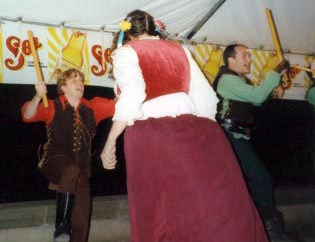
The previous section looked at the medieval beginnings of Robin Hood, with special emphasis on the ballads. But that's only part of Robin Hood's medieval tradition. In this section, he look at his performance tradition -- in plays, games and festivals.
In 1427, about two decades before the earliest surviving ballad, there's a reference in the records for Exeter in Devon to pay 20d (pence) to actors in a Robin Hood play. It's the first over a hundred references before 1600 to some kind of performance tradition for Robin Hood. These often occurred at events often referred to as the May Games.
Most of the Robin Hood performance records occur in the months of May and June -- most commonly around Pentecost, the seventh Sunday after Easter also called Whit Sunday or Whitsun, and the festivities of the following week Whitsuntide. There is less of an association with the first of May or May Day, although Morris Dances can be a part of both events, even though they were only introduced in England well after the start of the May Games.
The May Games tradition is medieval and present at the end of the Middle Ages, but while in declines over time, there are still examples of it well into the Early Modern Period of the 1640s.
David Wiles in his landmark 1981 study The Early Plays of Robin Hood appreciated the "diversity of terminology" with phrases such as play, game, ale and gathering as just some of the options. He chose to adopt the term game, "for the words 'game' and 'play' were completely synonymous in the late medieval stage."
But perhaps it's best to begin with the surviving play scripts we have and expand outward into the much broader Robin Hood performance tradition.
The first is from about 1475 and may come originally from the papers of the Paston family. In 1473, Sir John Paston had complained about a horse-keeper leaving his service, or "goon into Bernysdale" as Paston quipped as this servant had acted in plays of St. George and "Robyn Hod and the Shryff off Notyngham".
Following Paston's reference, many scholars have called the play-text Robyn Hod and the Shryff off Notyngham. It is also often referred to as a "dramatic fragment". The text is 21 lines, each line is a rhyming couplet. The surviving document has no stage directions, and it doesn't even identify the speakers. Scholars have assigned the lines differently.
Robyn Hod and the Shryff off Notyngham, edited by Stephen Knight and Thomas Ohlgren
Robin Hood and the Sheriff of Nottingham, edited by John Marshall
The story greatly resembles the ballad Robin Hood and Guy of Gisborne, which only survives in a later edition but is believed to be medieval. The Sheriff of Nottingham employs an unnamed knight to defeat Robin Hood. As in the ballad, Robin and his foe fight and Robin cuts off his head. The dramatic fragment ends with the Merry Men still held captive by the sheriff. At least, the idea that the story cuts off before the end is the common view. Stephen Knight has suggested otherwise. He notes the idea there is missing text "assumes there must be words for performance to exist."
What follows the end of the verbal text here may simply be heroic action. Like the long final sequences in many films, which usually have no dialogue at all as Robin rescues friends from a terrible fate and settles scores with his enemies. What seems a textual silence may indeed be the high point of performance: the dramatic character of the plays can itself be suggested by a lack of words.
- Stephen Knight, Robin Hood: A Complete Study of the English Outlaw, 1993, p. 101
One of Stephen Knight's strengths is that he challenges the traditional ways of thinking. That said, there are lines of dialogue during Robin and the Knight's fight. And usually heroes in action films get off a heroic quip or two. However, other scholars such as John Marshall support Knight’s view that the “dramatic fragment” may not be so fragmentary.
In the text, a character makes note of one outlaw's skill: "Be holde wele ffrere tuke / howe he dothe his bowe pluke." Friar Tuck isn't mentioned in the medieval ballads, and appears in very few of the later ones. But he appears in this 1475 drama. And he also appears in the other early play text we have.
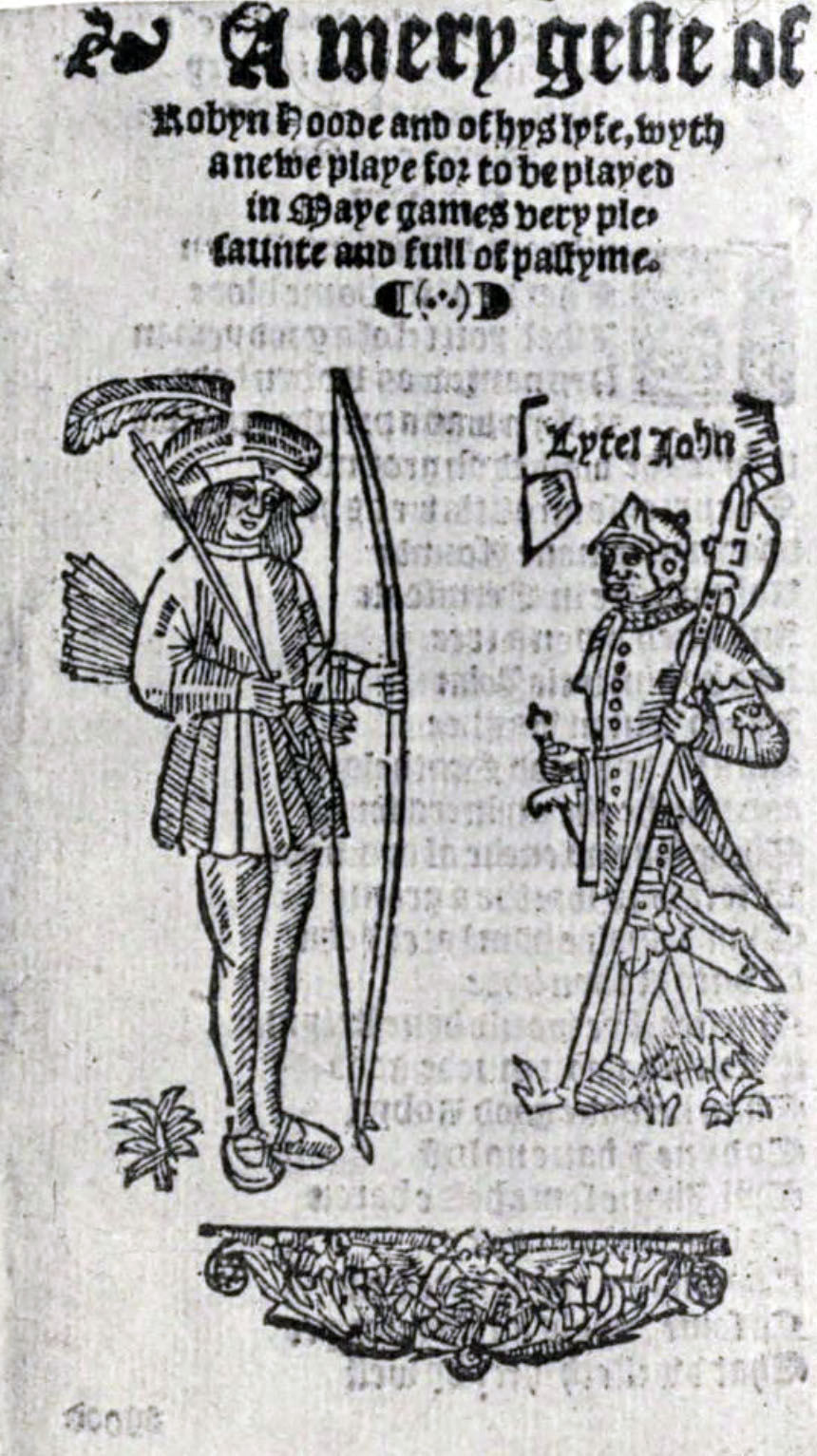
The other "play" appears at the end of William Copland's edition of the medieval ballad A Gest of Robyn Hode, printed circa 1560. Or as it proclaims on the title page "“A mery geste of Robyn Hoode and of hys lyfe, wyth a new playe for to be played in Maye games very pleasaunte and full of pastyme”. When that section begins, it's billed as The Playe of Robyn Hoode, verye proper to be played in Maye games.
The description as a "play", singular, is questionable, for it reads as two plays joined together. These days it's often referred to by the somewhat lengthy name of Robin Hood and the Friar and Robin Hood and the Potter.
The part about the play or plays being "new" is also questionable. The second half includes scenes from the ballad Robin Hood and the Potter, which first appeared in a manuscript nearly a century before Copland's edition. The play gives the potter a boy named Jack, not present in the surviving medieval ballad, and it removes the memorable aspect of Robin Hood himself disguising as a potter and tricking the sheriff.
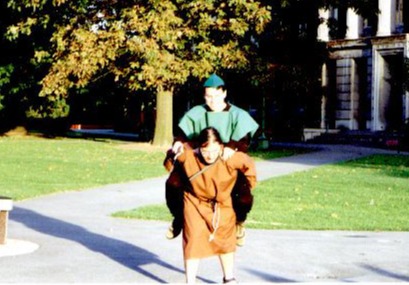
And the first half takes from the ballad Robin Hood and the Curtal Friar, a ballad that we do not have a record of until a century after the play text. Unlike the latter ballad, the play explicitly calls the friar "Tuck". The most memorable part of Robin Hood's meeting with the friar from the later ballad, the children's books and modern movies is present in the play. Robin crosses a river riding the friar's back. R.B. Dobson and J. Taylor conclude as most do that this means there is a lost version of the Curtal Friar ballad from earlier in the 16th century.
David Wiles agrees with them that this play clearly has its roots in the ballads. But Wiles also feels that the May Games tradition shaped the ballads themselves.
The combat motif in the ballad tradition has only one explanation, that it was inspired by the may-games combat played such an important part. We have seen already that the 1475 fragment was not adapted from any known ballad., and there is no reason why we should expect it to have been so adapted. For the case was commonly the reverse. The games provided a foundation upon which the poet could erect his narrative. In due course, as in the 1562 playlets, the narrative could again be translated and given dramatic form.
-- David Wiles, The Early Plays of Robin Hood. 1981, p. 46
Debates continue over just how much and in which order the plays and ballads influenced each other. Perhaps it didn't matter to those living in those days which came first.
In many parts of England by the end of the Middle Ages, Robin Hood the dramatic character may have been as familiar as Robin Hood the ballad here.
-- Jeffrey Singman, Robin Hood: The Shaping of the Legend. 1998, p. 62
But looking at it with hindsight, and the limited surviving texts, we see two characters who appear in the tradition of Robin Hood Games, but not in the medieval ballads (not the surviving ones at any rate.)
We've already discussed Friar Tuck's appearance into the legend. And at the end of the Friar section of the 1560s play, Robin Hood offers the friar a role in the band and a "lady fre". The friar says he'd rather dance in the mire with the lady who is implied to have a disreputable character.
Many Robin Hood scholars believe that unnamed free lady is Maid Marian.
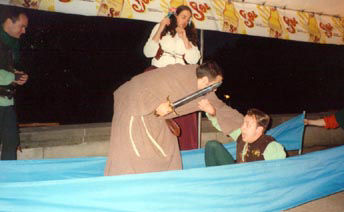
The friar is a common figure in the May Games tradition, as our other mock priests, such as the Abbot of Unreason. The name Tuck only appears rarely in the records -- at least in the dramatic records. The thing Robin Hood scholars are asked most often is surely "Is Robin Hood real?" And the honest answers to that question are often complicated or disappointing. But that might not be the case with Friar Tuck.
Twice in 1417, royal writs demand the arrest of an outlaw who led a band which robbed, murdered and committed other acts of general mayhem. One report says he "assumed the name of Frere Tuk newly so called in the common parlance." As J.C. Holt explains "the men who drafted the writs of 1417 had apparently never heard the name Friar Tuck before." (p. 59) A letter in 1429 says Tuck is still at large, and mentions his real identity -- Robert Stafford, chaplain of Lindfield, Sussex.
This chaplain may have employed an alias from a pre-existing legend, but it's quite possible that he was the first to use the name of Tuck.
R.B. Dobson and J. Taylor suggest that the Friar Tuck we know and love was born out of two separate traditions.
Many ingenious attempts to trace the origins of the Friar Tuck of the Robin Hood legend seem to have floundered on a failure to appreciate that he was a production of the fusion between to very different friars. As a renegade outlaw, he is recorded as early as 1417 ... and it was apparently in the capacity of bellicose outlaw that he played a part in the earliest known Robin Hood play of the 1470s, The almost always anonymous 'frere' of the morris dances was an altogether more jovial and buffoon-like character, at first unconnected with the greenwood legend at all; but by a natural process of conflation he gradually became inextricably involved with Robin Hood and took a modest place among his leader's 'merry men'.
-- R.B. Dobson and J. Taylor, Rymes of Robyn Hood (1997 edition), p. 41
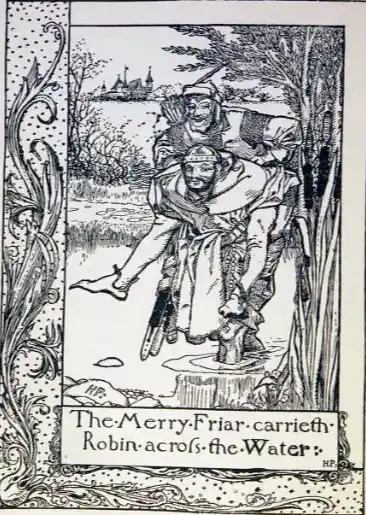
Friar Tuck and Robin Hood as illustrated by Howard Pyle
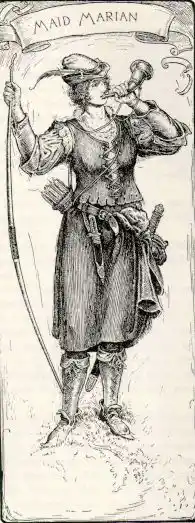
Maid Marian by Louis Rhead
Early references suggest Maid Marian’s early May Games appearances were not connected to Robin Hood. Also, she may have been imported from French pastouelle tradition, such as Adam de la Halle’s Le Jeu de Robin et Marion from the 1280s. But this Robin was not Robin Hood, he was a shepherd and Marion his shepherdess. However, when Marian was brought into the May Games, perhaps it seemed only natural to have made her the lover of Robin Hood eventually. Lesley Coote sees a connection between Marian and another aspect of the medieval Robin Hood tradition.
The pastourelles are important for the Robin Hood tradition because they illustrate what was probably the origin of his stories. They also demonstrate the origins of Robin as the lover/servant of the Virgin Mary, who was associated from an early stage with the shepherdess Marion.
-- Storyworlds of Robin Hood: The Origins of a Medieval Outlaw by Lesley Coote, p. 86
A lot of our knowledge about the content of the May Games comes from what records have been left. And REED - Records of Early English Drama - are coming through the records to find data for more counties.
We can see that Robin Hood, Little John, Marian and a Friar were characters in many of the games. We see records of the costumes being made. We can see references to a wide variety of activities.
We know that sometimes costumed players from one village would proceed to another village to ask for money. Robin Hood might sell badges (such as strips of cloth or paper) or church ales to raise money.
And it is the subject of money, where we best understand things. To pick a fairly late example, we know in 1561, the good villagers of Chudleigh in Devon paid 11 shillings and 6 pence for the cloth of Robin Hood’s coat (among many expenses) and that they received three pounds for the sale of ale. Perhaps it’s not romantic that so much of our knowledge of the legend comes from a ledger. But not all the Robin Hood references that year were so dry. In Edinburgh of 1561, the Robin Hood games had been banned, but that didn’t stop them from being performed which led to riot and robbery – in real life, not just the fictional, mock drama.
John Marshall made a special study of the parish of Croscombe in Somerset which have references to Robin Hood related activities 18 times in the parish’s churchwarden accounts between 1476 and 1526.
Robin Hood and his company, that includes, but may not exceed, Little John, preside over occasional revels or sports that contribute a ‘recones’ to church funds. It is probably safe to assume that the references are, in the main, to a church-ale with a Robin Hood flavour. Contemporary accounts indicate that church-ales could include feasting, drinking, dancing, minstrelsy, archery and other competitive sports such as wrestling, and plays. Of these, feasting is the only item from the menu possibly to feature in the Croscombe accounts.
"Comyth in Robyn Hode: Paying and Playing the outlaw in Croscombe by John Marshall, collected in Early English Performance: Medieval Plays and Robin Hood Games: Shifting Paradigms in Early English Drama Studies, p.251-2
Marshall notes a repeated reference to cheese in the records. But he also knows the most intense period of activity for Robin Hood in these records comes from when the church’s funds are depleted - at a time when church buildings needed repairs or additions. One expansion of the chapel of St. George. And it appears St. George began to displace Robin Hood as the central figure. Marshall quips that Robin Hood “may have been the victim of his own success.”
This was not the only parish to benefit from Robin Hood’s activities. The churchwardens also helped with poor relief.
And in the 1989 revised edition to J.C. Holt’s Robin Hood, Holt makes a connection by the fundraising of the May Games and what would become the most common expression about Robin Hood.
That Robin took from the rich and gave to the poor could have come about by an easy elision of associations. It could equally have been a brain-wave of some anonymous church warden who envisaged harnessing Robin's reputation to this end."
-- Robin Hood, Revised Edition by J.C. Holt, p,196
When combing through the records, a lot of possible patterns emerge.
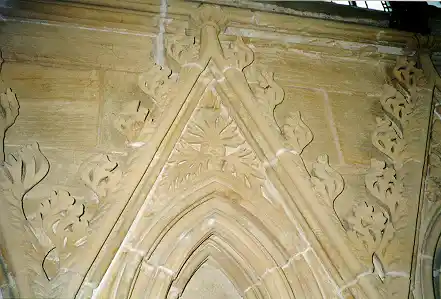
Some have argued that Robin Hood became almost a mythological figure through his association with the May Games. The first record of a Robin Hood play is from Exeter, only a few years after the city's first recorded May Games . Professor Lorraine Stock notes that Exeter Cathedral is filled with "Green Man" imagery, the human head with foliage growing out of his mouth. The Green Man, like Robin, has ties to the virgin Mary. (The Exeter Cathedral is dedicated to her.) The chapter house of Southwell Minster -- once in the heart of Sherwood Forest -- also is home to numerous Green Man carvings. Stock feels that the traditions of the Green Man and the Wild Man influenced the growth of the Robin Hood legend.
For David Wiles in his study The Early Plays of Robin Hood, it seemed that at the May Games, Robin did have a mythological presence as a King of the May or Summer King. And as a kingly figure, the person who plays Robin Hood would lead a procession. However, a later study by Alexandra Johnston undermines this position.
Unfortunately, the antiquarian source from which he took his reference is inaccurate. His source told him that there is a record from Amersham for 1530 that indicates that money was received "of the lord for Robin Hood. " Here it would appear that the summer lord was handing over money collected in the Robin Hood gathering. I have twice consulted the original manuscript both in the church in Amersham and in the Buckinghamshire Record Office, where it is now deposited. The entry really says "Resseuyd of the lades for Robyn hode." The scribe uses the z form of the r in secretary hand. There can be no mistaking the a for or, particularly since there is a clear or in the next word for. What this witness from Amersham is telling us, therefore, is something much more common: that the young men of the parish—the "lads"—were responsible for the Robin Hood gathering. There is, then, no unequivocal evidence that the figure called Robin Hood ever took the role of the mock king or summer lord at the summer festivals.
-- "The Robin Hood of the Records" by Alexandra F. Johnston in Playing Robin Hood: The Legend as Performance in Five Centuries pp.29-30
Looking into it further, Johnston compares the various records of plays that include both Robin and the king.
This is a figure or order, of reconciliation, not of disorder. It seems clear from the Thames Valley evidence, however, that the Robin Hood figure, within the setting of the summer festival presided over by a summer monarch, was the figure of disorder. Wherever there is a King Game, the king and Robin Hood are not the same figure. However fragmentary and elusive the evidence, the Robin Hood of legend and gest is an outlaw, a disturber of the peace, a figure of energy and combat. As such, the Robin Hood figures provide the counterpoint of disorder to the rule of the summer lords
-- "The Robin Hood of the Records" by Alexandra F. Johnston in Playing Robin Hood: The Legend as Performance in Five Centuries p. 33
The Robin Hood Games were certainly popular.
In 1571, one town bought gunpowder to welcome Robin Hood. Bishop Hugh Latimer recalled in one sermon that in the 1530's he visited a town where the church was empty, because "it is Robin Hoodes day." And in 1510, Henry VIII acted as Robin Hood as he and 11 nobles snuck into the queen's chamber.
But as Stephen Knight points out, there was a darker side to the Robin Hood celebrations. Real outlaws could be inspired by Robin Hood, such as in 1441 when some disgruntled people in Norfolk blocked the road threatening to murder someone. They sang "We are Robynhodesmen -- war, war, war." This is one of many examples.
As mentioned above, the banning of the Robin Hood plays in Scotland resulted in a riot.
And chroniclers compared outlaws to Robin Hood. Like the Derbyshire outlaw Piers Venables who in 1439 rescued prisoners. The record of the event states "beyng of his clothinge, and in manere of insurrection wente into the woodes in that county like it hadde be Robyn Hode and his meyne."
Comparisons to Robin Hood may have been going on a very long time. There are court roles where criminals are given the last name "robehood." Holt, in particular, believes these are clearly inspired by the stories of the famous outlaw. The earliest example of this was discovered by David Crook in 1984. The memoranda roll for 1261 refers to a Berkshire fugitive William, son of Robert le Fevre. But the roll from 1262 calls the same outlaw "William Robehod". However, the evidence in these cases is by no means certain. And it's possible that the nickname "Robin Hood" inspired the legend, and not the other way around.
Even in what I've called "the Early Years", Robin Hood has taken on many personas. That continues as the legend grows and changes. The Robin Hood on stage during the Elizabethan period was sometimes a far more respectable figure. You can learn about that in the next section.
CHANGES TO THE LEGEND:
PART 1: EARLDOMS AND ELIZABETHANS (16th-17th centuries)
PART 2: PROTESTANTS AND PROPAGANDA (17th century)
PART 3: BROADSIDES AND BUFFOONERY (17th-18th centuries)
PART 4: REVOLUTIONS AND ROMANTICISM (18h-19th centuries)
PART 5: CHILDREN'S NOVELS AND COMIC OPERAS (18th-20th centuries)
PART 6: FILMS AND FANTASY (20th-21st centuries)
PART 7: COMIC BOOKS AND COPYCATS (20th-21st centuries)
PART 8: ROBIN HOOD IN THE PRESENT AND THE FUTURE (21st century)
INDEX: WOLFSHEAD THROUGH THE AGES - THE HISTORY OF ROBIN HOOD (Index page)
ROBIN HOOD: THE EARLY YEARS
PART 1: BALLADS AND BACKGROUND (13th-15th centuries)
Thanks to Alan Lupack at The Robin Hood Project at the University of Rochester for allowing direct links to the ballads. Some of the texts have since been moved to the Middle English Texts Series website. I strongly urge that you donate to METS.
Click here to view additional information sources used for this specific section.
Wolfshead Through the Ages is only a small part of a much-larger site filled with information about the Robin Hood legend.
To read more of the ballads, check out the Robin Hood Tales section.
Text copyright, © Allen W. Wright, 1997 - 2026.
Title page to Copland's edition of the Gest with a May Game play attached comes from the 1914 reprint produced by The Tudor Facsimile Texts
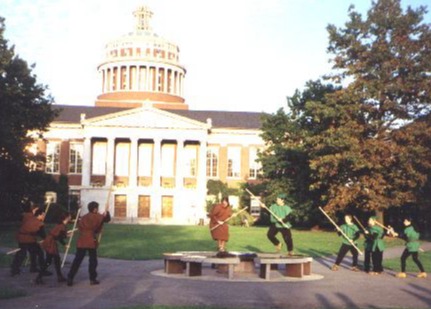
The cast of the 1997 University of Rochester production of Robin Hood and the Friar are: Eric Lichtenstein (Robin Hood), Kevin Carboni (Friar Tuck). And some of the following, even though not all were caught by my camera: Karen Hibbert, Richard Cassara, Cathy Fahey, Michelle deCastro, Ann McNamara, Charli Williams, Jason Lee, Ben Segal, Jeremy Steflik and Marianne Witgert. This version was directed by Cathy Fahey. Images are used with permission.
The 2001 University of Western Ontario version of Robin Hood and the Friar was produced by the Poculi Ludique Societas (PLS). Visit PLS's official website. Starring in the production were:
Robin Hood: Todd Campbell
Friar Tuck: S. Tyson
Little John: Rob Westgate
Maid Marion: Ty Andrassi
Merry Man 1 (Will Scarlet?): Kevin Robinson
Merry Man 2 (Arrow Boy): Matt Richardson
Crew:
Director: Daniel Levinson
Costumer/Producer: Linda Phillips
Dance Consultant: Clyde Whittam.
Images used with permission.
Contact Us