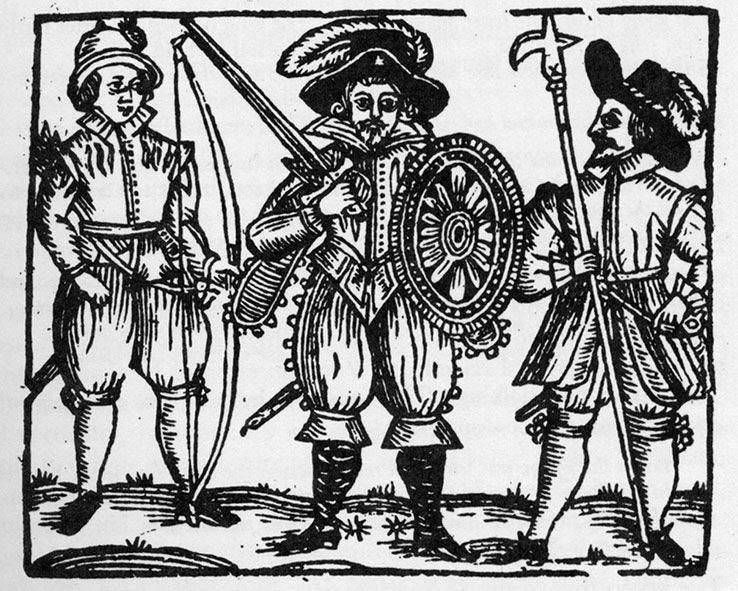
In the previous section, we looked at the transformation of the Robin Hood legend in 16th and early 17th centuries. This section explores the legend in the 17th and 18th centuries, particularly how the legend has been used for political purposes.
The Tudor period not only elevated Robin's social status. The outlaw, much like his native country, underwent a religious conversion.
Although he'd rob corrupt abbots, monks and bishops, the early Robin Hood was a devout Catholic (at least in irony). Even into the reign of James I, the Catholics behind the 1605 Gunpowder Plot to blow up Parliament were called "Robin Hoods".
Yet England had broken away from Rome in the 1530s. Sometimes, the dominant religion of England seemed like little more than Catholicism without the Pope. Other times, it was as Puritan or more Puritan than the European forms of Protestantism. And somewhere, in the shifting of religions, Robin came to represent a Protestant before his time.
For example, the church was behind Robin's downfall in Munday's play. Martin Parker's A True Tale of Robin Hood from 1632 has Robin "robbing especially the clergy and giving and lending to any in distresse." This includes such charitable activities of building almshouses. It also includes such violent activities as castrating monks. Bishops, like the Bishop of Hereford, became regular targets of the outlaw. Now, his former devotion to the Virgin Mary and the mass did not balance his anti-clerical robberies.
While his primary adversaries may have been the church, it should also be noted in Parker's True Tale Robin and Little John "not dreading law" rob the king's receivers of their gold. Robin Hood did not steal the king's taxes in the early ballads, but it would become part of the modern legend, and one used to politicize the story.
While he may have been depicted as a good Christian (whether Catholic or Protestant), Robin kept getting in trouble with god-fearing folk. For example, Mary, Queen of Scots banned Robin Hood plays in 1562. She wasn't the only one.
Just before the Civil War, Ben Jonson (a famous playwright and drinking buddy of Shakespeare in the Bard's last years) used his Robin Hood play, The Sad Shepherd , to criticize the Puritan movement's way of looking down on so-called "Pagan pastimes" as the courteous shepherd Lionell explains to Tuck:
Lio. O Friar, those are faults that are not seene,
Ours open, and of worst example beene.
They call ours, Pagan pastimes, that infect
Our blood with ease, our youth with all neglect;
Our tongues with wantonnnesse, our thoughts with lust,
And what they censure ill, all others must.Robin. I doe not know, what their sharpe sight may see
Of late, but I should thinke it still might be
(As 'twas) a happy age, when on the Plaines,
The Wood-men met the Damsells, and the Swaines
The Neat'ards, Plow-men, and the Pipers loud,
And each did dance, some to the Kit, or Crowd,
Some to the Bag-pipe, some the Tabret-mov'd,
And all did either love, or were belov'd.
Jonson never finished The Sad Shepherd, although later writers have offered conclusions to it. The play features the now-familiar cast of characters, Robin, Little John, Tuck, Scarlet and Scathelock (brothers as in Munday's play), Much and of course Marian. It also features an evil witch Maudlin, who impersonates Marian, and her servant Puck-Hairy. The play does feature some lusty fliration between Robin and Marian, even though Robin is largely sidelined from the action.
Speaking of Marian, as Stpehen Knight and others have noted, a key influence on Jonson was Michael Drayton's topographical poem Poly-Olbion. Drayton describes Marian thusly:
But to his Mistris deare, his loued Marian
Was euer constant knowne, which wheresoere she came,
Was soueraigne of the Woods, chiefe Lady of the Game:
Her Clothes tuck’d to the knee, and daintie braided haire,
With Bow and Quiuer arm’d, shee wandred here and there,
Amongst the Forrests wild; Diana neuer knew
Such pleasures, nor such Harts as Mariana slew.
That 17th century description of Marian might surprise some who may only think of the character as a damsel-in-distress. However, let us return to the political situation of the 1640s.
In the Parliamentary elections of 1640, a new party was formed -- the Robins. The candidate even assumed the alias of "Robin Hood". That candidate was "the Puritan gentleman Alexander Popham, a highly appropriate Robin Hood, some thought, because he was under sentence of outlawry for debt." Popham lost, but his supporters (called Little Robins and Little Johns) took Parliament's side in the coming conflict. [David Underdown, Revel, Riot and Rebellion , p. 135]
In 1641, the Puritan forces in the Parliament got fed up with King Charles I and kicked off a little fracas known as the English Civil War. [King Charles raised his standard in Nottingham, although the town later sided with Parliament.] This ended with Charles I being beheaded in January 1649. For 11 years, England had no king in a period known as the Interregnum. The Puritans set up the Commonwealth and Protectorate led by Oliver Cromwell.
During this period, the government banned May plays [like Robin Hood's once participated in] along with Christmas, Easter, and anything else that was "pagan", "Catholic", "licentious", "rowdy" and basically fun. However, in 1652, a traditional Robin Hood game was performed in the Oxfordshire village of Enstone -- without incident. Also, Robin Hood ballads still circulated in this period.
The radical movements of the Levellers and the Diggers (aka "True Levellers") both compared the social abuses in their time to the ideas of the Norman Conquest and the Norman Yoke. Despite that the Normans were commonly used as an allegory for the woes of society, the Robin Hood of this period still did not fight Normans as he would in the 19th-century onwards. Perhaps the use of the Norman Yoke by radical movements kept references of Normans out of the more mainstream Robin Hood ballads of the day.
In 1660, the late Oliver Cromwell's son Richard (Tumble-Down Dick) lost control, and King Charles II was brought in as the new king. This kicked off a period known as the Restoration, and as usual, Robin came along for the ride with many new plays and ballads.
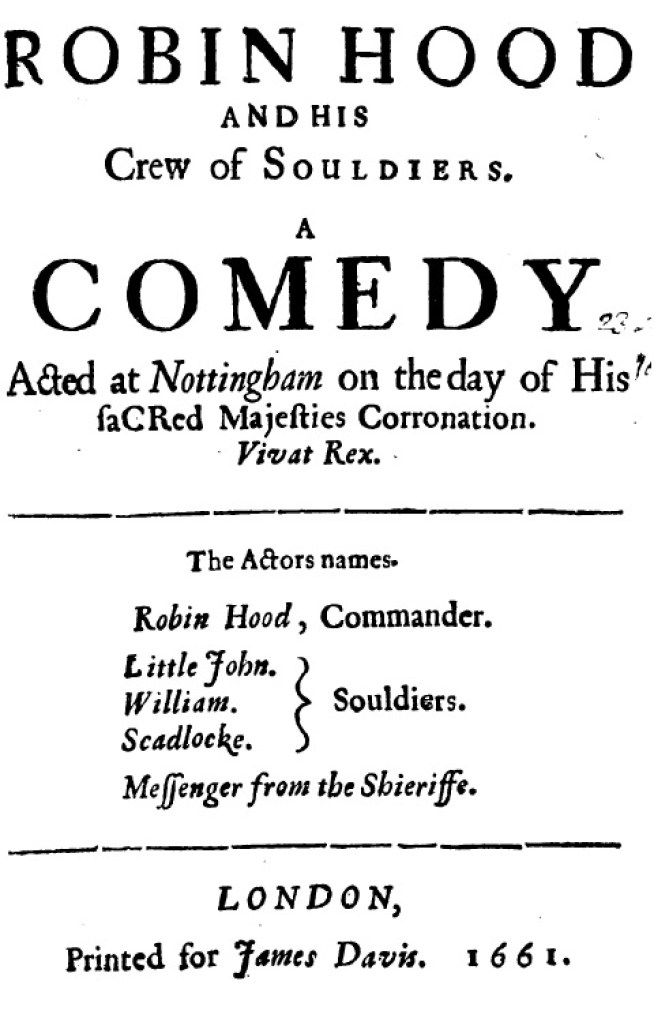
Nottingham was a trouble spot during the Civil War. The medieval castle had been damaged in the fighting. They'd just sent one of Cromwell's supporters back to Parliament. And the folks in Nottingham wanted to show their support for the king.
Hence, a curious play Robin Hood and his Crew of Souldiers was produced. A messenger from the Sheriff of Nottingham popped by to tell Robin and his Roundhead-ish rebels that a new king has come. Robin recants his rebel ways and decides that they should support the new king.
Robin: Ha! whence is this sudden change? That resolution which but now was
remorseless as a Rock of Diamonds, and unyielding as the hardned Steel, is
now soft and flexible as a weak womans passions. I am quite another man;
thaw'd into conscience of my Crime & Duty; melted into loyalty & respect to
vertue. What an harsh savage beast I was before, not differing from the fiery
Lyon or the cruell Bear, but in my knowledge to doe greater ill, my strength
and eager rashness was all my boast. How all my pride now is undermin'd?
How am I dwarfd in mine own sight? remov'd from that advantage ground my
fancy set me on, and shrunk to mine own low pitch? How am I torn now
from my selfe? sure some power great and uncommon hath quite transform'd
me, and consum'd all that was bad and vicious in me. Methinks these men,
companions in former ills, look like those Grecians, th' enchanted cup
transform'd: they've shapes of beasts, rude, uncomely and very affrightfull; yet
doe I see remorse bud in their blushing brows, as if with me they felt shame
and true penitence for their fore-past Crimes. Let us all then joyne in the
present sence of our duty, accept the profer'd pardon, . . . . and with one
voice sing, With hearty Wishes, health unto our King.
These aren't the only times that Robin Hood has been used for propaganda. In Robin Hood's Fishing (aka The Noble Fisherman or Robin Hood's Preferment), Robin takes to the seas as a second-rate fisherman, and ends up stopping French pirates.
And in 1727, the buffoonish Robin Hood of the popular street ballads came to represent and lampoon Sir Robert Walpole, the powerful and corrupt Prime Minister, in Robin and the Duke of Lancaster .
In the reign of James I, there was a Robin Hood club for political and philosophical discussion. It supposedly met in a tavern in 1613, and among its members was Hugh Myddleton, the Puritan who helped developed London's artificial "New River". And as in 18th century there was a Robin Hood Society, a weekly mechanics meeting where, to quote British historian Christopher Hill, "deists, Arians, Socinians and Jews were said to air doubts about the resurrection, the incarnation, the Trinity ('their everlasting butt'), the authenticity of the Scriptures and of the Gospel miracles." [Hill, Liberty Against the Law, p.80] There was a branch of this society in America as well. (Some sources would imply that this is a continuation of the Jacobean club.)
As you can see, Robin Hood could suit any number of political purposes.
CHANGES TO THE LEGEND:
PART 3: BROADSIDES AND BUFFOONERY (17th-18th centuries)
PART 4: REVOLUTIONS AND ROMANTICISM (18h-19th centuries)
PART 5: CHILDREN'S NOVELS AND COMIC OPERAS (18th-20th centuries)
PART 6: FILMS AND FANTASY (20th-21st centuries)
PART 7: COMIC BOOKS AND COPYCATS (20th-21st centuries)
PART 8: ROBIN HOOD IN THE PRESENT AND THE FUTURE (21st century)
INDEX: WOLFSHEAD THROUGH THE AGES - THE HISTORY OF ROBIN HOOD (Index page)
ROBIN HOOD: THE EARLY YEARS
PART 1: BALLADS AND BACKGROUND (13th-15th centuries)
PART 2: MAY GAMES AND MAYHEM (13th-16th centuries)
CHANGES TO THE LEGEND:
PART 1: EARLDOMS AND ELIZABETHANS (16th-17th centuries)
Thanks to Alan Lupack at The Robin Hood Project at the University of Rochester for allowing direct links to the ballads and plays. Many of these texts have since been moved to the Middle English Texts Series website. I strongly urge you to donate to METS.
Click here to view additional information sources used for this specific section.
Wolfshead Through the Ages is only a small part of a much-larger site filled with information about the Robin Hood legend.
To read more of the ballads, check out the Robin Hood Tales section.
Text copyright, © Allen W. Wright, 1997 - 2025.
The Woodcut from A True Tale of Robin Hood and the Frontispiece of Robin Hood and His Crew of Souldiers are believed to be public domain.
Contact Us