JANE YOLEN
Conducted
and transcribed by Allen W. Wright
Jane Yolen has published over 200 books for both children and adults.
Many of her books update classic folklore, such as Briar Rose, a
retelling of Sleeping Beauty, and several have an Arthurian theme. Her
books and short stories have won numerous awards. Ms. Yolen has often
been called "America's Hans Christian Andersen".
Her involvement with the Robin Hood legend includes editing (and writing
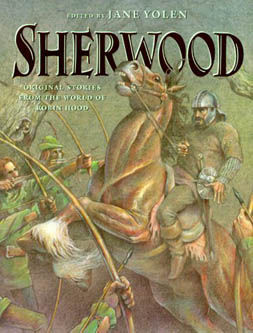
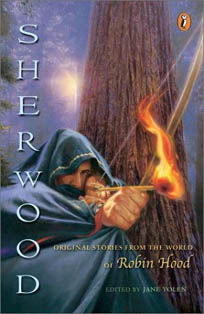
one story for) Sherwood: Original Stories from the World of Robin Hood
in 2000 and incorporating Robin Hood themes into her Young Merlin
Trilogy , particularly the final book Merlin.
She has served as past president of the Science Fiction Writers of America
and has been on the board of the Society of Children's Book Writers and
Illustrators for over 25 years. Born in New York City, Ms. Yolen and her
husband divide her time between homes in Massachusetts, USA and St. Andrews,
Scotland.
Click here to go to Jane Yolen's
official website
.
This interview was conducted via e-mail on June 30, 2002.
AWW: In your introduction to Sherwood you talk about
discovering Robin Hood through Howard Pyle's novel, and playing the
outlaw legend in New York's Central Park. What appealed to you the most
about the legend as a youth? And how does it appeal to you now?
JY: What appealed to me was the sense of adventure and the idea that,
despite having been outlawed for specious reasons, Robin went on to
right wrongs and help the needy. These days I am also quite fond of
the camaraderie and the sense of community working together for the
good of all.
AWW: How did you come to edit Sherwood, a new collection
of Robin Hood stories?
JY: It was a companion to a previous anthology I had done, about King
Arthur, called Camelot. So it seemed a natural follow-up.
AWW: What was your role in editing the Sherwood collection?
How much input did you have in the content and character of the stories?
JY: I sent out the call, inviting a number of writers specifically
to send me a story, but also announcing the anthology in both the Science
Fiction Writers of America publications and in the Society of Children's
Book Writers' Bulletin. My requests were that the story be around 5,000
words or shorter, if possible have a young person as a central character
in some way (it needn't be Robin himself), and be wonderfully and clearly
written.
Then I read all the stories, chose the ones that seem to fit the
anthology, give it balance and weight. I got rather too many RH as a
boy in Sherwood and could only publish a minimum of those. Some stories
needed heavy editing, some very little. After I had all the stories
chosen, I wrote my own, to fill in the missing area of Robin's life.
AWW: How have readers responded to this collection?
JY: The reviews have all been excellent. What reviewers have said:
"Clever application of folkloric elements to original stories combined
with consistency and smooth writing will enliven the imaginations of
all Robin Hood enthusiasts." -- School Library Journal
"Crafted by master word weavers, this wonderful collection of eight
original short stories adds new designs and textures to the to tapestry
of Robin Hood lore. ... And in Adam Stemple's humorous 'Robin Hood v.
1.5.3,' delighted readers will find Robin's cyber spirit redistributing
the world's wealth through the Internet. A beautiful painting enhances
each story." -- Children's Literature
"This book will be of interest to readers of the fairy tale based novels
by Robin McKinley and Gail Carson Levine, as well as anyone interested
in the Robin Hood legend itself. There is humor and adventure enough
for reluctant readers, and several of the stories would be great readalouds
in a classroom or library setting." -- VOYA
"... Adam Stemple takes it hilariously into our own future by setting
an Artificial Intelligence with a Robin Hood complex loose in cyberspace.
Though the stories will stand alone, readers already familiar with Robin's
career and better-known associates will have a leg up; consider this an
intermediate step between Jane Louise Curry's Robin Hood in the Green
Wood (1995) and novel-length treatments, from Robin McKinley's
Outlaws of Sherwood (1988) to Michael Cadnum's In a Dark Wood
(1998)." -- Kirkus
AWW: In the introduction, you write "Did it bother me that later
on I would read stories that were tremendously different from the ones
in this first book? It did not. Or that the names -- and spellings --
changed as well? I didn't care. I was always delighted to discover new
versions, and I read them with an understanding that story -- like gossip
-- changes in the mouth of the teller." I find this a refreshing attitude
-- I still remember reading one review of the Kevin Costner movie, where
the heart of the criticism was that it did not follow Howard Pyle and therefore
got the legend "wrong". Obviously shifting versions of stories are something
you must encounter a lot in your folklore research. What do you think
are the virtues of having several versions of one legend? And what are
your favourite changes to the Robin Hood legend?
JY: It puzzles me that people think a protean story like Robin Hood (or
King Arthur) must have a canonic storyline. If we know anything about
folklore and legend, it is how malleable it is, molded by the tellers
and their times.
The thing that bothered me about the Costner Robin Hood was not playing
fast and loose with the RH storyline (I liked the Muslim healer for example,
and adored the scenery chewing sheriff) but playing fast and loose with
English countryside. One simply cannot walk from Dover to Sherwood Forest
in an hour or two!
AWW: As a collection for youthful audiences, several of the
stories in Sherwood feature children in some role. In the classic
legend, children are pretty much absent. Do you think children make good
narrators?
JY: Children are great narrators for children's stories. In adult stories
they bring a wide-eyed innocence to the telling, which too often translates
into sentimentality.
AWW: Also, a few of the stories prominently feature Marian,
a character (who as you note in your introduction) was not in Pyle,
or the earliest ballads for that matter. What do you think this character
brings to the legend? In your mind's eye, what is Marian like?
JY: Marian is iconic today for many writers precisely because she is
so absent in earlier tellings. That gives the writer much leeway in discovering
HER story. Also, she is a perfect vessel for today's need for strong women
in story. In my mind's eye Marian is less beautiful than strong, capable,
inventive. She is a twenty-to-twenty-first century woman in medieval clothing.
AWW: Your own contribution to the collection, "Our Lady of the
Greenwood" involves the fairies. What are your thoughts on the mythic
elements of the Robin Hood legend? How did you come up with the idea for
this story?
JY: Not fairies in the sense of twittering, tiny winged creatures, but
the amoral, tricksy transformative, demanding fairies of the old tales.
I think the mythic elements were too often NOT explored and rather the
Boys Own Life version of RH were the one's promoted. So being a Sidhe
kind of writer, I went there instead.
AWW: Sherwood isn't the only time that Robin Hood has entered
your fiction. There are also elements which show up in your Young Merlin
Trilogy. Merlin is found by a falconer named Robin. And in the third
book, Merlin meets the forest-dwelling wodewose folk. They deem him to be
Robin o' the Wood or the Green Man. What led to this blending of the Arthurian
and Robin Hood legends?
JY: In my research, there were suggestions by several scholars (can't
remember who now) that there were times when the two great English legendary
characters blurred in the folk mind (though centuries lay between them.)
So it seemed like a fun thing to play with.
AWW: What do you feel are the differences and similarities between
the outlaw and Arthurian legends?
JY: They are both about the "king" in disguise who distinguishes himself
in his lower role first. They are both great romantic stories, full of
adventure, honor, loyalty and disloyalty. But Arthur's tale is really about
the change over from the pagan to the Christian worlds. Robin Hood is
thoroughly Christian already, so is free to comment on aspects of the church
(drunken monks, greedy prelates etc.) that Arthur cannot. It takes the Greenman
legend and thoroughly subverts it for Christian usage. Arthur is more symbolic
(grail, Green Knight, holy warriors, round table, etc.) but there is plenty
in the RH canon for symbol hunters if they want to look.
AWW: So, what are you working on now? And would you like to return
to the Robin Hood legend at some point?
JY: Just finished a big Young Adult Arthurian novel called Sword of
the Rightful King which will be out in the spring of 03. I may be done
with Arthur for a while. I have no plans to do more on RH right now. But
one never knows. . .
AWW: Thank you very much for taking time out of your very busy writing
schedule to answer these questions.
Please visit Jane Yolen's Official Website.
SHERWOOD edited by Jane Yolen. This is collection of original tales about Robin Hood and assorted characters.
Buy it on Amazon.com
Buy
it on Amazon.co.uk
|