Most Recent Interview
All Interviews
Novelists and Short Story Writers
Actors, Writers and Directors of
Film, Television and Theatre
Robin Hood Scholars
Officials from Robin Hood Country
Featured Interviews
Richard Carpenter
Creator of Robin of Sherwood
Mark Ryan
Nasir from Robin of Sherwood
Tony Robinson
Creator of and Actor from Maid Marian and Her Merry Men
Also host of Time Team and Baldrick in Blackadder
Theresa Tomlinson
Author of the Forestwife Trilogy
Robin McKinley
Author of The Outlaws of Sherwood
Clayton Emery
Author of The Beast of Sherwood and Robin and Marian mysteries
Professor Stephen Knight
Author of Robin Hood - A Mythic Biography and other Robin Hood scholarship
Professor Barrie Dobson
Co-author of Rymes of Robyn Hood
Main Sections
Main Page
Introduction & What's New
A Beginner's Guide
Robin Hood Tales
- Ballads & Stories
Wolfshead Through the Ages
- The History of Robin Hood
Search for a Robin Hood
Spotlight of the Month
Robin Hood - A Personal Journey
The Picture Gallery
Interviews in Sherwood
The Blue Boar Inn
- Message Board
Legendary Links
Pook's Hill
Information
Site Map
How to use this site
Search This Site
About the Author
My Biography
Send me an e-mail
Copyright
All text, unless otherwise noted, and title graphics - © copyright Allen W. Wright, 2004.
|
PROFESSOR R.B. [BARRIE] DOBSON
Conducted
and transcribed by Allen W. Wright
Professor Richard Barrie Dobson has taught Medieval History at both
Cambridge and the University of York. He and fellow professor John Taylor
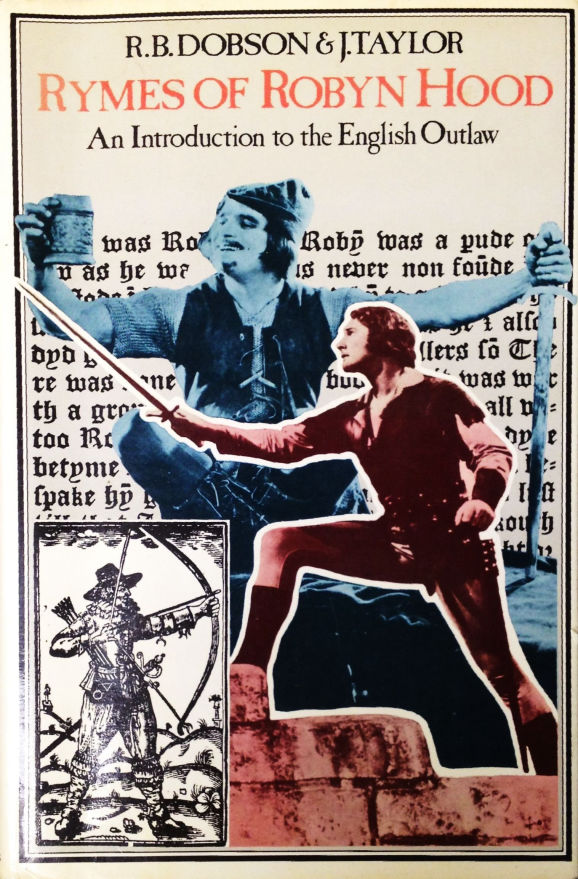
have written numerous articles on the outlaw legend. And their 1976 book
Rymes of Robyn Hood: An Introduction to the English Outlaw
is hailed as a classic of Robin Hood scholarship. Professor Dobson has
published several books on a variety of topics, including The Peasants Revolt
of 1381 and Church and Society in the Medieval North of England.
In 2001, Cambridge University Press published Pragmatic Utopias
in honour of Professor Dobson's 70th birthday. The numerous topics covered
in the book is a testament to his wide-ranging interests. But fortunately
for us, he still has a fondness of Robin Hood.
This interview was conducted at the first International Conference for
Robin Hood Studies, held in Rochester, NY in November 1997. I had been
a fan of Rymes of Robin Hood for over a decade, and it was an incredible
thrill to meet one of that book's writers. But my lasting memory of that
conference was not the impressive plenary address Professor Dobson delivered.
It was how gracious and friendly he was, to have pleasant conversations
about everyday life not captured on audiotape. I was fortunate to see him
again briefly at the 1999 conference. With me on that occasion was Alison
Carter, the person responsible for the wonderful visuals of this site.
She had the good fortune to have taken one of Professor Dobson's 2nd year
History courses.
AWW: I guess I'll start with -- what do you see as the relevance
of Robin Hood in the 1990s?
BD: Well yes, I think the relevance of the Robin Hood legend
is clearly demonstrated by the popularity of the conference which we've
been attending this last week. And I think some of the major elements in
Robin Hood are eternally popular. No doubt, the theme of the outlaw, out
of society, who brings justice back to the society which had become corrupted
by the Sheriff of Nottingham, or whoever it might have been.
Obviously the theme of the forest arcadia is a sort of perrenial
one. It's often said about the western here, isn't it? The cowboy myth
develops at exactly that point in time when the United States loses its
pristine wilderness, its original landscape. Just as the forests, the woodland,
disappear probably in the 15th and 16th centuries, more or less, that this
arcadian legend begins. This lament for the loss of the greenwood.
But you really asked me why the legend is so particularly popular
at the end of the 20th century, and I think the variety of reasons for that.
One of them is perhaps academic. That until comparatively recently, let's
say 20 or 25 years ago, Robin Hood was regarded as, to use an old proverb,
a person whose tales were only good for fools. That is somehow a vague,
popular plebian legend which didn't have the resonance or the depth or the
significance to be analyzed in any great detail. And I think that was changed
essentially by two historians -- I speak to you, of course, as a historian,
a medieval historian. One of them was Rodney Hilton, a Marxist, who wrote
his article in 1958 which suggested that, to use his own phrase, because
the peasants of medieval England didn't have a hero, they invented one.
And that hero was Robin Hood. On the other side, a couple of years later,
a brillant article produced by Sir James Holt who took, if you like, the
conservative view, that Robin Hood was not essentially a peasants' hero at
all but a hero of the English gentry. That is somebody who is fulfilling
the aspirations of the yeoman, the young man according to Holt, the servants,
the husbandman who served the lord in his banqueting hall and at battle.
And I think the fact that those two interpretations of Robin Hood so very
different appeared at nearly the same time stimulated a great academic interest
among historians. So, Robin Hood became not only a fashionable subject,
in the seminar rooms of the history teachers of England and indeed the rest
of the world, but also a controversial one. So people can put in their own
theories. Robin Hood is so popular in the 1990s, stimulus is provided by
new academic opening for that.
The second reason I suspect, this is a bit difficult to explain
(here again, you might be better able to do so than myself) I think there's
the desire to return to the comparatively primitive, as it were, which
isn't corrupted by society or capitalism. A familiar theme, but we see
it expressed in new forms with the green movement, the ecological movement
and so on. And Robin Hood obviously fits that particular current of thought
which seems so very common across most of the world, the English-speaking
world at least. Because he's a comparatively simple figure and straightforward
elements, because he isn't contaiminated by complicated thought, he fits
that bill particularly well. So I do see a good deal of his popularity now
being an ecological symbol of some sort.
AWW: The question I always get asked -- and you've mentioned this too
-- whenever you show an interest in Robin Hood is the inevitable "was there
a real Robin Hood?" and I was wondering what you thought about that?
RBD: I think it is the question everybody asks, isn't it? And neither
of us could open a conversation with a friend in a pub or sitting in a train
or whatever without the issue turning up pretty rapidly.
I think that it is an important question. It's probably not the
most crucial question. I think the most crucial question is how the legend
became articulated at the end of the middle ages, perhaps the early Tudor
period long after it really started. And to some extent to try to go back
to the vague, early first origins and to say to one's self -- was there
a real Robin Hood, was there some one single highwayman out of which the whole
legend began is to perhaps miss the most important point. That whether there
was or not, there was something in the legend and its themes which began
to appeal first to late medieval Englishmen, later of course to the whole
world.
Having said that, I think the question can't be evaded, or at least
any historian is bound to try to discover if there was a real Robin Hood.
And I think the difficulty involved in asking that question, which people
have been trying to answer for 250 years at least, is a difficulty which
has got even worse recently. To put it simply, the more research that's
been conducted on whether or not there is a real Robin Hood, the more difficult
it is to know. Which isn't, of course, very helpful. I think these difficulties
are usually fairly obvious -- that Robin Hood is a quite common name in medieval
English record sources, archives. So if that one finds a Robin Hood in
real records, for instance in the early 14th century or the early 13th,
it doesn't necessarily prove very much.
Secondly, there's a problem with our early texts on which we have
to rely. The so-called ballads are extremely slipperly to handle, very
difficult to date, very difficult to date the various themes within them.
It also makes it extremely difficult to know where one should locate Robin
Hood in time as well as in space. All one can say now with some degree of
certainty is by about the middle of the 13th century, you seem to know that
the name Robin Hood or Robehod had emerged as a compound surname for robbers,
often a surname they adopted themselves. If they wanted to run a robber gang,
they called themselves this sort of nickname, Robin Hood or Robehod. So,
that must push the original, aboriginal, Robin Hood if there was one before
1250 or so. So, at least one thing seems to be established in the last 15
years or so -- that the real Robin Hood if there was one, was considerably
earlier than had traditionally been thought.
The question that remains is whether this original Robin Hood was
a real person, or whether, in fact, the legend developed from a name and
that the name came before the legend. Because of its rhyming qualities, the
name Robehod became a nickname for any promiment highwayman, felon or murderer.
And the name was floating around as a name applied to people of that sort.
And against that background, I think there are two possiblities.
Either somebody with a good deal of ingenuity, some storyteller, singer
of rhymes whose name we'll never know thought "Wouldn't it be a good idea
if I started writing down stories about Robin Hood?" and that's how the legend
begins. The alternative view, of course, is I think as close to the answer
of your question as I'd like to get, there might have been a real robber
who actually was spectacular in his robberies and stories began to be told
about him. He would, of course, almost certainly not be called Robin Hood
literally. That wouldn't be his real name, because it would have been
almost inconceivable that with the name Robehod that somebody really called
Robin Hood would adopt the same name. But there might be somebody lurking
about who developed this.
If so, my own supposition would be that there would be many of these
Robehods, perhpas. The one who inspired, focused the legend, made it really
get off the ground, gave it dynamic was probably someone operating as a highwayman
on one of the great highwaymen tracks of late medieval England, a place
called Barnsdale Bar which is where the Great North Road in England, which
goes up to York and Scotland, forks with the left branch going off to Wakefield.
And it's as a result of clues in the early ballads that one can suppose
there might have been a particularly audaicious robber operating in that
area, who actually got the legends into a state of creative crisis. What
time that happened is still very much open, but I would suppose probably against
this background of many, many Robin Hoods, the one who existed -- and I think
he probably did -- who really inspired the legend was probably operating,
committing his highway offences between 1300 and 1340, that sort of period.
The reasons for that are partly documentary. Partly that it was a time
when the king's government -- the king's government departments were up in
York, and we happen to know from various sources that for obvious reasons,
rich pickings were to be had by highwaymen who operated on that stretch of
the Great North Road near Barnsdale Bar, as treasure and one's messengers
went backwards and forwards from London to York. So, I would think there
wasn't literally one Robin Hood, but quite a few of them -- almost impossible
to distinguish from one another in terms of their reputation. Probably none
of them had any great reputation, but the name circulated came to be applied
in particular to an extremely audacious one, operating north of Doncaster,
probably as I've said between 1300 and 1340.
AWW: That seems to fit the time period of Jospeh Hunter's thesis, the
Robin Hood in the court roles, a porter to Edward II.
RBD: Yes, that is a very popular thesis. First, as you know, suggested
by a Yorkshire antiquary named Joseph Hunter about 150 years ago. He was
the first person to point out that there is enough evidence for this Robert
Hood of Wakefield to suggest that he was first some sort of fugitive, some
sort of outlaw and later entered the king's service. And of course, particular
combination of facts, simple though it may seem, is often occured to be
people since, as it did to Hunter, because of their very familiar ending
of the Robin Hood stories, in particular the Gest of Robyn Hode which does
produce the conclusion that Robin is finally forgiven by the king and enters
his service. That makes that Robert Hood of Wakefield still, I think, an
interesting candidate. Though one has to say immediately two things. That
the precise names in the ballads, the references seem to be very slippery
and I wouldn't put too much weight on the fact that King Edward is mentioned
once or twice in the Gest. Secondly, we don't have any definite proof that
the Robert Hood in Wakefield was, in fact, a famous robber at all. If one
wants to take sort of line I've been taking of the Robin Hood legend as a
sort of amorphous mess of not so much stories but of nicknames, a lot of
people from the previous 100 years time. Then if one is to go along with
what I've been saying that maybe it was in the early 14th century that this
amorphous mess was brought together and ignited a much more, carefully articulated
legend in which songs are told and generate other songs, if you put that process
into the early 14th century, then I think that Robert Hood of Wakfield still
has to be looked at as a possiblity.
AWW: I'm interested in your own interest in Robin Hood, what makes
it so compelling for you?
RBD: I think the origins of my interest, like those of all of us at
the conference no doubt, are to some extent personal. I think I am probably
a little untypical in that I don't remember being told tales of Robin Hood
when I was being lulled to sleep as a four or five or six or seven-year
old. He was in the back of my mind, as he's in the back of the mind of
all English people and increasingly Canadians and Americans of all sorts.
But it was a sort of combination of factors which I wouldn't have
predicted. I had been teaching for about a half dozen years in Scotland,
but I didn't think about Robin Hood at all. I came down York and three
things happened very closely connected. Purely autobiographical, first
I had children of my own that were about six or seven, and I found myself
reading them Robin Hood stories and they were immediately very fascinated
by them. So their fascination, I think, bounced back upon me. Secondly,
more academically, my history department, which I then taught, decided
-- it was quite avant garde history department , at least by the standards
of those days -- decided it would have a course, quite an ambitious course,
on myths. And I was asked to run one. Medieval myths, I suppose it was.
And I found myself deciding that I had to have a couple of sessions on Arthur
and so on, other medieval myths. And suddenly it occured to me that very
little academic work had been done on Robin Hood's myth, that Robin Hood
might make a very interesting subject to teach. So, I taught it to second
year students quite a bit. The third thing was meeting a friend of mine,
who was already a bit of a friend and a close friend ever since, John Taylor,
who taught at the University of Leeds -- only 25 miles away. Originally
from Lancashire, he was very much a Yorkshireman by adoption, was interested
in Robin Hood for that reason. He suggested that the two of us should combine
to write about Robin Hood, in particular about the geographical issues which
I mentioned -- Barnsdale, the Sayles and places like that. ['The Medieval
Origins of the Robin Hood Legend: A Reassessment, Northern History, VII (1972).
Professors Dobson and Taylor wrote more articles on the legend, but most
notable is their 1976 book Rymes of Robyn Hood: An Introduction to the English
Outlaw, which reprints several ballads along with a very detailed and scholarly
introduction and appendices. For over 25 years, it has been regarded as a
major and classic work in the field of Robin Hood studies.]
AWW: You met in a pub called ...
RBD: The Robin Hood, we did, yes.
AWW: Was that in York?
RBD: Yes, like most English towns, there's a Robin Hood pub and very
often a Little John pub as well, of course. That opens up another area
which the conference actually hasn't talked about, as far as I know, the
question of Robin Hood placenames and whether or not they can be dated,
which usually they can't. But there is for instance a Robin Hood stone which
is actually quite well-known as a sort of marker on an important road up
in Yorkshire. It turns by about 1440s, and certainly by the time you can
begin to date many of these placenames, 1550, 1600, they're all over the
country. You have to actually do detective work, find the oldest maps you
can and so on, then there comes a point where you can't track down the placenames
any further. In England, we're fairly fortunate. About half the country
is covered by the Early English Placenames Society volumes, which especially
if they are recent (in the last 10 or 20 years) will be very, very meticulous
in their attempt to unearth every single placename, and probably date it
as early as they can. I did use those quite a bit. There are eight volumes,
no less, for the West Riding of Yorkshire, which includes Barnsdale and
Wakefield. But didn't find that many indisputably early references to Robin
Hood.
AWW: Do you have a favourite tale of Robin Hood? Modern or old?
RBS: Well, I think I would agree with George Orwell who once wrote
in an essay, rather surprisingly, that he thought Robin Hood and the Monk
was the finest poem in the English language. If you're talking about the
old -- the original -- legends, Robin Hood and the Monk has to me the greatest
poetic density and weight. And therefore it would be my favourite ballad,
so-called ballad, in the early camp. Robin Hood's Death, although much,
much shorter, was very affecting, like a border ballad almost, because
of that note of tragic doom that tends to lie through it.
In modern times, as you know, it's one of the most interesting things
about Robin Hood that it doesn't on the whole generate a great deal of modern
literature in quite the same way that Arthuur does. There are occasional
works, obviously Scott's use of Robin Hood as Locksley in Ivanhoe
is most important dynamic, if I may use that word again, in the 19th and
20th centuries. I suppose if one was to talk about the many, many retellings
of the story in modern times, I actually often go for a fairly simple one.
Partly because it is the one I used to lull my children to sleep, partly
because it came to my mind because it was on exhibition here at the conference
(Kevin Carpenter's splendid exhibition). It's a Penguin by R.L. Green, quite
an interesting writer who writes straight novels. And he does a fairly simple
job of just writing a book which is a Penguin just called The Adventures
of Robin Hood. And instead of trying to write a long novel, he just tells
tale after tale after tale, which is, of course, true to the spirit of the
original stories. I just think he tells them extremely clearly and neatly
and well. If we're not including films like Errol Flynn and so on. In terms
of books, Roger Lancelyn Green's Adventures of Robin Hood would be
one of my favourites.
AWW: How about films and TV? Do you have a favourite?
RBD: Well, I haven't seen as many films, I'm afraid, as you would have
done or most people here in Rochester at this conference. Of course, I
am one of the many, many people -- there must be millions of them practically
-- whose first film of that generation, the first film they consciously
remember seeing was -- with the possible exception of Snow White and the
Seven Dwarfs -- was actually Errol Flynn's -- Michael Curtiz's, I should
say [the diretor's] -- The Adventures of Robin Hood, produced in
1938, just before the war. Which, of course, swept one off one's feet for
a variety of reasons. I think it still must be my favourite Robin Hood
film, because of the sheer verve and the combination of sheer adventure
with a touch of viciousness, if you like, but at the same time, the basic
prevailing note of good humour, which I think the Robin Hood legend always
ought to preserve. It was meant to cheer one up, and I think Errol Flynn
does cheer one up.
Before putting this interview online, I contacted Prof. Dobson and asked
a few follow-up questions.
AWW: What has been your strangest experience in your work in Robin
Hood studies?
RBD: I suppose my two 'strangest' (neither very strange) experiences have
been: (1) having a colleague in the English Department here at York actually
called 'Robin Hood' and (2) constant frustration despite my many attempts
to see Robin Hood's alleged grave at Kirklees. I was almost certainly going
to be allowed to visit it last year by Lady Armitage, the owner of the estate,
but foot-and-mouth disease put paid to that. I still hope to achieve that
ambition!
AWW: What has been the most rewarding experience?
RBD: My most REWARDING academic experience in the field was (perhaps unexpectedly
for a medieval historian) writing the section in the 'Rymes of Robyn Hood'
which were devoted to the post - medieval legend. I now think that there
is probably a most important book to be written on the legend in the Tudor
period, when I suspect that in some ways the legend was at its most popular.
AWW: At the beginning, I asked about the state of Robin Hood in 1997. It's
five years later now, and I'm wondering -- what has changed? What, for you,
have been the biggest developments, both academically and in the general social
context?
RBD: I have given the occasional talk about Robin Hood of late; but I have
not done any very serious work on the greenwood hero since the Rochester Conference.
But (as you will know) there is good deal of activity on the topic still
! I especially look forward to a book (probably two years before it is
published) by Professor Anthony Pollard on Robin Hood (for Sutton Publishing
Co., I think).
I may be out of touch already ! But I would undoubtedly think that the most
important changes since 1997 are due to the increased involvement of literary
critics in thestudy of the legend. Ironically enough, back in the 1970s and
1980s I - and other historians- used to lament the fact that members of
English literature departments took little interest in the outlaw. In the
wake of Stephen Knight, all that seems to have changed in the last few years,
in some ways uncomfortably (too much relativism) - but in other ways Robin
Hood has begun to be a more universal hero, illustrating more moral problems
than ever before.
AWW: And finally, do you have anything else to add? Is there more that you
think needs to be said?
RBD: Whether or not more 'needs to be said' about Robin Hood, there seems
no doubt that scholars and others will continue writing and talking about
him - more than ever, I would guess. I imagine that new work will soon
ernerge on the forest background of the legend, on the nomenclature of Robin
Hood and his fellows in the state records; and I still believe that the interpretation
of Robin Hood's appeal as essentially that of a 'non-deferential individualistic
hero', (central to John Taylor's and my views) should have a fruitful future
ahead of it.
And of course it helps that the 'real' Robin Hood is becoming more rather
than less elusive as scholarship progresses. He is the ideal problem-orientated
hero for us all?
I hope that these rather obvious comments are of some little use. All best
wishes with your own work in every way.
AWW: Thank you, Professor Dobson, for comments that have been insightful,
not obvious. And for your kind words, pleasant conversation and an
impressive amount of scholarship.
This interview is copyrighted to Allen W. Wright. Please ask for my permission
if you are going to quote more than small sections from it. Thank you.
RYMES
OF ROBYN HOOD; AN INTRODUCTION TO THE ENGLISH OUTLAW
by R.B. Dobson and J. Taylor. Alan Sutton: Gloucester, UK,
1989. Originally published by Heinemann in 1976, this
is a classic collection of ballads and poems with a wonderful
historical introduction. A new edition was released in 1997
with an updated foreword.
Buy it on
Amazon.com
Buy
it on Amazon.co.uk
|