STEPHEN KNIGHT
Conducted
and transcribed by Allen W. Wright
Professor Knight is the head of the English Studies department at the
University of Wales in Cardiff and one of the world's leading experts
on Robin Hood. His 1994 book, Robin Hood -- A Complete Study of the
English Outlaw , is a major work on the legend. He also teamed up
with Thomas Ohlgren on Robin Hood and Other Outlaw Tales, a collection
of Robin Hood ballads, plays and poems. And he edited the recently -discovered
17th century Forresters Manuscript collection of Robin Hood ballads
and Robin Hood: An Anthology of Scholarship and Criticism.
His most recent book on the Robin Hood legend is Robin Hood -- A Mythic
Biography.
This interview
took place over a transatlantic phone call on August 19, 1997. It is the
first one to appear in the Interviews of Sherwood series. I'd like to extend
my deepest thanks to Professor Knight agreeing to this interview.
Many of the
Robin Hood ballads and plays that Prof. Knight mentions are online at The Robin Hood
Project at the University of Rochester . Click on any highlighted text
to be taking directly to that ballad, play or whatever. I'd like to thank
Alan Lupack at the RH Project for allowing me to create this direct links.
Much of the material at that site is under copyright.
**UPDATE**
1999
Professor
Knight has graciously sent me his controversial thoughts on the sexuality
of Robin Hood and the "gay Robin Hood" coverage in the mainstream media.
Click here to read Gendering Robin Hood.
AWW: How
did you become interested in the Robin Hood legend?
SK:
Well, teaching ballads, really. When I was in Sydney, Australia teaching
a course in ballads, I found that the Robin Hood ballads were both interesting
and there wasn't much on them in literary and socio-cultural terms. Or indeed
in textual terms. I thought Child [an American who produced a comprehensive
ballad collection in the 1880's] was fine, but there didn't seem to be a lot
of work done on them in the sort of historical, cultural studies way I'm
interested in working. That's where it started from. That was about 15 years
ago.
AWW: Why
did you find there wasn't a lot of studies on Robin Hood?
SK:
When I researched it, I found most of the work that had been done on Robin
Hood was of the historical biographical sort -- "Will the real Robin Hood
stand up?" But earlier in the century people like Clawson [who published
a 1909 edition of the Gest] and so on had done some very interesting
work, but in recent decades it had been mostly social historians working
on it. Douglas Gray had written a good article in 1984 analyzing the language
of the Gest, but compared with a lot of other medieval literature
or late medieval literature, I thought criticism and scholarship was at an
unadvanced stage. I got curious about what there was to find out.
AWW: What
are some of your theories on the Robin Hood legend?
SK:
One is that I am personally opposed to the "Robin Hood was a real man"
school of thought. I feel that the social historians who are concerned with
the real Robin Hood are operating a sort of empiricist, individualist myth
of their own. It's a very 20th century obsession, like "Was there a real King
Arthur?" and "Where did Sherlock Holmes really live?" But I think that's a
blind alley. I don't think that the data is there, and it's not very interesting
anyway.
I'm much more interested in looking at how the Robin Hood tradition
has changed over time and in different contexts. I want to read it as a sort
of text in historical/cultural studies.
AWW: What
sorts of changes have you found to the legend?
SK:
Well, there are a variety of Robin Hoods, aren't there? There's the very
early social bandit who is clearly quite aggressive, capable of killing the
sheriff, representing yeomanry -- whatever that quite is -- and clearly represents
some sense of local, organic values against distant intervention and oppression
by abbot, sheriff or even king.
Then, in the 16th century, there's clearly developed a gentrified
Robin Hood, who eventually we learn was an earl, who was displaced who wins
his earldom back. This is very interesting, because while remaining a bandit,
an outlaw, he's become a conservative outlaw, standing up for true hierarchy
rather than the social bandit who's resisting any hierarchy. So, the gentrified
Robin Hood is another major version.
But they overlap. There are social bandit ballads being produced in
the 17th century. And there are other Robin Hoods. There is a post-Reformation,
anti-Church Robin Hood, the who appeared in Munday's
plays and Parker's
True Tale of 1632 . He's very much an enemy of the medieval
Catholic church. He's been Reformed.
And I think there's a later Robin Hood who comes mostly out of Scott,
Keats and so on, who is the nationalistic English Robin Hood.
And somehow in our film versions these days, we get them all mixed
up together. You get Errol Flynn as "Sir Robin of Locksley", who is in part
a Saxon patriot, in part a man of the people, in part a natural aristocrat.
So, we get all these variant versions that come from different versions tending
to mingle. I find it very interesting.
AWW: Why
do you think the Robin Hood legend has changed so much over the generations?
SK:
I think one reason is that it's inherently a very simple legend. If you
compare it with, say, the King Arthur legend or the Roland legend, there's
not much narrative that is compulsory. I mean if you have King Arthur, you've
got to have a mysterious birth, knighthood, round table, Guinevere, Lancelot,
grail. There's a whole schmeer of things that you tend to have. You can have
a Robin Hood story by just having Robin Hood. I mean, some of them don't
even have Maid Marian, some of them don't even have King Richard, some of
them don't even have Little John. So, it's a very simple life form as a
narrative. So it can change. It doesn't have a canonical narrative.
And the other reason I think it has varied so much is that it's an
inherently popular narrative. The fact that it's in film and television
in our day is characteristic about it, as it was in song and popular drama.
It's almost like an oral language which is subject to very rapid, linguistic
change. Because it's so popular at a low level, culturally speaking, it's
very volatile. I think that's an intriguing element as well.
AWW: Do
you have any favourite versions of the legend?
SK:
I'm particularly fond of a film starring George Segal called
The Zany Adventures of Robin Hood . I don't know if you are familiar
with that, but it's a fine sort of ironic Hollywood production from, I think,
the 1980's with Morgan Fairchild as a particularly spectacular Maid Marian
who is extremely frustrated. At one point she says, "I'll soon be Old Maid
Marian." That's a particular favourite of mine. I must say I prefer the looser
versions. I certainly do think that the comic, farcical has always been
an element. The Robin Hood tradition comes out of local plays and farce
and theatrical mugging has always been an element of it. I think some of the
least successful versions are some of the more sombre versions, a bit like
Tennyson's The Foresters.
I think that there is a trickster element close to the strongest
of the Robin Hood traditions. And I think that the best of the films get that.
The Errol Flynn version got that. So did the Fairbanks version.
AWW: What
elements of the Trickster do you see in Robin Hood?
SK:
He is something like a law to himself. He creates new law, which is against
old law as the trickster does. He goes in disguise very often. There's quite
a lot of subversion. You know, making the Normans walk back to the castle,
turning the bishop back to front on his horse. Subversive elements appear
quite a lot in the friar who eats a lot and is very jovial. Subversion whether
for just entertainment or political grounds is a strong element of it. The
Robin Hood figure is not always a very long ways away from the Puck figure,
the forest sprite who is playful, mischievous. There is a strong sense of
what is coming through the tradition is true, organic law, rather than false,
imposed law. And that's something that I think is not far from the fully-developed
trickster tradition. I think it's a social bandit coupled with a trickster
tradition inherently.
AWW: Can
you give some examples of his early social banditry that you find particularly
appealing?
SK:
Well, something like Robin Hood
and Guy of Gisborne , where Guy of Gisborne is a bounty hunter
looking for Robin. Little John has, meanwhile, been arrested. Robin find
and kills Guy of Gisborne, dresses himself in Guy's horsehide -- why Guy
is wearing a horsehide and head is pretty mysterious and semi-mythic. But
then he returns in that outfit to where the sheriff is; the sheriff thinks
it's Guy coming, and Robin then rescues Little John, and Little John shoots
the sheriff through the head as he runs away. This is the hero's rescue of
his lieutenant which is a characteristic social bandit phenomenon. And also
Robin's group of outlaws are a strong commonality who protect each other,
look out for each other, gather to save each other, which is a strong element
of the social bandit myth as you get it described by Hobsbawm's book on
bandits [Eric Hobsbawm's book, Bandits , uses Robin as the archetype
of the social bandit.]
The
Gest of Robyn Hode [large and influential early ballad] is moving
a bit away from the social bandit to versions of gentrification. In the
opening sequence, Robin is almost imitating King Arthur in wanting to see
a miracle or marvel before he eats. But some of the earlier ballads are social
bandit. So, is a slightly later ballad which doesn't appear before the 17th
century, but was known by 1600 because it's referred to in the Sloane Life
[of Robin Hood]. It tells the story of how Robin becomes an outlaw; how when
he's a young man he meets the foresters, and they bet he can't perform a
shooting feat. He performs it; they refuse to pay them, and then he kills
them all. So it's a rather radical explanation of how he's forced into becoming
a murderer, which is also a feature of social banditry.
AWW: It
seems like Robin Hood has inspired real bandits, because there were a lot
of people calling themselves Robin Hood throughout history.
SK: Yes,
it's certainly a very usable term, isn't it? Hardly a week goes by without
some story in the paper about a grandmother who robs somebody to save a dog's
home. and saying "Robin Hood Granny" or something like that. It's such a
compulsory term for the good criminal, isn't it? And so it's hardly surprising
that there are people over the centuries who have wanted to represent themselves
as Robin Hood to persuade us that they are good criminals. And there certainly
were outlaws of this kind.
I'm skeptical that there was a real Robin Hood. I think it is a mythic
name like Santa Claus. You become Santa Claus when you put a beard on and
give presents to children at Christmas. And you become Robin Hood when you're
an outlaw, and live in the forest shooting the king's deer. That did happen.
There are certainly instances of people giving their name as Robin Hood.
"What's your name?" "Robin Hood, guv'nor!"
AWW: In
your book, you suggest a different location, in Rutland, for Barnsdale [Yorkshire
stomping grounds of Robin Hood in many of the early ballads], has there
been much response to that?
SK: No,
not at all. They're very interested in Rutland. It got on the front page
of the Rutland Courier. Well, my point was to indicate that there is another
Barnsdale. The problem about Barnsdale is one that Dobson and Taylor in their
book [Rymes of Robyn Hood] honestly as good historians acknowledge.
It [the traditional Yorkshire one] was never recorded as a royal forest. And
although Barnsdale is very early referred to as the site of Robin Hood's activities,
it was never a royal forest, although it was a site of highwaymen on the
road that runs through it.
We were actually living in Rutland, and I was amazed to find there is
a substantial and ancient forest there also called Barnsdale, which was in
fact a royal forest. And it's not very far from Nottingham. Only 20 miles
from Nottingham, and yet indeed a site of highwaymen. The A1 does run along
the side of it, the Great North Road.
Now, I'm not really suggesting that the Gest doesn't occur in the
Yorkshire Barnsdale. It is clearly located in it. What I'm suggesting is
that there were many Robin Hoods and there are even two Barnsdales. And
it may well be that the Royal Forest of Barnsdale with outlaws was the Rutland
one, and the one in the North was another highwaymen robber area. And they
get conflated and mixed up, just as in the very earliest references. In
Wyntoun's Chronicle of Scotland , Robin Hood is said
to operate in both the Carlisle district, in Inglewood which is near Carlisle
on the Scottish border, and Barnsdale. For a Scottish historian to mention
Barnsdale, he may well have had in mind the Rutland Barnsdale, because the
people who owned it were, in fact, the Scottish Royal Family. When Wyntoun
said Barnsdale, it was more likely to be understood in Scotland as the Rutland
Barnsdale than the Yorkshire one. But who knows? My point really was to say
that Robin Hood is a polymorphous creation, and even the Yorkshire Barnsdale
has a double.
AWW: Another
Scottish connection with the Rutland Barnsdale, of course, is the Earl of
Huntingdon.
SK:
That's correct. It did strike me as very strange and fascinating that Rutland
Barnsdale had been owned by the Earl of Huntingdon, the king of Scotland's
brother. I can't show any actual link between that fact and Munday's use
of the name Earl of Huntingdon [as Robin Hood's title in the Elizabethan
plays]. My very strong supposition is that John Stow, the great Elizabethan
archivist and historian who was close friend of Munday's, knew about it and
told him about, but I can't prove that. And Stow never actually, that I've
been able to find, mentions the Earls of Huntingdon [owned Barnsdale].
But he may have known about it. That's my guess, but I can't prove it, and
so it's just curiosity. There's certainly no other good explanation in
my view for Munday making Robin Hood the earl of Huntingdon. There is a
suggestion that it is a reference to the Protestant earl from the earl
16th century, but I don't that convincing.
AWW: What
sorts of developments have occurred in Robin Hood scholarship in the last
few years, since there have been a fair number of books since the late 1980's.
SK:
Yes, there have. I think the historical scholarship coming out of British
archivists is still going on. Colin Richmond's recently written an interesting
article, and John Bellamy. I think that's still going on, the British love
of "Will the real Robin Hood stand up?" I think much more interesting to me,
and I believe more advantageous in the long term, has been a good deal of
scholarship, mostly in North America, in two areas. One is in film study,
looking at the Robin Hood films, the context in which they were made and the
sort of meanings.
The other interesting area, which again relates to part of the American
academy and its institution interests, is children's literature. Quite
a lot of the people working in Robin Hood these days are working in children's
literature. And I think that is very interesting, because Robin Hood is
a major feature in children's literature. When I was researching my book,
I was absolutely stunned to find how much publication in Robin Hood studies
there was in children's plays, stories for children, poetry for children
in Britain, but also in America, from about 1900 to about 1930. It was an
absolute bloom industry. And the Americans were probably producing more than
the British. And there's a tremendous wealth of stuff that the children's
literature people are beginning to explore. And I think they've been very
interesting areas.
The other area where I've noticed scholarship is in legal history.
Quite a lot of the legal history courses are very interested in outlawry as
the definition of the limits of law. It's certainly true that the edition
that Tom Ohlgren and I have got just coming out has quite a lot of historical
material because there was an interest in it. Many people who wanted to use
the book are in fact historians of law and social historians. So I think there
is a range of areas. I think we are only beginning to see the development
of a broad-based Robin Hood studies, like there is a sort of wide-based King
Arthur studies.
AWW: Could
you please tell me a bit about the Forresters manuscript?
SK:
Yes, it's a small bound book with turned up in the hands of bookseller
from a house clearance in 1993 in the west of England. There's no chain of
providence. Nobody knows who owns it. There are no names written on it. The
initials W. F., but they are not original. It's a manuscript of 22 ballads,
or if you like, 21 because there are two versions of Robin
Hood and the Pindar of Wakefield . It's hand-written very
neatly by two hands, one of which is clearly the supervisor who writes the
partials and after the fourth ballad, has written the first two stanzas
of most ballads and then the second scribe follows it. That's quite a common
practice. It's like an editor and an editorial assistant.
Many of these ballads are familiar. In fact, most of them are pretty
familiar. There are some of them which are almost identical to ballads existing
in Child's great volume 3 or 5, depending on which edition you've got. But
there are some very interesting developments. For example, there's a ballad
called Robin Hood and the Sheriff which is based on Robin Hood
and the Golden Arrow . But it starts with a new 18 or 19
lines which tells how the sheriff was so cross with Robin stealing his goods
and forcing him to eat off his own household plate, that he thought up
the idea of the archery competition. So, familiar stuff, but there isn't
one ballad which does this.
There's another ballad called Robin Hood and the Kin g which
takes the well-known ballad, the King's Disguise
and Friendship with Robin Hood , and adds to the ending of
it, a story of Robin Hood's death. So, there are some original things. There's
also a version of Robin
Hood and Allin a Dale which is very different, called Robin
Hood and the Bride. It's in a Northern dialect. It has quite different action.
It just has the story of Robin arranging a wedding for a young man and his
girlfriend, who is getting married to a horrible fellow.
So, there are very variant versions. The most interesting to me are
two versions of Robin
Hood and Queen Catherin and Robin Hood's
Fishing , which is a version of Robin
Hood's Noble Preferment . They are clearly better versions;
they've got more stanzas. It's clear from looking at them that the versions
that Child has were cut down to fit into a broadside.
I wouldn't say the manuscript gives us better text of any but two,
possibly three, ballads. But what it is does show us is there was a lot
of activity when the manuscript was being produced, around 1670. And what
it really is is a manuscript garland. It relates closely to the 1663 and 1670
garlands (collections of Robin Hood ballads). It's better than both of them.
And I dare suspect, and will suggest tentatively in my edition that
it might have been the copy for another garland that someone didn't [produce]
because the 1670 one came out.
It's very interesting. It shows us how many versions are missing.
Of the 21 versions, only four come from a source we can identify -- they
are all copied from the 1670 garland. The rest have different sources and
so on. What they remind us is that although we have a lot of Robin Hood ballads
from the 17th century, 30 or so, there must have been many, many more which
are lost. So, it's not exactly a new resource, but it certainly puts a different
spin on a lot that we know about the existing ballads.
AWW: I
was wondering if you could share a couple of childhood experiences about
Robin Hood.
SK:
Well, as a child, I suppose the Robin Hood material I knew was the British
black-and-white television which started in 1954, I think. It was shown in
the States as well. With Richard Greene as Robin Hood. I don't know if you've
ever seen these.
AWW: A
handful of them, yes.
SK:
He was slightly overweight, plump. And I like to think of him as "Squadron
Leader Robin Hood". It's very much sort of British, post-war fiction. He's
an officer class type, and the outlaws are very much lower deck or non-commissioned
officers or working class. But also it reminds us that Britain in the 40's
and 50's was a socialist state committed to reform. Because they're rather
serious. There's not much joking in them. And they're all about how these
bad Normans have mistreated the people and let the country run to rack and
ruin. And they're much represented in terms of the old Conservative government
from the 30's.
So, I grew up on, I must say, a rather serious Robin Hood. So, it
was quite a relief to see the more comic versions that came along. But we
certainly watched those faithfully when I was a child, because that was
about the time that people began to get televisions. A lot of people got their
televisions for the coronation in 1953. We didn't, but my neighbours did,
so we then could move on from coronation to Robin Hood.
AWW: Robin
Hood seems extremely popular in North America, even more so than it Britain.
Why is that?
SK:
Well, don't forget that cultures always like things from another culture.
You know, John Wayne was a great hero in England. And the otherness of the
Robin Hood stories, the fact that it is not American, must give it some attraction.
But I also think the American Robin Hood has in some way absorbed
the frontier myth. The lone cowboy, the private eye figure, the Natty Bumppo
figure somehow belongs to Robin Hood. I think he was Americanized by Fairbanks
[in Douglas Fairbanks Sr's 1922 film] -- more active, more independent. So,
I don't think it is a myth that is at odds with the American myth. I think
that America has been very important in sustaining and developing the material
in this century.
I think America interprets Robin Hood. There's some stress on the
heroic individual working for the good of others. He's not entirely unlike
those characters James Stewart played in the 1930's like Mr. Smith Goes
to Washington . But there is a sort of culture yearning as it were in
all cultures. And I think American interest in Robin Hood is a sign of that.
And one that goes back a good way. As I say in my book, I was fascinated
that Tennyson's The Foresters wasn't produced in England. But there
was a very splendid production in America which was enormously successful
and much imitated. And I think that's one of the reasons there were so many
early Robin Hood films. The Augustin Daly production of the 1890's and the
Reginald DeKoven musical of the same period [Robin Hood: A Comic Opera
, called Maid Marian in the UK] made Robin Hood a part of American
popular culture, almost in the same way My Fair Lady was made a part
of American popular culture or indeed Camelot made Arthur the same
sort of thing. These major American productions with all the skill that the
American cultural institutions have. I think that the 1938 Errol Flynn picture
made by Warner's is technically the best of all the Robin Hood texts. The
quality of scripting, action, directing, music is very high. So, I think of
the things that America has done is produce major art cultural versions of
the Robin Hood tradition.
Whereas in Britain, they still tend to be a bit scruffy. You know,
pantomimes, musicals, parodies like Maid Marian, the feminist Maid
Marian [comedy TV series by Tony Robinson where Marian is the brains and
RH a brainless figurehead]. America has in some sense mainstreamed the Robin
Hood tradition in a way that the British have not. I think it's a different
sort of story in the two cultures. It's still got some of the social bandit
element in it in Britain. In America, it's the myth of the natural person
-- a more mainstream story.
AWW: Do
you have a problem with it being brought into the mainstream.
SK:
No, no. I think it's very interesting. I think that the difficulty is for
the producer/director to maintain a sense of trickster vitality. For me,
the problem with the Kevin Costner movie is that it was too much liberal
mainstream, and not enough sort of trickster farce. I think that's why I like
Men in Tights and the George Segal Zany Adventures of
Robin Hood, because they are off the mainstream. They are Hollywood parody.
But I think the danger of mainstreaming is that it becomes a bit sonorous.
I think that shows up in Prince of Thieves , but who's to say that
when it took so much money.
AWW: Is
there anything else you would like to add about the Robin Hood legend?
SK:
I have a speculation that I think Robin Hood is very popular at the moment.
But I think that King Arthur is not very popular at the moment. I think the
two have phases like a weather clock. King Arthur is popular in some periods,
and Robin Hood in the others. Robin Hood is popular in time of conservative
dominance. This is the Knight theory. [Laughs.] Robin Hood acts as a safety
valve. Robin Hood came to the fore against in the period of Reagan and
Thatcher. I'm very interested in the way Robin Hood materials tend to cluster.
For example, in the Restoration [1660 onwards] under King Charles II, there
is a lot of Robin Hood activity where there hadn't been under the Parliament
[where there was no king for ten years after the English Civil War], and
very strikingly in about 1818, 1820 under the new very conservative governments,
Robin Hood material is used. I think the Robin Hood material can be used
for safety valve or fairly tame resistance under conservative governments.
I'm working on a timeline of this at the moment. I think we are in a Robin
Hood phase at the moment.
AWW: Thank
you very much for taking the time to talk to me.
This interview
is copyrighted to Allen W. Wright. Please ask for my permission if you are
going to quote more than small sections from it. Thank you.
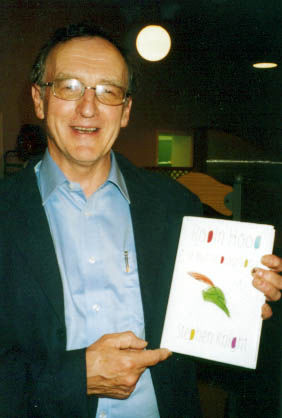
ROBIN HOOD
-- A MYTHIC BIOGRAPHY is Stephen Knight's latest book on the Robin Hood
legend.
It looks the
different ways that Robin Hood has been portrayed over the centuries and
focuses on four archetypal natures of the character.
Buy it on Amazon.com
Buy
it on Amazon.co.uk
|