SAM HART
Conducted
and transcribed by Allen W. Wright
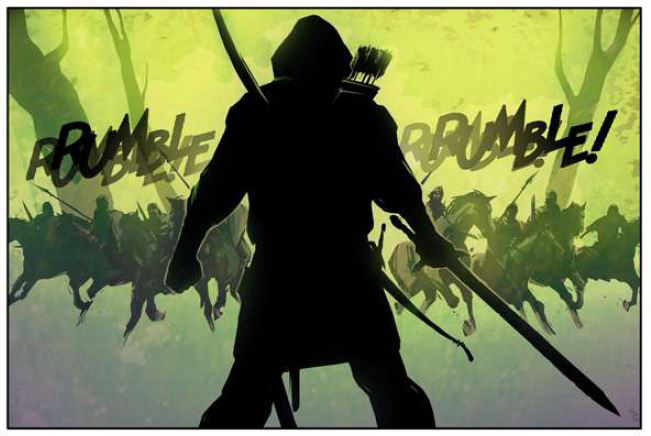
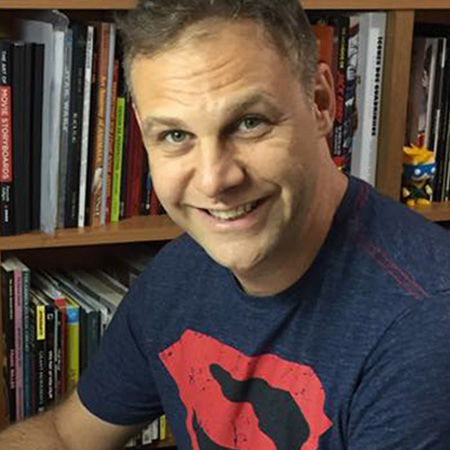
Sam Hart was born in England, but now lives in San Paolo, Brazil. He has illustrated several magazines and comics in Brazil and around the world. His collaborations with writer Tony Lee include Starship Troopers, Brothers: The Fall of Lucifer and the subject of this interview, the graphic novel Outlaw: The Legend of Robin Hood published by Walker Books in the UK and Candlewick Press in North America. Tony and Sam are teaming up again on another graphic novel on the Arthurian legends to be published in 2010.
Click here to go to Sam Hart's official website.
This
interview was conducted via e-mail in June 2009.
AWW:
Writer Tony Lee explained that the Outlaw: The Legend of Robin Hood
graphic novel got its start because you drew a Robin Hood sketch in
response to a one-page appearance by the character in his earlier
Midnight Kiss comic book series and that you were very enthusiastic to
work on a Robin Hood project. I gather you've been a long-time fan of
Robin Hood -- perhaps not surprising as you were born and raised in
the Midlands. Did Robin Hood play a role in your childhood, and what
appeals to you the most about the legend?
SH:
Robin Hood played a large role in my childhood, as did most stories I heard at that age –
Peter Pan, King Arthur, all the Mother Goose and Grimm tales, Chinese folk stories, etc.
I had a very active imagination and two very interesting parents. I lived on a narrowboat
for the first 6 years of my life, and I loved hearing the stories of people who had
worked, lived and died on those boats. What I most enjoyed about Robin Hood were the
swordfights, shooting arrows, and that it was a great excuse for climbing trees. Later
when comic books came into my life, I was hooked into this graphic medium and the
possibility of being a part of the storytelling.
AWW:
How much input did you have in
designing the characters in the
graphic novel? And what inspired you for the various characters? Your
Little John, for example, looks very different than the bearded
wild-man type that's common to film and TV versions in the last 30-odd
years.
SH:
Well, Little John was basically my younger brother, who has grown to gigantic
proportions over the years and sported a weird beard for some time that I thought
appropriate for the character. Lady Marian is slightly a mix of Tony’s then-girlfriend
and my wife: the stylish clothes, moody eyes and hard determination. Most of Tony’s main
characters that I’ve had the luck to illustrate have been well-humoured, charming guys,
and Robin is no exception. The only thing Tony insisted on for Robin was the hood and
leather straps, to make a more modern design.
AWW:
What were your biggest artistic
influences in illustrating Outlaw?
SH:
A few I can single out are Frank Frazetta, Brian Bolland, Wally Wood, Alex Toth, N. C.
Wyeth, David Lloyd, Alex Raymond, Bernie Krigstein and Kathe Kollwitz.
AWW:
Did you do much
historical research for the 1190s setting?
 SH:
As much as possible from afar. Films, books, Google, Wikipedia and I made the best of a
UK visit in 2007 to spend a few days in Nottingham and Sherwood. Also Bernard Cornwell’s
Grail Quest Trilogy and Warren Ellis’ Crecy. Learning British history has been a great
bonus for me with this project - and the next, King Arthur - as I left for Brazil just as
History classes at school were starting to cover the Romans in Britain (I instead had
plenty of Brazilian and Portuguese History).
AWW:
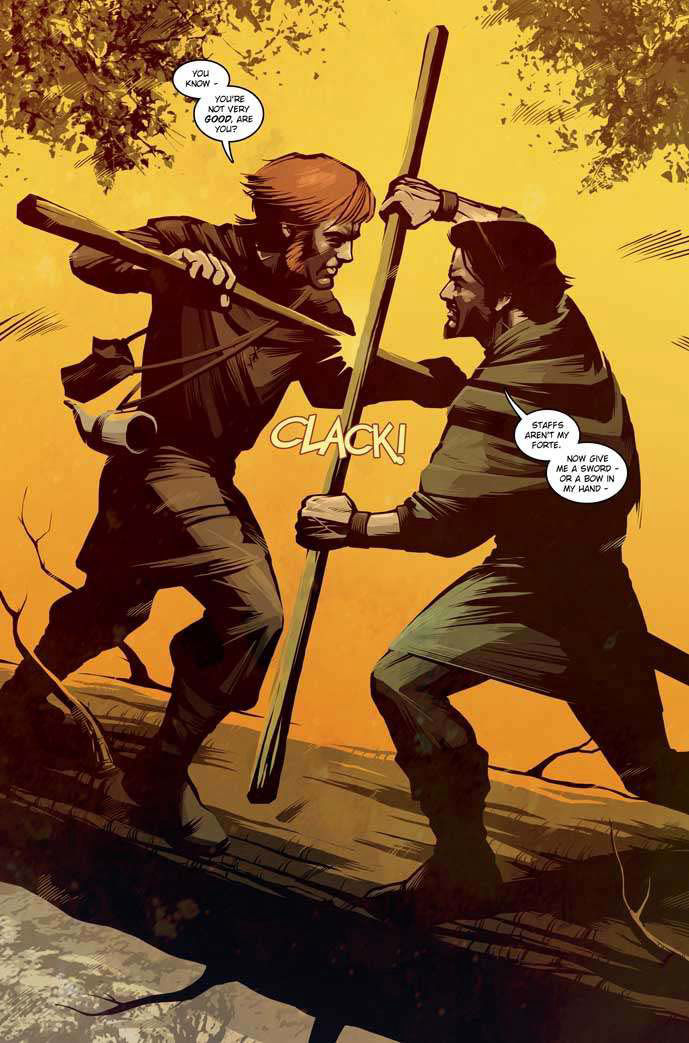
Robin Hood has succeeded on film and
television in part because of
the action sequence - the quarterstaff duel and swordfights, for
example. What challenges are there in creating the sense of movement
in such sequences with only a handful of still images. How do you pick
the moments to create a sense of the scene?
SH:
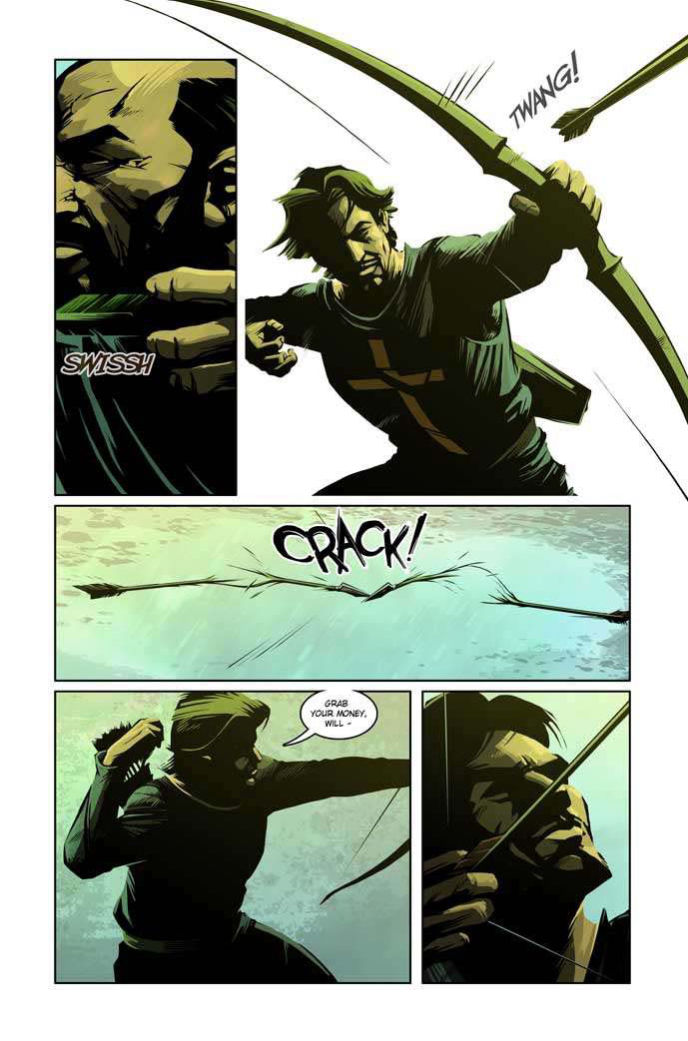
Well, action sequences are something that superhero comics (and young kids) thrive on,
and I’ve been practicing drawing those since forever. Paraphrasing expert advice from
John Buscema, in How to Draw Comics the Marvel Way: draw the first or last part of the
action sequence (the parts where there is recoil or release) because that’s where you’ll
see the most energy (and not, as you might think, at the actual point of contact).
 AWW:
As
an artist, how much freedom were you given from the script? Was
there anything you pushed to change because you had a better idea?
SH:
This was my third or fourth collaboration with Tony, so we’re very accustomed with each
other’s way of “seeing” the page and characters. His scripts are often the minimum
necessary to work on; so, I have plenty of input in a scene and I’ll sometimes “collapse”
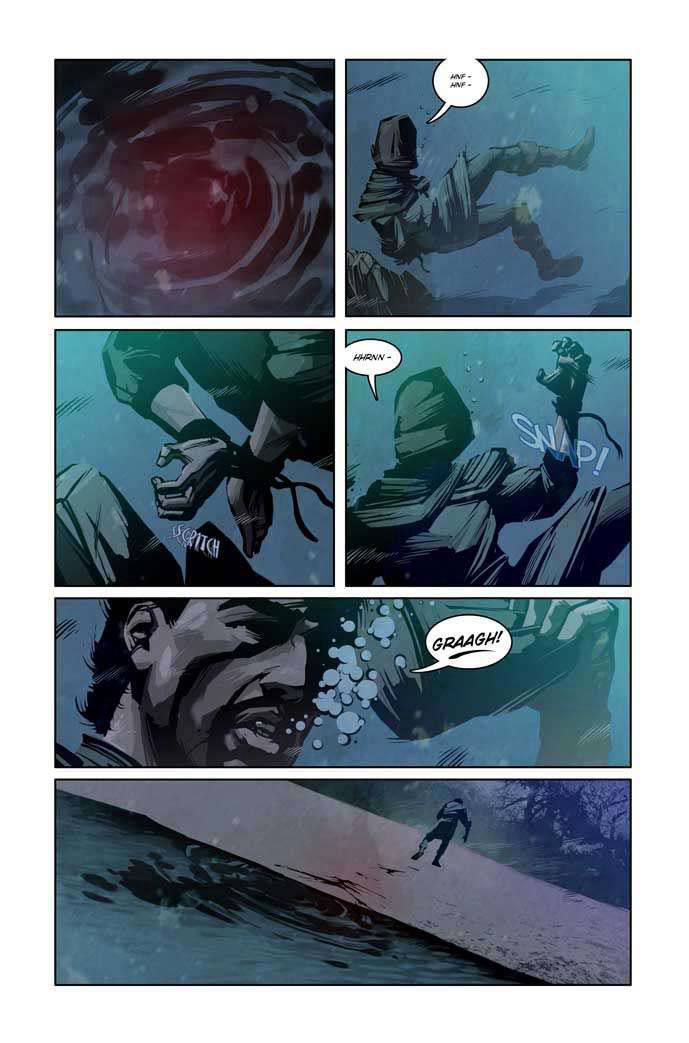
two panels into one, or change the suggested angle if I think it works better. For
example a one-page sequence in Outlaw I thought could work better underwater, and Tony
had no problem with that. But these alterations are not often, and I make sure that it
never changes the action or dialogue.
AWW:
What are you most proud of in Outlaw?
SH:
The size, for one thing: 142 pages is a lot of work, and just getting through to the end
felt incredible. Another thing is being part of this great story, alongside all the
people who have taken part in the telling of it –from the 12th century ballads to Walt
Disney, Sean Connery, Errol Flynn, Frank Bellamy etc. And I must thank Artur Fujita, who
did some fabulous moody colours. If I could point people to the
outlawrobinhood.blogspot.com you can see some of the art process.
AWW:
I understand you're
now working on a similar graphic novel with
Tony Lee about the Arthurian legend. How is that going, and does it
present different challenges from adapting the Robin Hood story?
SH:
I’ve finished all the layouts, and have started inking. Again, it’s over 140 pages,
medieval setting – 6th century this time – with plenty of action and drama, and also some
magic. I often feel that one job is practice for the next, and Robin Hood and King Arthur
have been no exception.
AWW:
I understand the legend of the real-life early 20th century bandit
Lampião [real name: Virgulino Ferreira da Silva] and his wife Maria
Bonita has taken on a Robin Hood-level of popularity in Brazil where
you now live. What do you think of this modern outlaw legend and how
does it compare and contrast with Robin Hood?
SH:
Well, Lampião lived at the start of the 1900s, and in the very north of Brazil, which is
poverty and corruption-infested to this day. He was poor and robbed and killed almost
anyone who came in his way, and was quite a bloodthirsty chap. Another comparison might
be with the drug-dealers that live in and control the favelas in Rio de Janeiro… Looking
out for their community with a law of their own, feared by most rich or middle-class
citizens, smart and resourceful even if it means living outside the law.
Maybe in his day Robin Hood was more bloodthirsty and less charming than the legends and
books tell?
AWW:
Thanks very much, Sam.
SH:
And thanks for the afterword for the book. It completes the story very nicely and is
something people often ask about.
Also, check out this interview with Outlaw's writer Tony Lee.
OUTLAW - TTHE LEGEND OF ROBIN HOOD by Tony Lee, Sam Hart and Artur Fujita. Read the graphic novel we've been discussing.
Amazon.com
Buy the Outlaw graphic novel [hardcover edition] on Amazon.com (to be released in Sept. 2009)
Buy the Outlaw graphic novel [trade paperback edition] on Amazon.com (to be released in Sept. 2009)
Buy the Outlaw graphic novel [UK trade paperback edition] on Amazon.com (available now, ships in 3 - 4 weeks)
Amazon.co.uk
Buy
the Outlaw graphic novel [Walker Books, UK paperback edition] on Amazon.co.uk (available now)
Amazon.ca
Buy the Outlaw graphic novel [hardcover edition] on Amazon.ca (to be released in Sept. 2009)
Buy the Outlaw graphic novel [trade paperback edition] on Amazon.ca (to be released in Sept. 2009)
|