|
Like my last
trip to Britain, this return vacation was based around a Robin Hood conference. It
was held in York from July 7 - 10, 2003. Before
the conference, I made a brief stop at Huddersfield to crash at a colleague's house
as I put the finishing touches on my conference paper.
Huddersfield is very close to Kirklees and Robin Hood's grave, which I visited
on my previous trip, but this time I didn't get to that Robin Hood site.
However, there were many other Robin Hood sites I did get to visit both
during and after the conference. The conference
accommodations were at York St. John College, just across from Robin Hood's
Tower on along one of the city's medieval walls. The lectures were
delivered a short walk away at King's Manor. King's Manor was once the private lodgings of the abbot who was Robin's legendary
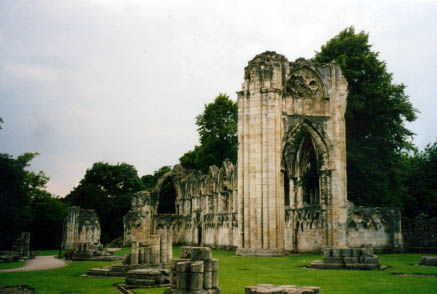
archenemy. (After the dissolution of the monasteries, King's Manor housed the Council of the North, governed by Sir Henry Hastings, Third Earl of Huntingdon. Some believe the Elizabethan Hastings was the inspiration for Robin's legendary earldom.) King's Manor is next door to the ruins of St. Mary's Abbey, York. I first visited St. Mary's Abbey in 1993, and I was able to squeeze
in a brief walk around the abbey grounds into the busy conference schedule.
Unfortunately, I didn't have much time to sample the many sights of
York. I arrived later on Sunday, July 6, than I had originally intended.
I did go shopping with some friends along the pedestrian shopping street
of Stonegate and wandered down the old-fashioned Shambles after store hours.
And I did an early morning stroll along the medieval wall. But
then, this trip had many, many more pleasures than the tourist attractions. As always, the
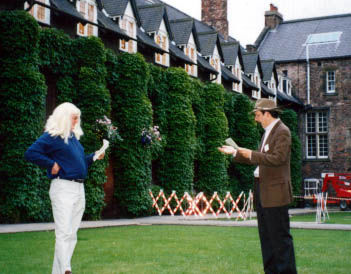
conference was a celebration of all things Robin Hood. Topics ranged from
genuine medieval outlaws of Barnsdale to the early ballads and plays to
the later legend. As usual, my paper was mostly based in the modern
era. I examined the role of religion in the modern Robin Hood legend, although
I cast a look back at the early ballads too. David Hepworth and I also chaired
a small, informal session about Robin Hood and the Internet. Naturally, this
site was a major topic of discussion. I wrote a Spotlight giving a more detailed account of the conference.
Photos of the Robin Hood sites on this trip can be found at my Picture Gallery.
If that sounds
a little bizarre, crazy and possibly fun -- then you've grasped the charm
of these conferences. That's not to take away from the scholarship. New insights into the legend come up at the conferences
-- Tom Ohlgren seems to have made a habit of it. But well ... it wouldn't be in keeping with the legend if there wasn't some fun -- including Paul Bracken's rendition of the ballads. It was especially
nice to be with such friends in so many locations associated with the Robin
Hood legend. On the last day of the conference, July 10, we toured
various Robin Hood sites. First up, our
coach stopped at a place I've longed to visit -- Barnsdale. The Barnsdale
region of Yorkshire was the setting for many of the medieval ballads and
the name still occurs in later versions of the legend. It was never a royal
forest like Sherwood, nor even heavily wooded. However, there are medieval
records of robberies occuring in this area. The coach pulled in at Wentbridge
at the northern edge of what was once Barnsdale. In an early Robin Hood
ballad, a potter that Robin fights is said to be from Wentbridge. On the
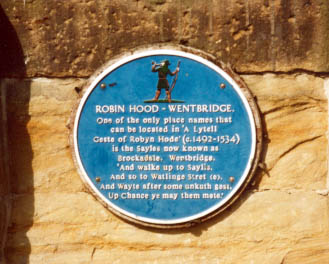
bridge over the river Went, a blue plaque commemorates the area's Robin Hood
connection. Even though quite a few Yorkshire sites are still mentioned in
the modern Robin Hood tales, this plaque is the only one to acknowledge the
outlaw's Yorkshire heritage.
Barnsdale isn't
the first time I've stood somewhere associated with the legend. But it's
still weird to picture the outlaw heroes once standing where I am. Unfortunately,
there isn't a great deal to look at in Barnsdale. After walking back to Wentbridge and having some tea, we visited another Barnsdale site -- Robin Hood's Well. It's one of many wells that bears Robin Hood's name, although this one has a long pedigree. The well-house was designed in the 18th century and in the 20th century, it was moved to accommodate a highway. But references to this well go back to the 17th century when it was a famous stopover. The well was near the now lost "Robin Hood's stone", the first recorded Robin Hood place name from 1422 (or 1322, depending on who you ask). Then as the
coach zoomed through Yorkshire, other locations were pointed out to us.
"Just behind those trees is Little John's Well." We drove near another Robin
Hood's Well. When we drove through Wakefield, David Hepworth pointed out
where a Robert and Matilda Hood of the 14th century once lived. We drove by
the Pinderfields, where part-time Merry Man George a Greene aka the Pinder
of Wakefield would have worked. Then, we disembarked at Ripon to spend a few
minutes in the city's medieval cathedral. Our last stop
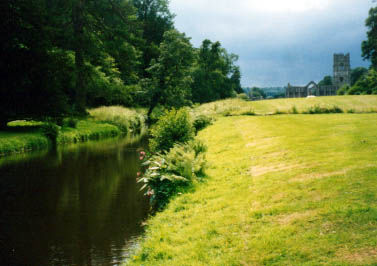
of the day was easily the best -- Fountains Abbey. These enormous abbey
ruins made St. Mary's, York look like a tabletop model set. Actually,
it was some Benedictine monks from St. Mary's who founded this abbey in 1132.
Shortly after its founding though, it became a part of the Cistercian order.
These monks, known has "white monks" for their undyed robes, were an order
who wanted to get back to the early monastic tradition with stricter rules
on poverty and dieting. That's ironic, considering the abbey's most famous
resident was not known for his restraint. You've heard of him -- a friar by
the name of Tuck. You might wonder
how an overweight, brown-clad friar could be associated with a Cistercian
abbey. Well, the abbey is mentioned as the friar's home in the 17th
century ballad Robin Hood and the Curtal Friar. The friar isn't named in the
ballad version, but the action is similar to a 1560 play with Friar Tuck.
If you've seen the Errol Flynn movie or read many of the Robin Hood children's
books, you would be familiar with the basic story. Robin jumps on the friar's
back and forces him to cross the river. After a few reversals, Tuck dumps
Robin into the water. And then they fight. In the ballad version, Tuck summons
50 arrow-catching dogs to battle the Merry Men. But it's not
just ballads that tie Fountains Abbey with outlaws. On the coach ride to
the abbey, John pointed out that an area near the abbey was called Thieves'
Wood and was the site of many medieval highway robberies. In the abbey gift shop, I mentioned the Friar Tuck connections of the abbey. The girl behind the counter hadn't heard about that. It reminded me of my first visit to St. Mary's Abbey ten years ago, when the official tour guide didn't know about that abbey's frequent appearance in the Robin Hood legend. Certainly, for the general public, the legend's Nottinghamshire locations are better known. And after we returned to York, I said goodbye to my friends and colleagues and boarded a train to travel back to Nottingham. Fortunately,
I didn't have to say goodbye to everyone quite yet. I shared the train ride
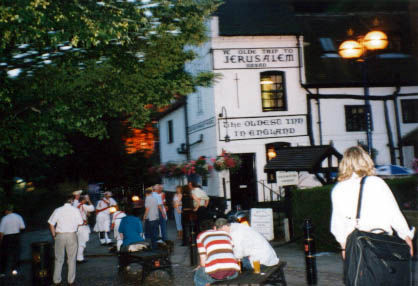
with Nottingham resident Paul Bracken. Upon our arrival, we stopped of at
the Olde Trip to Jerusalem for a farewell drink. This pub claims to have
been founded in 1189 and is partially carved into the sandstone rock which
"Nottingham Castle" sits on. I can personally recommend having a glass of
Old Trip. I'm not a fan of beer, but I found this house brew very drinkable.
Early Friday,
July 11, I walked through the old Lace Market section of town. I paid a return
visit to St. Mary's Church, where Robin Hood prayed and then killed
12 men in the ballad Robin Hood and the Monk. The current church only dates
from the mid-1400s (around the time of the ballad manuscript), but there
was an earlier one on this site. In 2002, archaeologists discovered
a tunnel between the church and the "Galleries of Justice" across the street.
The press at the time declared this was proof of the "real Robin Hood".
(Actually, the ballad's action doesn't quite happen as the press claimed.)
I met two people working in the church and mentioned this discovery. They
both thought the press was full of nonsense -- an opinion that matched my
own. Still, a tunnel
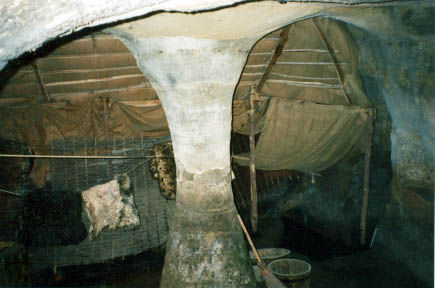
isn't too unusual for Nottingham. Built on sandstone, there are hundreds of
man-made caves underneath the city. And my next stop was the City of Caves
attraction at the Broadmarsh shopping centre. While there were a couple of
tacky new age elements, it was mostly a good exhibit with people in period
costume describing how the caves were once used for tanning leather and in
World War II, they were used as an air-raid shelter. Also, the caves once
provided refuge for the homeless of England.
Then, at 3pm,
I had tea with the Sheriff of Nottingham. No, really. John Hartshorne was
the latest person to hold the office associated with Robin's most famous enemy.
It's largely ceremonial these days, mainly a cultural ambassador to drum
up business and tourism for the city. But he's also a city councillor, and while serving as sheriff was also the
Lord Deputy Mayor and picked to be the Lord Mayor of Nottingham in 2004.
I interviewed Councillor Hartshorne. He was very gracious, shared his love of Nottingham history
and gave me a paperweight. On Saturday,
July 12, I returned to Sherwood Forest, Robin's other legendary home. I interviewed
Park Manager Izi Barton.
Then, I once again walked to see the Major Oak. Since my last visit, the trees
wooden supports had been replaced by metal ones. It might be a bit young
to have been Robin's headquarters, but this tree (which some say was originally
three trees that tangled together) is still impressive. And it rightly deserves
its status as one of 50 Great Trees of Britain.
I returned to
Nottingham, and concluded the day with a Ghost Walk which began at the other
centuries-old pub, the Salutation Inn. It concluded in the pub's cave that
I mentioned in my other writings on my travels. Early Sunday, July 13, I took the train to London. Then, I took the tube to Heathrow and flew back to Toronto. So, have I seen everything in Robin Hood Country? No. There's still a lot I'd like to see. And the folks I've met in both Yorkshire and Nottinghamshire have made me feel very welcome. In the cliched words of a movie cyborg (who paraphrased Douglas MacArthur), I'll be back. Next time, I returned it was on someone else's dime - or 10p - as I travelled once again to Robin Hood sites in 2006 as part of a TV documentary. You can read about that holiday on the next page. Click here to see Robin Hood Locations on Google Maps. I designed this map to showcase some of the sites discussed on this page, as well as others related to the legend. The map is interactive and allows you to zoom in, switch to satellite or Google Earth views. And if you drag the orange figure to the map, you can navigate at street level via Google's 360-degree photos. Many sites are visible from the road. View Robin Hood Locations in a larger map | BACK TO: Robin Hood Country (1999) | TOP | CONTENTS | FORWARD TO: Robin Hood Country (2006) | Text copyright, © Allen W. Wright, 1997 - 2010. |
|
|