Robin Hood -- A Personal Journey

Why I Like Robin Hood

What is it about this outlaw hero that fascinates me? Why would I spend so much time producing a web page devoted to him?

Robin Hood (Eric Lichtenstein)  and  Friar Tuck (Kevin Carboni). You know, I've thought about this long and hard, and any answer I come up doesn't really satisfy me. But I'll give it a go.

On one level, Robin Hood is just so damn cool. He dresses in my favourite colour. He uses a longbow. Most of the Robin Hoods I've read have had great wit and charm.

And he's an outlaw. Even though he usually has a heart of gold, Robin's not entirely respectable. There's something very appealing about a hero who's disreputable. Look at Star Wars. Han Solo is far more popular than Luke Skywalker.

And from a left-wing perspective, I enjoy the redistribution of wealth motif running through the recent Robin Hoods. Yet, in my callow youth, I was a conservative, and Robin Hood appealed to me then too. Sometimes the outlaw does represent the status quo.

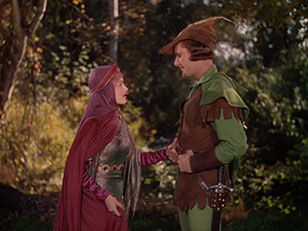
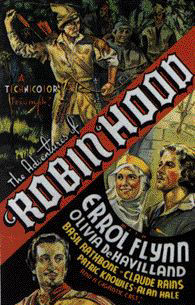
The trouble is that there have been so many different Robin Hoods. I can explain why I like Errol Flynn's Robin or Michael Praed's, or the novel Sherwood. But to explain my interest in Robin Hood in general?

Charm, charisma, boundless energy, freedom of thought and action and a good cause, Flynn's Robin has it all. Hmmm.... most versions of Robin Hood contain an element of the trickster. And that's a powerful archetype for me. The cunning tricks, the witty comebacks -- it's the stuff I want to cultivate in myself but rarely manage to bring out. Robin Hood may plan, but he can also be tremendously spontaneous too. And in my overly shy lifestyle, I covet spontaneity. "Act without thinking," Herne told Robin of Sherwood. Oh, how I wish I could follow that advice at times. Usually the closest I get is being thoughtless.

One aspect of the trickster is a sense of freedom. Robin Hood is free. He's doing what he wants to do in his life. Instead of being a mere yeoman or even an earl, he became the King of Sherwood. He risks death on a daily basis, but that doesn't matter. He's free in his mind and his spirit. Even in the modern versions of Robin Hood where he often shows very human doubt, Robin is able to overcome the mental prison we put ourselves in.

Not that I want to push this freedom analogy too far. I'm sure some people could quite easily use Robin Hood to justify the militia movements in the States. And as a moderate socialist, that's a road I don't want to travel down. [I've just learned that Timothy McVeigh once compared himself to Robin Hood. My gut reaction is to scream "Don't you dare sully my hero, you murdering ..!"] I think it's possible to be mentally free and a part of society at the same time. Robin's often a very socially responsible fellow.

And yet part of me knows that the original ballad Robin Hood had a lot in common with a mafia boss. So, the legend has to have charms beyond social responsibility. That's something unsettling to think about. Most stories that last have some degree of darkness about them - look at the original fairy tales, for example. In fact, something I've come to worry about in recent years is that Robin Hood is becoming a bit of a joke. That the trickster and sometimes downright dangerous anti-authoritarian has been diluted to the point where for many, the legend is almost irrelevant. For example, the Sheriff in Prince of Thieves is infinitely more popular than that film's Robin Hood. Does Robin need to reclaim his outlaw heritage? I think he does to some extent.

I hope I explained that without sounding too pretentious.

Anyway, I'd like to hear about your interest in Robin Hood. What does he mean to you?

What versions of the legend do you like? What bits of obscure trivia can you remember?

Here's me just a week or two into growing a Robin Hoodish goatee, wearing the cap Jonathan discarded. Does anybody remember the episode of Voyagers where Jeffrey travels to Sherwood Forest? I remember him telling the Merry Men that his dad told him Robin Hood was really a man called .... I think they used Robert Fitzooth, the Earl of Huntingdon. And Little John replies, "Aye, that's Robin's real name." I don't remember exactly who they said Robin was. Do you? And do you remember the plot? I think they had to go rescue Robin Hood. It's what most time travellers to Sherwood have to do. Rocket Robin Hood rescued his ancestor. And the Justice League and Justice Society tried to. But it turned out that the sheriff was really holding the Green Arrow of Earth-2. Do any of these references mean anything to you?

Please e-mail me at puck@boldoutlaw.com if you'd like to talk about the legend and what it means to you.


| BACK TO: Robin Hood Country (2003) | TOP | CONTENTS |

Text copyright, © Allen W. Wright, 1997 - 2004.