|
I can't remember when I first became interested in Robin Hood. My first encounter with the outlaw is lost to my childhood memories. However, I can remember five major Robin Hood influences in my childhood.
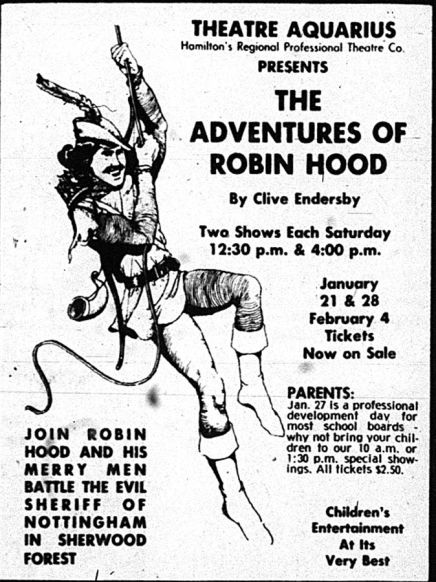
But as much as I like book versions of the legend now, I know it was one of three visual versions that made me a Robin Hood fanatic. When I was seven or eight, I saw a children's play at Hamilton Place. I can't remember much about it. But I do remember Friar Tuck talking to the audience, but some dastardly villain was going to shoot him. We all yelled out "Duck!" And he kept correcting us. "No, it's Tuck. Friar Tuck."
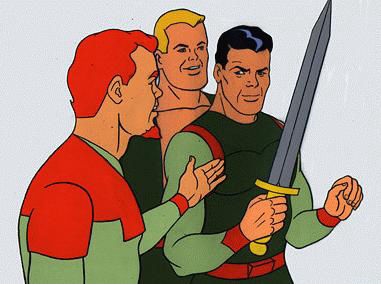
[Oddly enough, not only do I share my first name with one of Robin's band, but for the first 25 years of my life I lived on DALEwood Avenue. Weird. And my mom's name is Barbara Allen, the title character of another famous ballad. On my dad's side of the family, there's a John Little on a very distant branch of the family tree. And the first Wright in my family -- my great, great, great-grandfather -- to come to Canada was named Robin.] I can't remember when, but I saw a Robin Hood movie on TV. For the whole day, I was quoting dialogue from the film. Now, I don't even know which movie it was. For the longest time I thought it was Errol Flynn's The Adventures of Robin Hood. But I remember a scene that's not in the Flynn movie. Robin and Will Scarlet entered Nottingham Castle by a high window and taunted the Sheriff of Nottingham and Prince John. Maybe it was Flynn's movie, and my youthful memories are combining the scene where Robin and Will rescue Much with the later scene where Robin brings a stag to the banquet. If you know which movie this was, please e-mail me . I'd love to see it again! (It is possible that it was the 1938 film and I just have jumbled memories of how this scene played out.) And of course, there was Rocket Robin Hood. This delightfully silly cartoon featured the direct descendants of the Merry Men in the far distant future. Flying around in space ships, Rocket Robin and his crew battled Prince John and the cowardly Sheriff of N.O.T.T. Does anybody remember what N.O.T.T. stood for? I know it was an acronym for some kind of despotic government. Who could forget Little John as a country bumpkin? Or Friar Tuck repelling bad guys with his stomach? Or the episodes that shared the same footage as Spider-Man? Sadly, a lot of my early knowledge of Robin Hood came from this cartoon. For any kid growing up in Canada of the 1970's, it would have been hard to miss this show. It was on all the time. (That probably had more to do with Canadian content laws than Rocket Robin Hood's quality.)
A slightly less major Robin Hood influence was the Robin Hood brand flour that was a fixture of my mom's kitchen. I was wracking my brains to figure out how I could remember the classic 1950's Robin Hood TV theme as being a part of my childhood when I didn't see the show until I was nearly 20. Then I remembered, the theme song (you know, "Robin Hood, Robin Hood, Riding through the glen") was used in the commercials for Robin Hood Flour. I guess they must have changed the lyrics a bit, because I don't think flour can be "feared by the bad, loved by the good" as the original song went. I grew up in Hamilton, Ontario, Canada. The neighbouring town of Dundas, where my paternal grandparents lived, had streets named after the outlaw legend -- Robin Hood, Maid Marian, Little John, and Sherwood. I don't consider this a major influence, but I just thought I'd mention it for the sake of completeness.
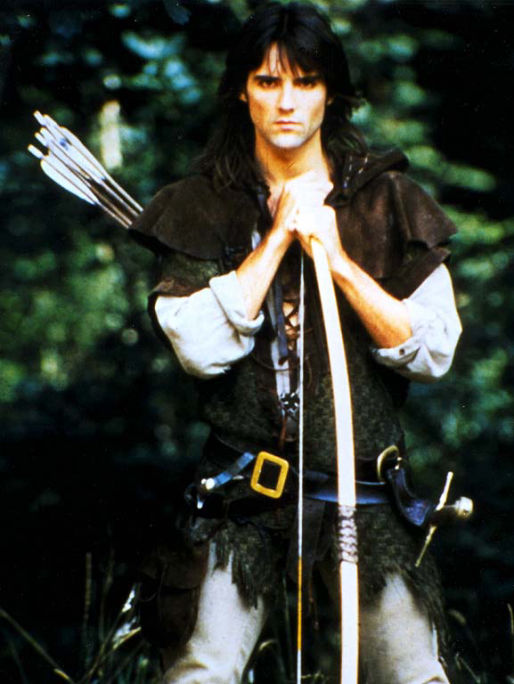
And in my OAC (or Grade 13, to use the old term) English class, I turned to my childhood hero for my independent study. That's when I learned the origins of the legend and read the original ballads for the first time. I read the works of Holt, Bellamy, Dobson & Taylor and several others. And I've reread these books several times. Many of them refer to another English outlaw, Adam Bell, whose exploits have mostly been forgotten in this day in age. But not by everyone it seems. When I was working on the essay, I caught a few minutes of a British Robin Hood series. The Robin was the son of a forest god, Herne the Hunter. It looked interesting. And the week after I handed in my essay, I tuned in to catch my first full episode of Robin of Sherwood (re-named Robin Hood here in North America). What a surprise to find that an older, cynical Adam Bell was the guest star. He had returned to Sherwood, his career overshadowed by Robin Hood's. Using Adam Bell impressed me. I was hooked.
Since then, a lot of new versions of the legend have come along. I've enjoyed many novels such as Parke Godwin's Sherwood, and I thought the 1991 TV movie starring Patrick Bergin was very good -- unlike the Kevin Costner flick of the same year. Also, I've tried my hand at some Robin Hood fiction. One was an abortive attempt at a novel. And I've been tinkering with a couple of short stories about Robin Hood. In May of 1993, my fantasies came true. My graduation present was a trip to England. And of course, I spent a few days in Robin Hood's old stomping grounds. I will talk about this trip in detail below. In late 1996, I decided to set up a webpage. Originally, I was only going to have some Robin Hood links. But I didn't find many pages which covered the whole legend. And that bothered me. King Arthur? Sure, there are tonnes of Arthurian pages, but very few dedicated to Robin Hood, who is usually perceived as a more popular hero. So, I decided to set up this page. And so far, it's been a wonderful time. I've chatted with several visitors to my website. I've helped out some teachers and students. And when I set up my interview section, it gave me a reason to chat with several people associated with the legend, people I've long respected.
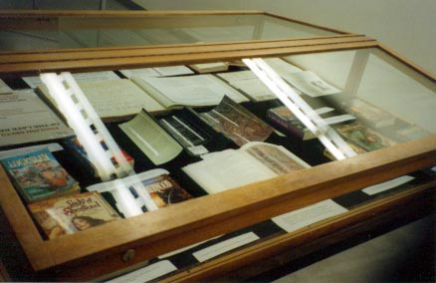
There were presentations with Robin-related music spanning 700 years, North American ballads, modern British pantomimes, and a production of the very first complete Robin Hood play. There was an exhibition of art, books, toys and other things to do with the outlaw hero. But more important than any of this was the people I met.
Many of the professors I talked to said it was one of the best conferences they've been to. I think the subject of Robin Hood is one you can have fun with. And so, there was a sequel in July, 1999 in Nottingham. I was looking forward to it.
In April 1999, I re-presented my paper on Robin Hood comic books at a history conference in Dayton, Ohio. (Along with Laura, my friend from SEMA and Rochester.) Then in July 1999, I returned to Robin Hood Country! I attended and this time presented (another somewhat altered version of the comic book paper) at the Second International Conference for Robin Hood Studies -- held in Nottingham. It was a delight to see old friends and meet new ones. And I not only re-visited places like Sherwood Forest but got to tour the rarely visited grave of Robin Hood in Kirklees, Yorkshire. I also got caught up in the "Robin Hood is gay" controversy that the media manufactured just in time for the conference. I was quoted in the Nottingham Post on the subject. But you'll be able to learn more about this trip in my Return to Robin Hood Country section.
On Saturday evening, most people at the conference took a trip to the nearby Stratford Festival. I chose to see Henry IV, Part 1 -- an enjoyable play with many Robin Hood themes.
On Oct. 8, 2001, some of my comments were featured on an Ideas documentary on CBC Radio 1, along with several other conference goers. I also helped supply sound clips and tracked down music for the programme. "Hunting for Robin Hood" won the New York Festivals Gold World Medal award for radio programming. A few days before the show first aired, documentary writer/interviewer Seth Feldman promoted the documentary on another radio show. He had considerably kind words to say about both me and this website. (Thank you, Seth.) But contrary to what Seth claimed -- I really don't know everything there is to know about Robin Hood. Then that's a good reason to go to conferences, to learn a lot more. (As for being "pleasantly obsessed" by the legend, well... that's a fair cop.) Most of all though, it was great to see friends from past conferences and make new friends, to hang out with top scholars and to just feel human. So, a big thank you and greenwood salute to everyone involved at the conference. Special thanks to conference organizers Prof. Richard Firth Green and Scott Holden-Jones. You did a great job in holding up a proud tradition. In April 2003, I was interviewed for a television documentary about the legend. This documentary, Robin Hood: The First Outlaw Hero, aired on Canada's History Television channel in March 2004. There are some brief clips of me talking about Robin Hood and the Internet and the history of my website. Better than I had hoped for, actually. A more happy experience in 2003 was yet another Robin Hood conference. This one was held in York, UK on July 7-10, 2003. I describe the conference in a Spotlight review, and also my latest visits to Yorkshire and Nottinghamshire Robin Hood sites are chronicled below in the Further Adventures in Robin Hood Country section of this Personal Journey. In September and October 2005, I attended the fifth Robin Hood academic conference. This one was held in Newark, Delaware. Far from Robin's haunts ... or so one would think at first. This area was home to Howard Pyle and N.C. Wyeth, two of the best artists ever to depict the outlaw. Included in the conference was a trip to the nearby Brandywine River Museum (and the Wyeth home and studio) in Chadds Ford, PA. Regrettably, the only original Robin Hood art from Pyle and Wyeth that I saw at the conference was a Wyeth painting of Robin and Little John's famous duel, housed at the University of Delaware. However, the Brandywine Museum did have some nice Robin Hood-like paintings by N.C. Wyeth used to illustrated Stevenson's The Black Arrow. I've always been a fan of Pyle's art, but Michael Boudewyns of the First Children's Theater recited/performed the words of Pyle in a way that gave me new appreciation for the text. Other entertainment included the early music group Hesperus performing live musical accompaniment to the Fairbanks film, and the University of Delaware music students performed songs from Reginald De Koven and Harry B. Smith's 19th century comic operas Robin Hood and its sequel Maid Marian. Given the proximity of the Brandywine school of art, the theme of the conference was appropriately "Images of Robin Hood". Keeping with that theme, I presented a paper on Robin Hood comics from the 1980s to the present. I'd like to thank Professor Lois Potter and her team for a well-organized and fun conference. So, what does the future hold? Well, I expect I'll attend future Robin Hood academic conferences. (The next one is in Cardiff, Wales in 2007.) And I'm getting ready to scratch that itch to write some original Robin Hood fiction. I'd would be nice to carry this legend forward and inspire others like the tales have inspired me. | TOP | CONTENTS | FORWARD TO: Robin Hood Country (1993) | Text copyright, © Allen W. Wright, 1997 - 2004. |