Current Spotlight
All Spotlight Reviews
Novels and Short Stories
Films and Television Shows
Plays, Poems and Ballads
Robin Hood Scholarship
Miscellaneous
Featured Spotlights
Robin Hood - Prince of Thieves
starring Kevin Costner
The Adventures of Robin Hood
starring Errol Flynn
Robin of Sherwood
starring Michael Praed and Jason Connery
The Forestwife
by Theresa Tomlinson
A Gest of Robyn Hode
(early ballad)
Robin Hood and the Friar
(16th century play)
Robin Hood Tales
(1950s comic books)
Main Sections
Main Page
Introduction & What's New
A Beginner's Guide
Robin Hood Tales
- Ballads & Stories
Wolfshead Through the Ages
- The History of Robin Hood
Search for a Robin Hood
Spotlight of the Month
Robin Hood - A Personal Journey
The Picture Gallery
Interviews in Sherwood
The Blue Boar Inn
- Message Board
Legendary Links
Pook's Hill
Information
Site Map
How to use this site
Search This Site
About the Author
My Biography
Send me an e-mail
Copyright
All text, unless otherwise noted, and title graphics - © copyright Allen W. Wright, 2004.
Art © Quality and National Comics, 1956-8. Presumably the copyright is currently
held by DC Comics. It is used without permission under fair use for the purposes of criticism and review. Quality comics were illustrated
by Matt Baker and Chuck Cuidera. The National/DC art is by Ross Andru and
Mike Esposito.
|
January 1999
Robin Hood Tales
(Quality
Comics, 1956; National (DC) Comics, 1957-1958)
I've
been a fan of comic books since my childhood. I've also been a fan of Robin
Hood since my youth. But until recently, I've never collected Robin Hood
comics.
Then,
in March of 1998, the call went out for papers for the SouthEastern Medieval
Association's annual conference. A friend on the Robin Hood mailing list
wanted to do a Robin Hood roundtable. I submitted two ideas, and she picked
the one about Robin Hood comic books of the 1950s. The conference approved
our plan.
Trouble
was, aside from the reprint of one 8-page story, I didn't have any 1950s
Robin Hood comics. So, I went shopping.
In
a column in Comic Book Marketplace, Michelle Nolan notes that at
least 7 publishers produced Robin Hood comics during the years of the classic
Richard Greene TV series. Like Nolan, my favourites were the ones produced
by National (better known as DC) Comics.
In
1954, the comic book industry adopted a self-regulatory Comics Code. This
Code was created as a public relations gesture to calm the public fears
(and US senate investigation) about the supposed ties between comic books
and juvenile delinquency. The Code not only toned down the violence of
comic books, it also imposed a moral status quo on them. Provision 1 of
the Code was "Crimes shall never be presented in such a way as to create
sympathy for the criminal, to promote distrust of the forces of law and
justice, or to inspire others with a desire to imitate criminals."
An
outlaw was an unlikely hero for these times. To quote from my paper on
the subject,
The
Robin Hood of the Comics Code was very different from his medieval counterpart.
According to Stephen Knight [in his book Robin Hood: A Complete Study
of the English Outlaw, p.81], even the most courtly of the early Robin
Hood stories, A Gest of Robyn Hode, 'advocates massive theft from
the church, civic insurrection against and murder of a properly appointed
sheriff, breach of legitimate agreement with a king, and it imagines that
all those things can lead to a lengthy and happy life.' Every point in
Knight's description violates a provision of the Comics Code. However,
the greenwood legend had changed in 600 years. And the Code-approved comics
are the best example of how in the 20th century, the stories which gave
names and inspiration to rebels and robbers had become safe and harmless.
Harmless,
yes. But often entertaining as well.
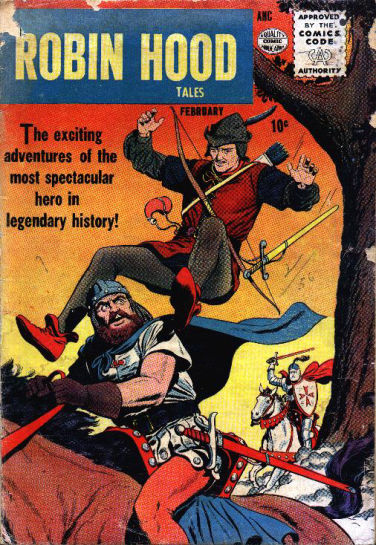
Quality
Comics began publishing Robin Hood stories with Robin Hood Tales,
cover dated February 1956. (Cover dates are actually three or four months
later than when the comic was actually released.) However, National (DC)
Comics took over many of Quality's comics and with issues #7, cover-dated
February 1957, it became a DC Comic. DC was already publishing superb 8-page
Robin Hood stories in the adventure anthology series The Brave and the
Bold. Robin Hood Tales ceased publication with issue 14, cover
dated April 1958.
The
comic books of the time often contained three or four small stories. The
Quality issues also included a back-up feature about adventures on the
Third Crusade. And the DC issues had various educational pages (both comic
and text pages) with titles like "In the Days of Robin Hood". They informed
us about medieval taxes, law and superstitions. These short features contained
more history than the actual Robin Hood stories in the comics.
Short,
simplistic and viewed as crude by the general public, these comic book
stories were not too far removed from the Robin Hood broadside ballads
of centuries past. Individual issues served as "garlands" of these illustrated
adventures.
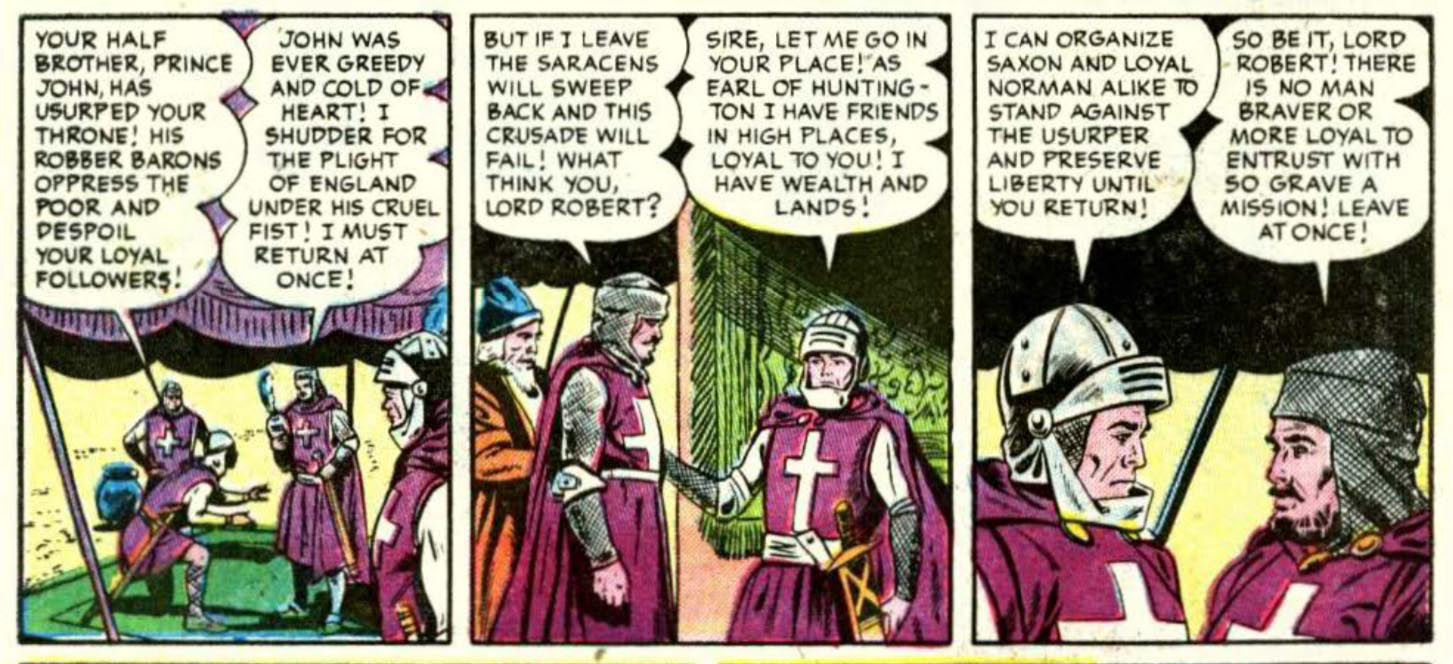
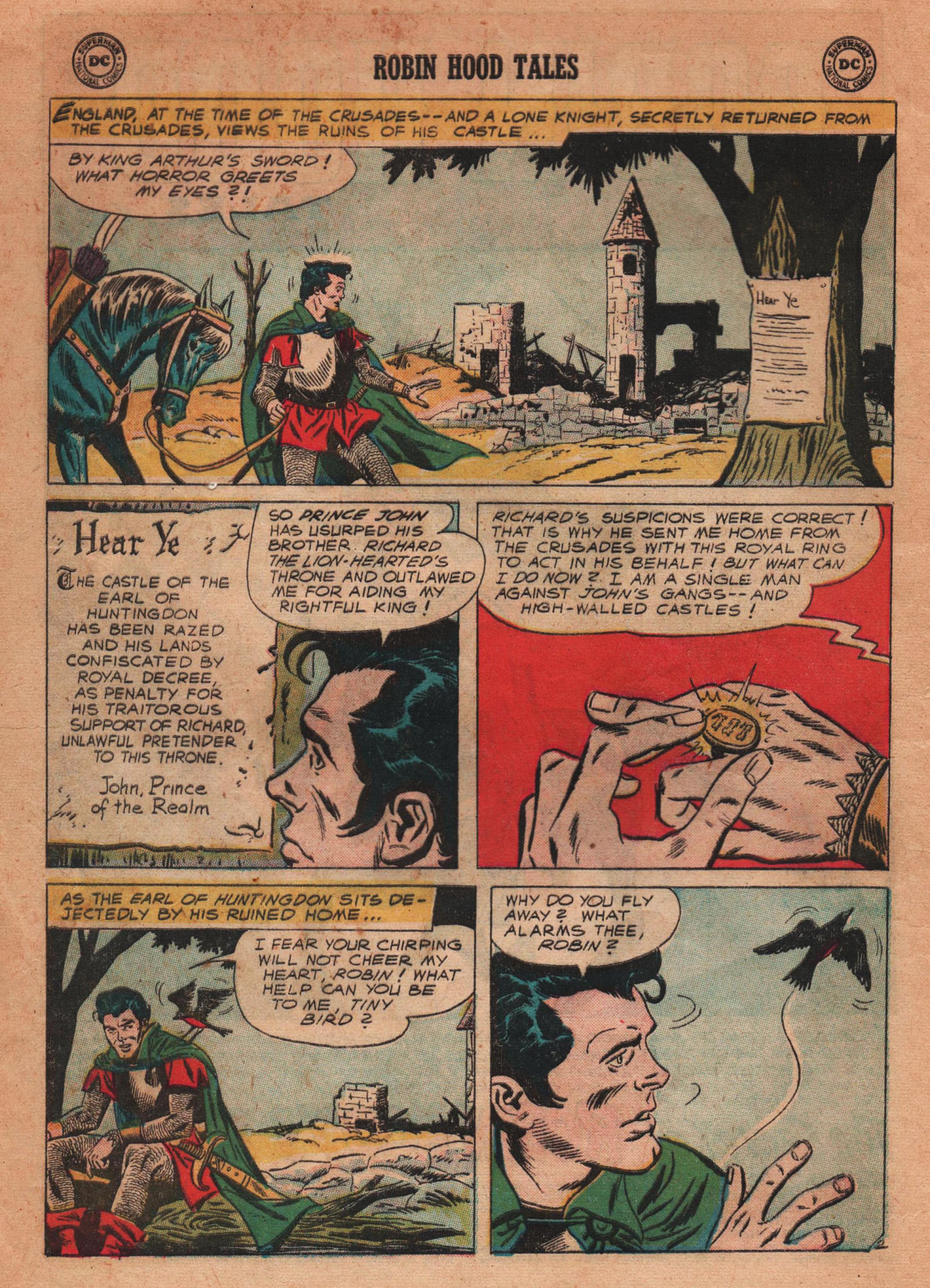
Both
Quality and DC made Robin Hood, the Earl of Huntingdon, a loyal supporter
of King Richard. His lands were seized by the evil Prince John. This origin
was similar to the one used on the Richard Greene television series, although
on TV, Robin was only a former knight, Sir Robin of Locksley.
Quality
drew its inspiration from the ballads, or perhaps from the many children's
books which were inspired by the ballads. "Rescue of Maid Marian", the
lead story in issue 2, features the origin of the Merry Men. It has brief
scenes from ballads like Robin Hood and Little John and Robin
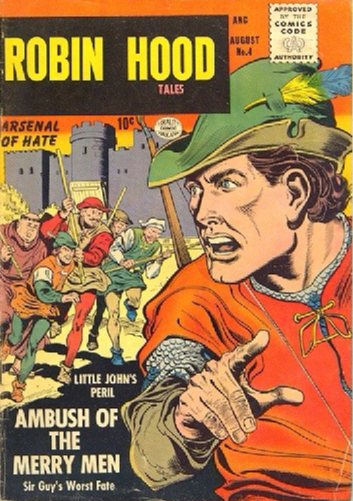
Hood and the Curtal Friar. "Little John's Peril" in issue 4 adapts
the Guy of Gisborne ballad, albeit in a bloodless Code-approved
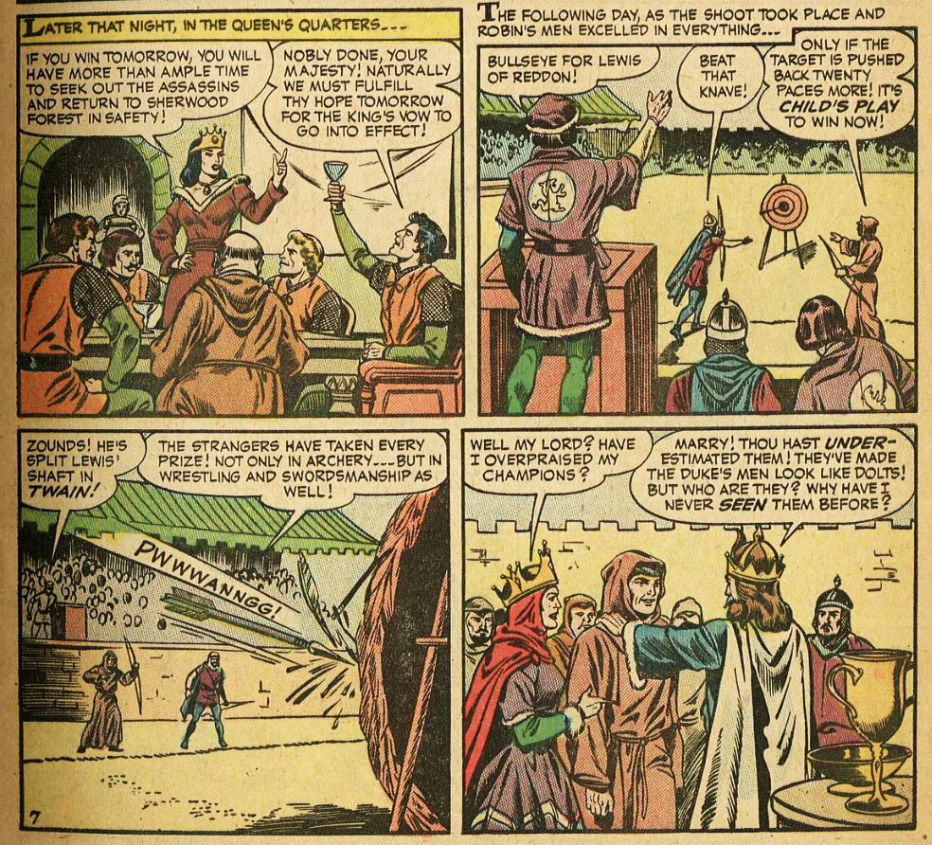
way. In issue 5, "The Menace of the Royal Assassins" combines the ballads
Robin Hood and Queen Catherin and its sequel Robin Hood's Chase.
[In the original ballads, the king and queen were most likely Henry VIII
and Catherine of Aragon. Here, they are Henry II and Eleanor of Aquitaine.]
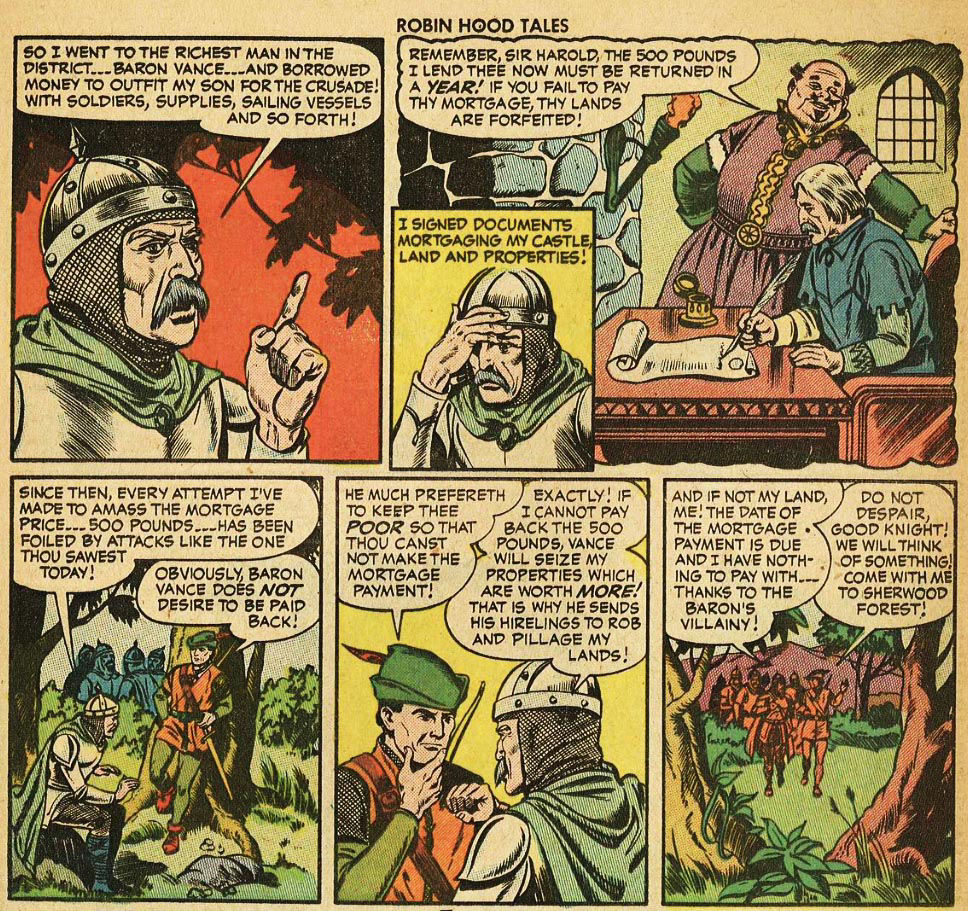
And in the same issue, "The Capture of Robin Hood" borrows from the story
of the knight's debt in the Gest. However, here the debt is owed
to a robber baron, not the abbot of St. Mary's as in the ballad version.
(The Code forbade that any religion be attacked or ridicule. As a result
there is almost no mention of religion in these stories. Apparently, this
provision only applied to Christianity and Judaism as the Crusading stories
don't paint the most favourable view of Islam.)
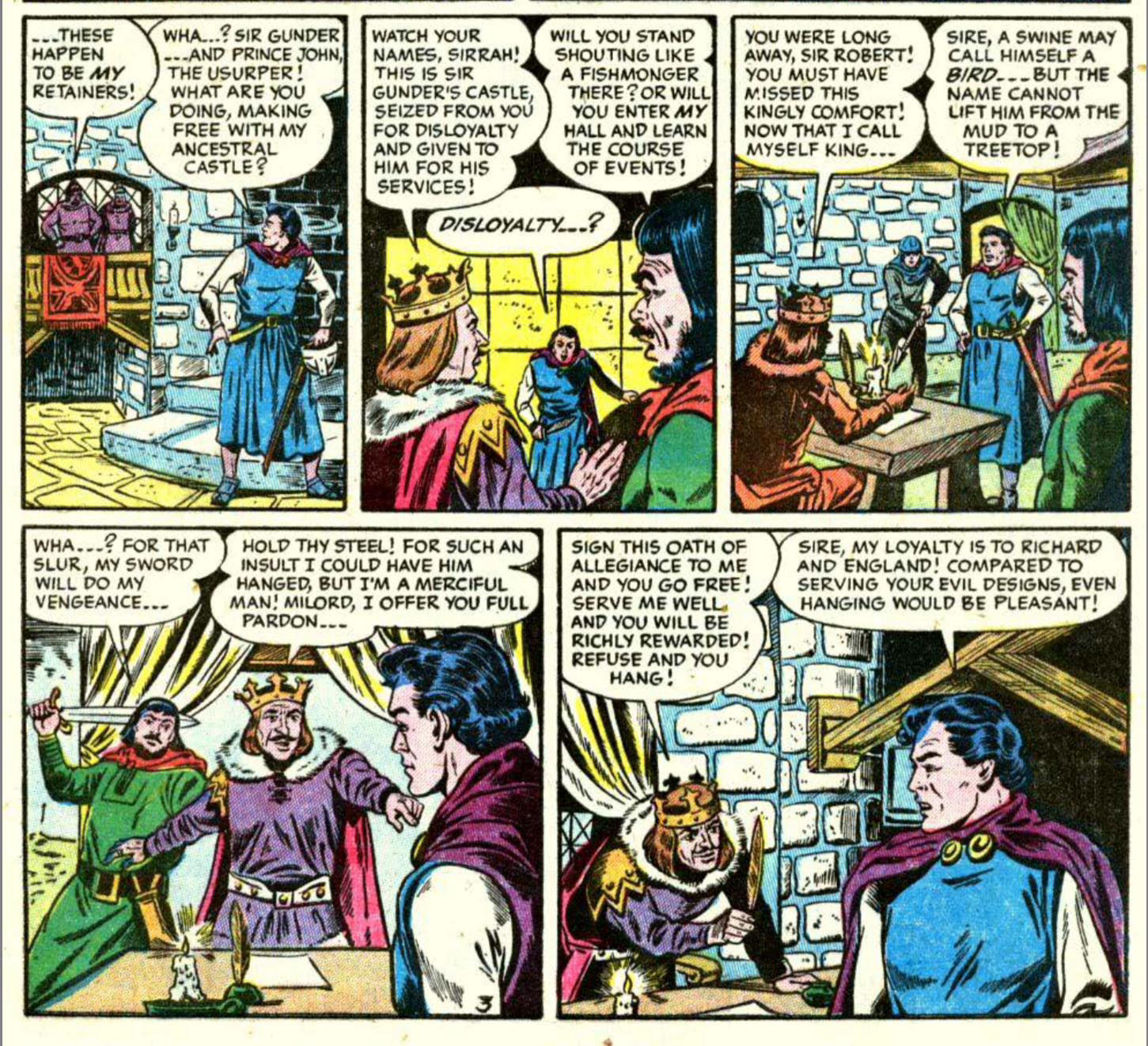
Robber
barons were common villains in the code-approved Robin Hood comics. Since
the barons were holding their power from the usurper Prince John, they
were not legal authorities to be respected. When Robin took money from
these barons, he made sure to point out that it was the barons who were
the real thieves and crooks.
In
the earliest Robin Hood ballads, there's no mention of taxes, except the
one Robin himself imposed. By the time of the comics, it was a common
theme that Robin Hood robbed taxes to give to the poor or pay King Richard's
ransom. In "Ambush of the Merry Men" from issue 5, one tax collector complains
"Unless we get rid of Robin Hood, we'll never keep what we steal!" Taking
money from these men was not considered a crime. To quote my paper again,
"In a country which was founded by men protesting tea and stamp taxes,
fighting corrupt tax collectors was not insurrection but patriotism."
When
DC took over Robin Hood Tales, Robin did less robbing. His stories veered
away from the ballads into the realm of the superheroes.
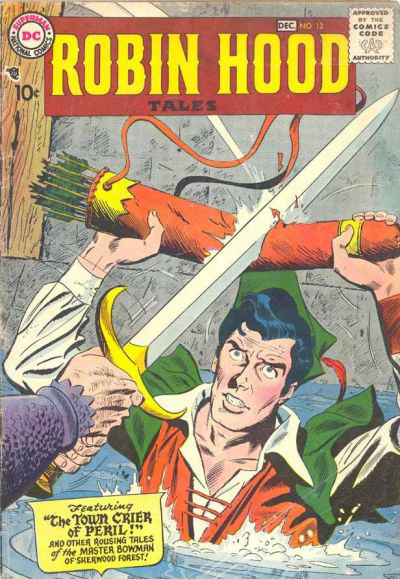
The
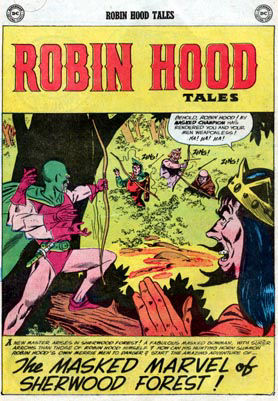
most extreme example of this shift in tone comes in "The Masked Marvel
of Sherwood Forest" from issue 12. Robin actually loses a Nottingham archery
contest to a stranger clad in purple and green. The "Masked Marvel" was
dressed in a full mask, cape, sleeveless shirt, and briefs -- a costume
as gaudy as the gaudiest superhuman. It turns out that the Marvel was really
Robin in disguise, tricking his way into Prince John's service. The "Robin
Hood" at the archery competition was really Will Scarlet in disguise.
Although
this is the only time Robin Hood dresses like a superhero, he often acts
like one. He foils the villains plans by using his wits. For example, in
"The Amazing Arrow" from issue 8, Prince John promises to free a prisoner
if Robin will face three death traps using only one arrow. Robin fires
two arrows during the story, but he did not break the rules. He broke the
longbow arrow in half and formed two crossbow bolts.
It
would have been unthinkable for Robin Hood to cheat outright. Another example
comes in "The Strange Vow of Robin Hood" from issue 9. Robin vows not to
set foot on English soil until he recovers Richard's ransom. He believed
the money was stolen by Norman pirates, but soon learns that in fact the
money is being held by the villainous Baron Grote in England. Robin refuses
to break his vow, and travels to the robber baron's castle by swinging
through the trees, rolling down a river in a barrel, and rides on a stage.
When he gets near the castle, he's helped out by a passing draper who rolls
a long carpet straight to the castle door.
One
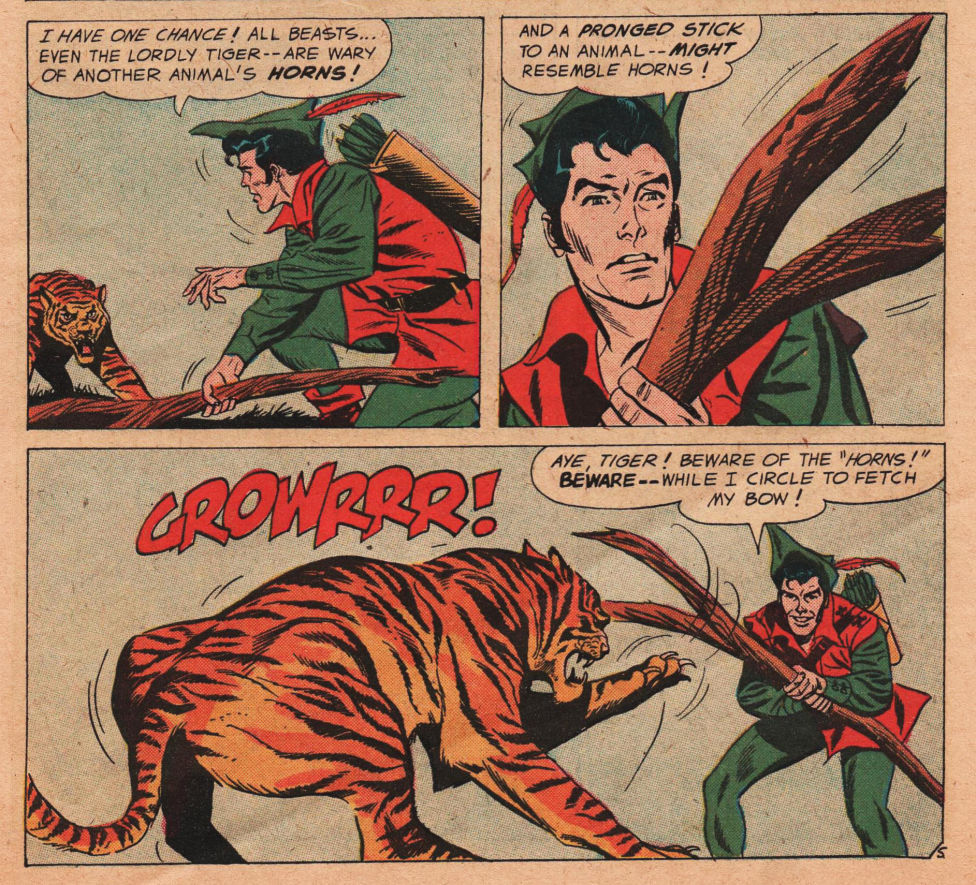
gimmick used in many DC stories were battles between Robin and exotic animals.
In issue 10 Robin faces a panther. In issue 12 he fights falcons trained
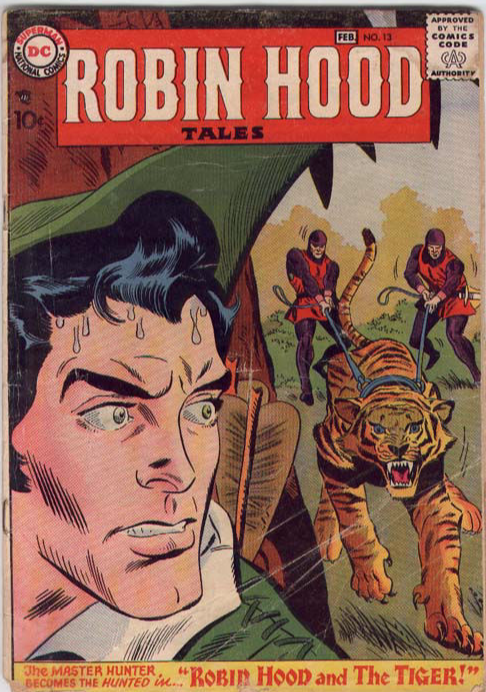
to catch his arrows and a man-sized hawk. In issue 13 Robin saves Tuck
from two tigers. And in issue 14 Robin battles an ape. [Simians were frequent
guest stars in DC Comics. Apparently they increased sales. Go figure.]
The
National/DC Robin Hood Tales adventures were drawn by Ross Andru and Mike
Esposito (except for issue 8, drawn by Irv Norvick) who went on to draw
Wonder Woman. And the stories were written by people like Bill Finger,
Batman's co-creator. DC was the only American company making money off
superhero comics at the time. It is not surprising that the stories resembled
the adventures of Batman more than the ballads of Robin Hood. Also, the
sorts of adventures the DC Robin Hood found himself in were far less controversial
than those of the Quality Robin Hood. DC was one of the more conformist
comic companies.
But
if the DC Robin Hood was not revolutionary, he was imaginative. The stories
in the DC half of Robin Hood Tales were fun, apes and all. Of all the companies
to publish Robin Hood stories, DC's Robin was least like his legendary
counterpart. But the history of the legend is one of changing with the
times. And the DC Robin Hood was best adapted to the comic books of the
day.
Visually,
both the Quality and DC Robin Hoods resemble Richard Greene. Robin has
dark hair and is clean-shaven. Also, green was not the primary colour of
this outlaw. His tunic was either red or orange. (In issue 8 he uses the
tunic to fight a bull). Comic collectors have told me there was a belief
that heroes dressed mainly in green would not sell.
Researching
my paper and this article has been a blast. The stories are a hoot. And
I felt awe-struck when I actually bought a comic from the long-defunct
Quality comics.
Some
information for this page came from "Seven Robins!" from the Nolan's Notebook
column in the May 1998 issue of Comic Book Marketplace and from Seal
of Approval: The History of the Comics Code by Amy Kiste Nyberg. I'd
especially like to thank Professor Nyberg for allowing me to bounce some
ideas off her. And of course, a very big thanks to Sherron Lux for getting
me started on this project. Our roundtable discussion was well-received
and a lot of fun. (More thanks to Henry, Holly, Laura and Lorraine from
the SEMA conference.) In July 1999, I presented a heavily revised version of this paper at the Robin Hood academic conference in Nottingham.
|