|
The History of a Hobgoblin
One
of the most popular characters in English folklore of the last thousand
years has been the faerie, goblin, devil or imp known by the name of Puck
or Robin Goodfellow.
The
Welsh called him Pwca, which is pronounced the same as his Irish incarnation
Phouka, Pooka or Puca. These are far from his only names.
Parallel words exist in many ancient languages - puca in
Old English, puki in Old Norse, puke in Swedish,
puge in Danish, puks in Low German, pukis in
Latvia and Lithuania -- mostly with the original meaning of a demon, devil
or evil and malignant spirit ... Because of this similarity it is uncertain
whether the original puca sprang from the imaginative minds
of the Scandinavians, the Germans or the Irish.
-Gillian Edwards, Hobgoblin and Sweet Puck p.143
Indeed,
Pouk was a typical medieval term for the devil. For example, Langland
once called Hell "Pouk's Pinfold." And the Phouka was sometimes pictured
as a frightening creature with the head of an ass. Truly a devil to behold.
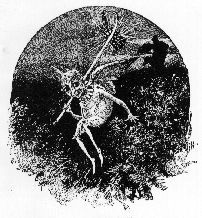
The Welsh Pwca also did not match our modern conception of dainty tinkerbell
fairies. According to Louise Imogen Guiney, a peasant drew the Pwca as
"a queer little figure, long and grotesque, and looked something like
a chicken half out of his shell".
As a shape-shifter, Puck has had many appearances over the years.
He's been in the form of animals, like how the Phouka can become a horse,
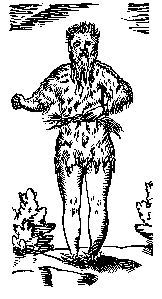
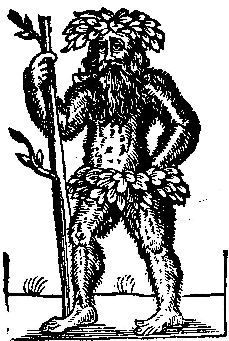
eagle or ass. He's been a rough, hairy creature in many versions. One
Irish story has him as an old man. He's been pictured like a brownie
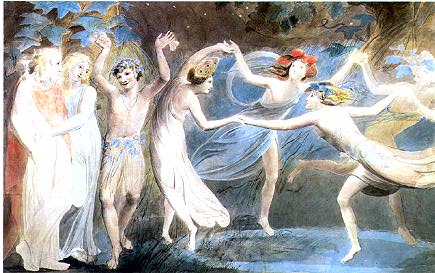
or a hobbit. In a 1785 painting by William Blake
, he looks like Pan from Greek mythology. In
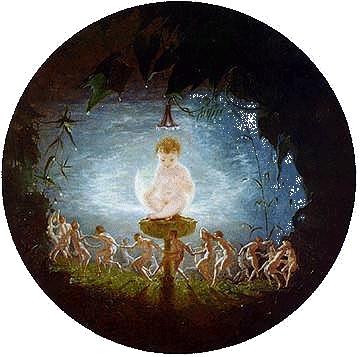
a 1841 painting by Richard Dadd
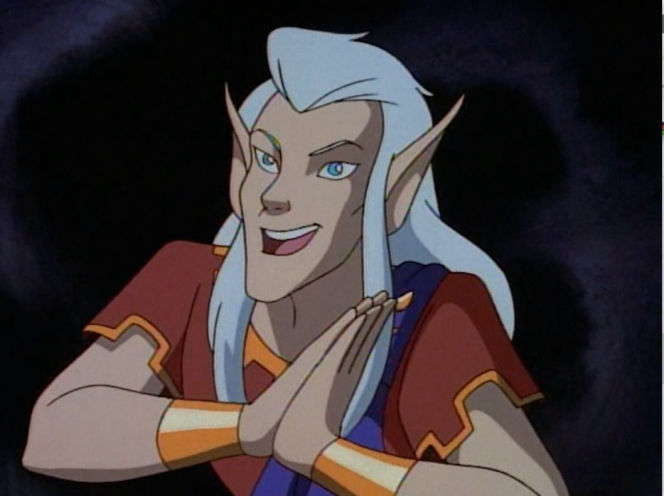
, Puck looks like an innocent child. And a modern cartoon show portrays
him as a silver-haired elf.
Puck
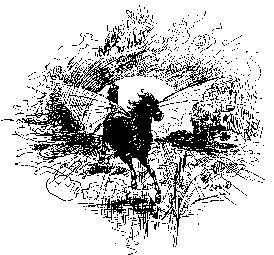
used his shape-shifting to make mischief. For example, the Phouka would
turn into a horse and lead people on a wild ride, sometimes dumping them
in water. The Welsh Pwca would lead travels with a lantern and then blow
it out when they were at the edge of a cliff. Being misled by a Puck (sometimes
the legends speak of Pucks, Pookas and Robin Goodfellows in the plural)
was known in the Midlands as being "pouk-ledden."
That's a lot like the phrase Pixy-led, which described a similar
action on the part of the Somerset faeries known as pixies. Some believe
the term Pixy is derived from Puck. Yet another expression for being lost
is "Robin Goodfellow has been with you tonight." There's a reference
to this at least as early as 1531.
Robin
Goodfellow is one of the faeries known as hobgoblins or just hobs. Hob
is a short form for the name Robin or Robert ("the goblin named Robin".)
Robin itself was a medieval nickname for the devil. Robin Goodfellow was
not only famous for shape-shifting and misleading travellers. He was also
a helpful domestic sprite much like the brownies. He would clean houses
and such in exchange for some cream or milk. If offered new clothes, he'd
stop cleaning. There are stories of the Phouka and Pwca doing similar deeds.
Ironically, Reginald Scot wrote in 1584 that belief in Robin Goodfellow
was not as strong as it had been a century earlier. In fact, Robin was
about to get some big breaks in Renaissance show business.
There's a record for a Robin Goodfellow ballad in 1588. And a little
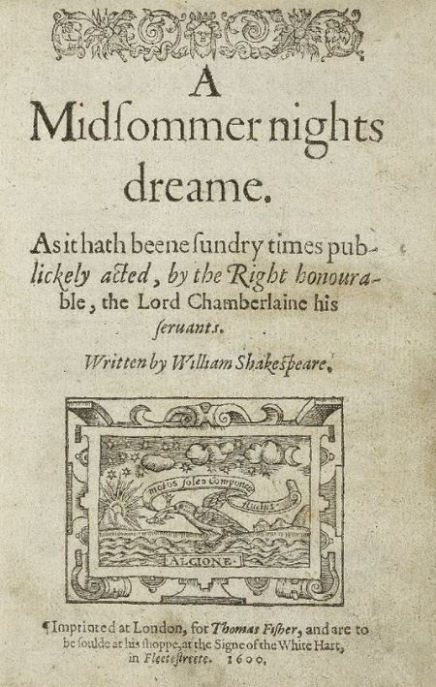
less than a decade later, William Shakespeare gave his Puck the name and
nature of the more benevolent Robin Goodfellow. However, Shakespeare's
Puck is more closely tied to the fairy court than most Pucks or Robin Goodfellows.
Here's a long quotation from A Midsummer Night's Dream. It's from
a meeting between Puck and one of Titania's fairies. I think it sums up
Robin Goodfellow's nature better than I could.
FAIRY
Either I mistake your shape and making quite,
Or else you are that shrewd and knavish sprite
Called Robin Goodfellow. Are not you he
That frights the maidens of the villagery,
Skim milk, and sometimes labour in the quern,
And bootless make the breathless housewife churn,
And sometime make the drink to bear no barm,
Mislead night-wanders, laughing at their harm?
Those that Hobgoblin call you, and sweet Puck,
You do their work, and they shall have good luck.
Are you not he?
PUCK
Thou speakest aright;
I am that merry wanderer of the night.
I jest to Oberon, and make him smile
When I a fat and bean-fed horse beguile,
Neighing in likeness of a filly foal;
And sometime lurk I in a gossip's bowl
In very likeness of a roasted crab,
And when she drinks, against her lips I bob
And on her withered dewlap pour the ale.
The wisest aunt, telling the saddest tale,
Sometime for three-foot stool mistaketh me;
Then slip I from her bum, down topples she,
And 'tailor' cries, and falls into a cough;
And then the whole quire hold their hips and laugh,
And waxen in their mirth, and neeze, and swear
A merrier hour was never wasted there.
-- A Midsummer Night's Dream, Act II, scene i
Having Shakespeare as a publicist certainly did not hurt Puck or Robin
Goodfellow's career. Prior to Shakespeare, who may have been influenced
by the Welsh Pwca, Puck and Robin Goodfellow were considered separate
creatures. Now they are considered the same creature.
A Midsummer Night's Dream remains one of Shakespeare's most performed
plays. Perfect for a forest-like setting, this classic is performed every
summer in parks around the world.
Robin
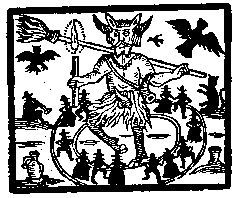
Goodfellow appeared in more plays around 1600. And there were many 17th
century broadside ballads about him.
Click here to see two of these ballads.
In these ballads, Robin Goodfellow is the son of Oberon, the fairy
king, and a mortal woman. He pulls pranks, shape-shifts into various
animals and the foolish fire known as the Will O' The Wisp, gets into
trouble and does the kind of thing described in Shakespeare's play. Robin's
trademark laugh is "Ho Ho Ho!" One 1628 ballad song may have written
by Shakespeare's drinking buddy, the great Jacobean (in the reign of
James I, the king after Elizabeth I) playwright Ben Jonson.
And Ben Jonson certainly knew his tricksters. The Puck-Hairy or
Robin-Goodfellow is a character in his unfinished Robin Hood play,
The Sad Shepherd.
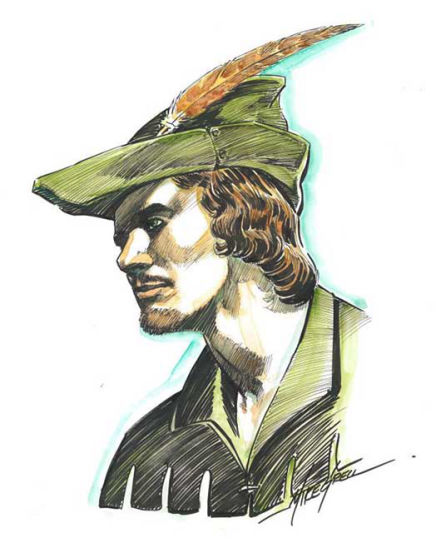
There may be a connection between Robin Hood and Robin Goodfellow.
Many Pagans feel Robin Hood was originally a faerie or Pagan God. I think
that case is overstated, as there is little magic in the earliest Robin
Hood tales. But still, the two Robins have some things in common. Both had
a penchant for giving travellers a hard time. Puck was a shape-shifter,
and Robin Hood a master of disguise. And Gillian Edwards notes that the Goodfellow
in Robin Goodfellow's name could either mean a boon companion or thief.
"If you were one of Hood's archers and looked upon him as a boon companion,
or the Sheriff of Nottingham and pursued him as a thief, you might consider
him equally well-named Robin Goodfellow." Since the Robin Goodfellow ballads
appear later than the Robin Hood ones, it's possible that the faerie may
have taken his name from the outlaw -- not the other way around. (For more
information on Robin Hood, please visit
my Robin Hood website
.)
Even
though after Shakespeare fairies seemed more dainty and inoffensive
than their heroic or demonic medieval forms, Puck and Robin Goodfellow
still had their critics. Puritans, like Robert Burton, felt fairies were
devils, including "Hobgoblins, & Robin Goodfellows". In his Anatomy
of Melancholy , Burton writes "Terrestrial devils, are those
Lares, Genii , Faunes, Satyrs, Wood-nymphs,
Foliots, Fairies, Robin Goodfellowes , Trulli, etc. which
as they are most conversant with men, so they do them most harme." (Quoted
in A Dictionary of Fairies by Katharine Briggs, p.53)
But the hobgoblin so despised by 17th century Puritans became a
much-beloved figure in children's literature in our own century thanks
to Rudyard Kipling. Two English children, Dan and Una, were performing
a simplified version of A Midsummer Night's Dream, when Puck,
the last of the People of the Hills (he is offended by the term, fairy)
appeared before them. Kipling used to play A Midsummer Night's Dream
with his own children. In a series of popular stories collected in
Puck of Pook's Hill (1906) and Rewards and Fairies (1910),
Puck delighted Dan and Una with tales, and visitors, from England's past.
Kipling's Puck was very critical of the common image of fairies
at the beginning of the 20th century, which Puck said were made up things.
"Can you wonder that the People of the Hills don't care to be confused
with that painty-winged, wand-waving, sugar-and-shake-your-head set of
impostors? Butterfly wings, indeed!"
This Puck was "the oldest Old Thing in England" and immune to many
of the traditional fairy weaknesses.
'By Oak, Ash and Thorn,' cried Puck, taking off his blue cap, 'I
like you too. Sprinkle plenty of salt on the biscuit, Dan, and I'll eat
it with you. That'll show you the sort of person I am. Some of us' --
he went on, with his mouth full -- 'couldn't abide Salt, or Horse-shoes
over a door, or Mountain-ash berries, or Running Water, or Cold Iron, or
the sound of Church bells. But I'm Puck!'
Puck continues to pop up in popular culture. For example, the six-foot
tall invisible rabbit in the classic Jimmy Stewart film Harvey is
said to be a Pooka. Of course, there are several movie and television versions
of A Midsummer Night's Dream. A 14-year old Mickey Rooney made a very
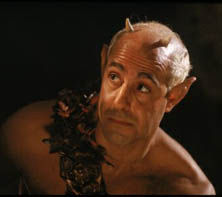
cherubic Puck in the 1935. And Stanley Tucci played a much-older, somewhat
wearier Puck in the 1999 film.
And if being a movie star didn't give Puck a swelled head, having
a moon named after him must have. The tenth moon of Uranus was discovered
in 1985. It's named Puck.
In Raymond E. Feist's novel Faerie Tale, Puck appears as one of
a variety of characters haunting upstate New York. It's possible that
the true Puck in the story is Ariel, a fellow Shakespearean fairy (this
one from The Tempest) and another moon of Uranus. One of Ariel's
shape-changing alter-egos is Wayland Smith, a legendary blacksmith and a
character in Puck of Pook's Hill.
Jacky Rowan, the heroine of Canadian author Charles de Lint's contemporary
fantasy novel, Jack the Giant-Killer is referred to as a puck.
And in the sequel, Drink Down the Moon, we meet Jemi Pook, a young
female sax player, who is the newest Pook of Puxill, the Faerie realm which
overlaps the Ottawa-area Vincent Massey Park. One of the characters, noting
the similarity to Kipling's book, wondered which had come first. (These
novels are collected in Jack of Kinrowan.)
The Shakespearean Puck was sighted in de Lint's fictional city of Newford,
in the short story collection The Ivory and the Horn.
The connection with Robin Hood is still strong. Puck shows up as
a silent and cryptic figure in Clayton Emery's 1988 novel Tales of
Robin Hood, now retitled The Beasts of Sherwood. And in Parke Godwin's Sherwood, Robin takes
his name from the forest sprite. His mother even calls him Puck-Robin.
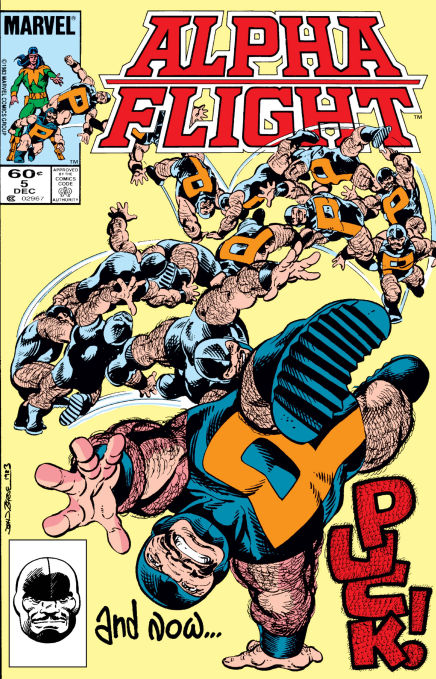
One of the stranger Pucks has been Eugene Milton Judd aka Puck,
a member of the Canadian superhero team Alpha Flight. This gruff yet
good-natured former mercenary is named for both the Shakespearean imp
and the hockey puck. His acrobat stunts fit both types of Pucks. But whoever
could ever see the Puck of legend with the boxer's cauliflower ear that
the Marvel Comics' Puck has? In 2004, a new Puck has joined a revamped Alpha Flight - this one is teenage Asian girl. Hobgoblin is the name of another Marvel Comics character, one of Spider-Man's foes.
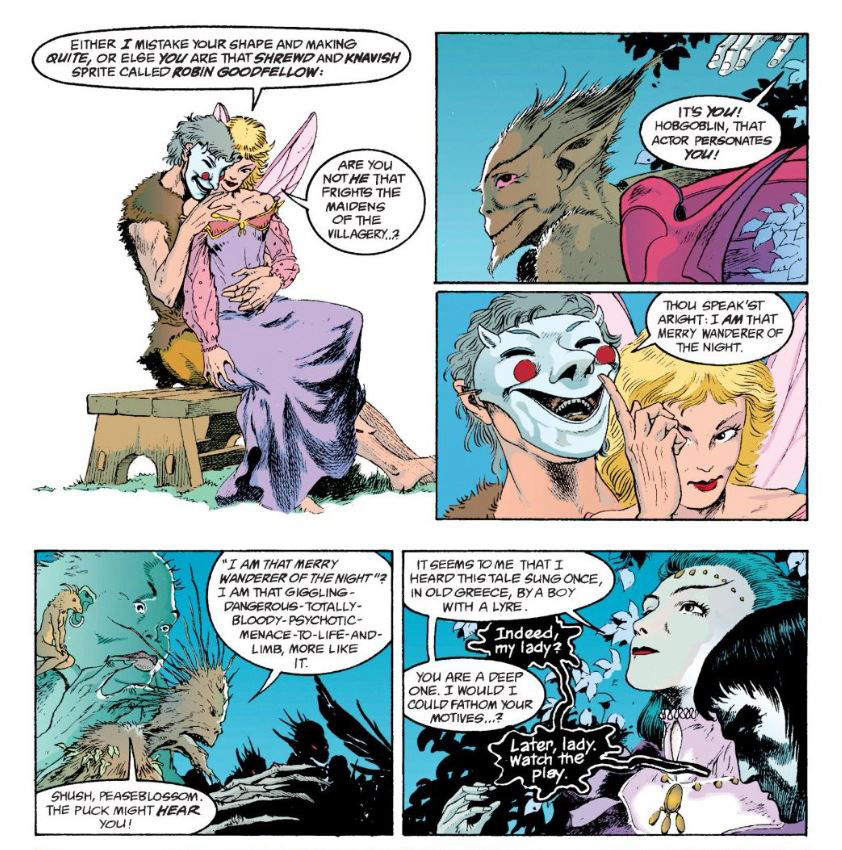
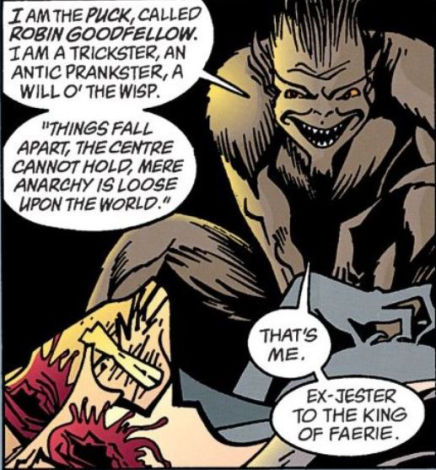
A more mythological Puck has appeared in DC Comics/Vertigo's dark fantasy
series The Sandman. His first appearance is in issue 19, where he and
the other real faeries are invited to attend the first performance of
A Midsummer Night's Dream. With a hedgehog-like appearance,
this Puck has some of the darker elements of the legend. For example, upon
hearing the Shakespearean passage quoted above, the real Peaseblossom comments,
"'I am that merry wanderer of the night'? I am that giggling-dangerous-totally-bloody-psychotic-menance-to-life
and limb, more like it."
At the end of the comic, the faeries prepared to the depart the
mortal realm for good. Auberon asks Puck to hurry along.
What, leave, my lord?
When there are mortals to confusticate and vex?
Go you all. Your Puck will stay -- the last hobgoblin in a dreary
world. Ho ho ho!
-- Neil Gaiman, Sandman #19, A Midsummer Night's Dream.
That issue was the first and only comic book to win the World Fantasy
Award for Best Short Story. It was much deserved, and Puck made further
appearances in the comic series.
And that trickster's appearances aren't limited to North American comics. The magazine Puck (from 1920-1936 by Amalgamated Press) featured a trio of tiny tricksters, Puck, Pot and Pan by Joe Hardman. In the Korean comics - called manhwa or manwha, similar to Japanese manga - of the 1990s and 21st century, our rascal faerie appears again, well sort of. In the North American translations of Faeries' Landing by You Hyun (published by Tokyopop), the impish antlered and donkey-eared, sex-driven young man from Avalon who started the trouble is named Goodfellow. The European faerie references apparently come from adapting the original and similar Korean concepts to terms that would be more familiar to Western audiences.
Puck is also a recurring character in the Disney cartoon Gargoyles.
The role is voiced by Brent Spiner (Data on Star Trek: The Next Generation)
with the appropriate wit and sarcasm. This Puck also has a secret identity
for most of the series as the corporate bad guy's faithful servant, voiced
superbly by Jeff Bennett. As Puck observes of all the parts a trickster
has played, never before has he been the straight man.
The Disney Puck has a surprisingly large fan following. There are
many websites dedicated to the trickster and his matter-of-fact alter
ego, Owen. Some of them are churches. A church to Puck? I wonder what the
Puritans would have thought.
Concerning Hobbits -- and Harry: Dob, like Hob and Robin, was a short-form
of Robert. So, Dobby the House-Elf from J.K. Rowling's Harry Potter novels
takes his name from the hobgoblin-related legends as well. He certainly has
some of the features of legendary hobs and hobgoblins. And if we are speaking
of hobs, what about J.R.R. Tolkien's most famous creations -- hobbits?
Undoubtedly, the Bagginses, Gamgees, Tooks and Brandybucks from Tolkien's
20th century novels (and 21st century films), The Hobbit and The
Lord of Rings, must be distant cousins of the hobgoblin.
Puck or Robin Goodfellow has had a long and colourful past. And
judging from his recent appearances, he has a long and colourful future
ahead of him too.
If you're interested in books and videos featuring Puck and related characters, please visit A Hobgoblin's Bookstore.
The following books were a great help in writing this page.
Briggs, Katharine, A Dictionary of Fairies, Penguin Books,
London, 1977.
Edwards, Gillian, Hobgoblin and Sweet Puck, Bles, London,
1974.
Guiney, Louise Imogen, Brownies and Bogles, D. Lothrop Company,
Boston, 1888.
Gifford, Dennis, The Encyclopedia of Comic Characters, Longman, 1986. (For information on Puck, Pot and Pan of the British comics. Information about North American comics was gained from my own comic collection, and a reader of this site tipped me off about the Korean Faeries' Landing series.
(C) Text Copyright 1997 - 2004, Allen W. Wright
"The Welsh Puck" and "The Irish Pooka" are by Edmund H. Garrett and appear
in Louise Imogen Guiney's 1888 book, Brownies and Bogles.
Woodcut Images are taken from various collections of old English
ballads.
Puck (C) Marvel Characters, Inc. 1997, art by Scott Clark
Puck (C) DC Comics Inc. 1997, art by Charles Vess
Puck from Gargoyles (C) BuenaVista Television, 1997.
Stanley Tucci as Puck (C) Fox Searchlight Pictures, 1999.
The use of the images from DC and Marvel Comics, Fox Searchlight
and Disney are in no way intended to infringe on their copyright of the
artwork. They are used without permission for purposes of review or comment
under the "fair use" provisions. This page is in no way affiliated with
those companies.
© copyright Allen W. Wright, 1997 - 2009.
|