Current Spotlight
All Spotlight Reviews
Novels and Short Stories
Films and Television Shows
Plays, Poems and Ballads
Robin Hood Scholarship
Miscellaneous
Featured Spotlights
Robin Hood - Prince of Thieves
starring Kevin Costner
The Adventures of Robin Hood
starring Errol Flynn
Robin of Sherwood
starring Michael Praed and Jason Connery
The Forestwife
by Theresa Tomlinson
A Gest of Robyn Hode
(early ballad)
Robin Hood and the Friar
(16th century play)
Robin Hood Tales
(1950s comic books)
Main Sections
Main Page
Introduction & What's New
A Beginner's Guide
Robin Hood Tales
- Ballads & Stories
Wolfshead Through the Ages
- The History of Robin Hood
Search for a Robin Hood
Spotlight of the Month
Robin Hood - A Personal Journey
The Picture Gallery
Interviews in Sherwood
The Blue Boar Inn
- Message Board
Legendary Links
Pook's Hill
Information
Site Map
How to use this site
Search This Site
About the Author
My Biography
Send me an e-mail
Copyright
All text, unless otherwise noted, and title graphics - © copyright Allen W. Wright, 2004.
© Photos taken from Scott Lynch-Giddings website
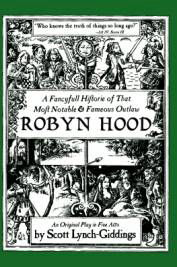
Cover art by Dan Giddings
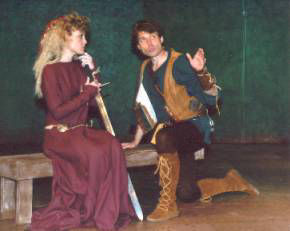
Robin Hood (Stephen Spencer) disarms Maid Marian (Roxanne Fay) in the 1995
premiere production at Chicago Dramatists Workshop.
|
February 2002
A Fancyfull Historie of That Most Notable & Fameous Outlaw Robyn Hood
aka
William Shakespeare's Robin Hood
An Original Play in Five Acts
by Scott Lynch-Giddings
In
the plays of Shakespeare, there are some references to Robin Hood and his
men. And As You Like It is like a Robin Hood play without Robin
Hood. Some of Shakespeare's contemporaries wrote Robin Hood plays.
But William Shakespeare himself never dealt with the outlaw legend directly
nor in great length -- until 1995, that is.
Scott
Lynch-Giddings is a Chicago playwright who wondered what a Shakespearean Robin
Hood might be like, and so he set out to write the Bard's version of Robin
Hood.
And stylistically, Lynch-Giddings succeeds fairly well.
His use of language is very good. Lynch-Giddings has done a considerable
amount of research into the expressions and idioms of 1590s speech.
But more than merely accurate, his use of language is close to Shakespeare
in the sheer level of wit and playfulness. One, perhaps minor example,
involves Robin Hood invoking a familiar Robin Hood expression. Will
Scarlock is mocking Robin for his love of Marian, and Robin says:
Thou hast given advice which oft hath hit
The mark on many things, but not on Love:
On Love, thou speakst of what thou dost not know,
For thou art one that never bent that bow.
As the footnote dutifully tells us, "'Many speak of Robin Hood that never
bent his bow' is an old saying."
Also, found are the witty insults and banter of Shakespeare, and the Bard's
crowd-pleasing sexual innuendo, in this case of the sale of pots and pans.
But the puns and word-plays are so common that it grows somewhat tiring after
a while. Plain speech would sometimes be a welcome novelty.
Unfortunately, while he has ample command of metaphor, Lynch-Giddings doesn't
quite have the poetic range of the Bard. The language is fun, but it
doesn't have an emotional core that lingers in the mind. And the great
inspirational call to action (delivered here by Marian) does little to inspire
my interest, let alone want me to risk my life in a dramatic adventure.
(A similar problem exists in the Kevin Costner film.)
All my criticisms aside, I should say that Lynch-Giddings's work is vastly
superior to the two genuinely Elizabethan plays scripted by Anthony Munday.
In use of language, plot and faithfulness to the legend, this Chicago playwright
far exceeds an Elizabethan counterpart. But when held against William
Shakespeare, sadly Scott Lynch-Giddings falls far short -- as do most other
playwrights, however.
In terms of plot, much more is taken from the Robin Hood legend than Munday
ever borrowed. In particular, scenes from the early ballads The Gest
of Robyn Hode and Robin Hood and Monk are used. (I do think
that the references to the Virign Mary, common in the medieval ballads, would
have been frowned upon in the Elizabethan era.) However, Lynch-Giddings
is acceptably anachronistic in some of his borrowings. I see elements
in the ransom plot and ambush by false outlaws plot that seems to owe a debt
to the 1819 novel Ivanhoe, or one of that book's descendants.
I also see a touch of Errol Flynn, particularly in the Robin and Marian romance
and banter.
The main plot of Earl John and the Sheriff's machinations for Richard's throne
and the king's ransom are pure Walter Scott. Making Robin Hood "Sir
Robert Turneham" is new, although like Munday's play, Robin is also the earl
of Huntington.
The borrowings from future versions of the legend nicely help to fill out
the plot. But they also show part of the problem with not only Lynch-Giddings's
Robin Hood -- but problems that true Elizabethan playwrights also would have
faced.
The Robin Hood legend has done very well in film. And there are moments
in the play which are written for sheer Hollywood magic. The ambush
of the sheriff and Marian, one can picture it happening like in the Errol
Flynn movie. The archery competition cries out for the trick shooting
of Howard Hill (archery coach on Errol Flynn's The Adventures of Robin
Hood). The battle between the sheriff's men disguised as outlaws
and the Merry Men calls for widescreen treatment. But here, by necessity,
all those scenes take place off stage. Even if a production were to
stage some of those scenes, they wouldn't be able to top the production values
of film.
There was a time when there were more references to Robin Hood folk drama
than any other kind of folk drama in Great Britain. But the sorts of
fights in old-fashioned Robin Hood games -- bouts with swords, wrestling
or yes, archery -- would seem some what small scale as our expectations in
Robin Hood action have risen. Even by the time of Queen Elizabeth I, Robin
Hood had begun to outgrow his role as a simple local combatant. And those
simple forms of combat would still be difficult to pull off in time when
people are concerned about an actor's safety.
So, we are left with expectations of great action that can't be shown on
stage. Well, a lot of the "action" in Shakespeare's plays happens off-stage
as well. The heart of the play comes in human responses to the off-stage
action.
And here's where the problem with Robin Hood truly lies. Robin Hood
is not often a complex character, nor are any of his Merry Men. That's
true of the legend in general, and it's true in Lynch-Giddings' play as well.
The emotional resonance within the characters -- which is vital when the
action is not staged -- is somewhat muted. Yes, Robin does have a grudge
against the sheriff, his wits are addled by love, and Marian discovers what
the world is truly like. But it is all very simplistic. While
their external fortunes have changed, internally the characters remain pretty
much the same from beginning to end. Some cinematic spectacle
would have concealed these faults better. As with the last time I reviewed
a play, I am reviewing from script only. Actors may be able to bring
this piece to greater life.
It's a dilemna for anyone trying to do an Elizabethan Robin Hood. But
still the attempt to do Robin Hood in the style of Shakespeare is a fascinating
experiment. And I think Scott Lynch-Giddings succeeds better than most
would. Ultimately though, even in terms of language, it does remain
an experiment, a gimmick. Still, a very noble and intriguing attempt.
Scott Lynch-Giddings's official website for the play has a synopsis, excerpts,
background information, reviews, information on ordering the script and details
on how to produce the full play or an outdoor abridged version. Check it
out at www.robinhoodplay.com
.
|