SHERWOOD,
NOTTINGHAM AND BARNSDALE
By Allen W. Wright
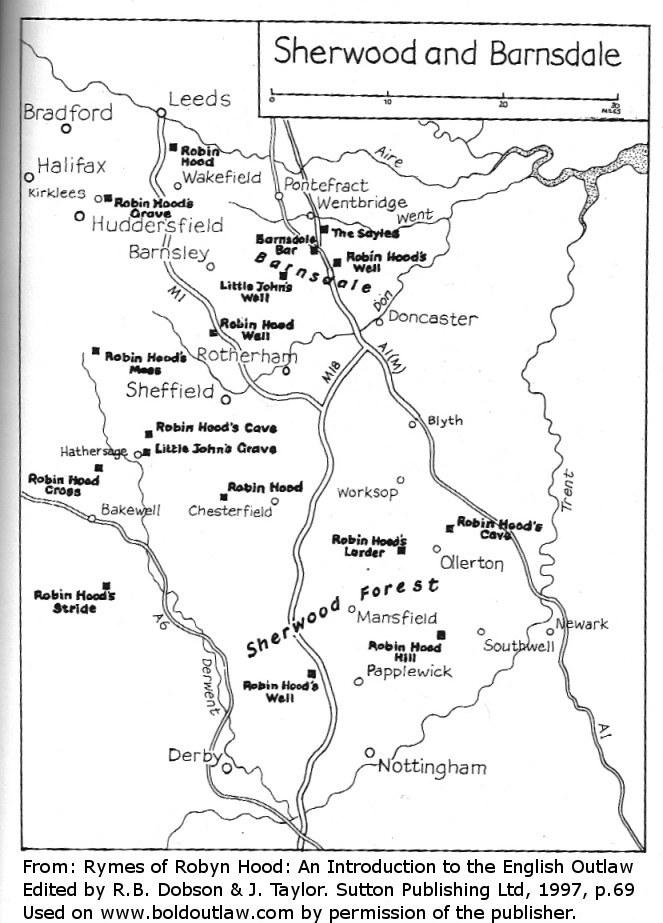
Click here to see a map of Sherwood and Barnsdale from R.B. Dobson and J. Taylor's Rymes of Robyn Hood (1997 edition, Sutton Publishing.) reproduced with permission of the publisher.
Click here to see Robin Hood Locations on Google Maps. (Prepared by this site's webmaster.) The map is interactive and allows you to zoom in, switch to satellite or Google Earth views. And if you drag the orange figure to the map, you can navigate at street level via Google's 360-degree photos. Many sites are visible from the road.
The stories you're likely most familiar with say that Robin Hood lives in Sherwood Forest in Nottinghamshire. Certainly Sherwood Forest and Nottingham are mentioned in some early tales, but that's not the only setting for the legend.
 Some
say Robin Hood's headquarters is a tree. Others say a cave. One early ballad mentions a lodge in the greenwood. One of Robin's
legendary headquarters still stands, even if somewhat battered by time
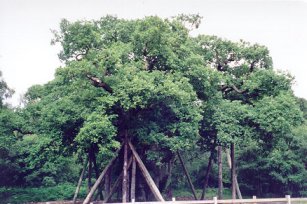
and vandalism, the Major Oak. It's said that Robin and his men used to
hide in this hollow oak tree, or perhaps stored their treasure there. In
truth while the Major Oak is over a thousand years old, it's too young
a tree to be Robin Hood's home, but Sherwood has had many oak trees over
the centuries. It would be nice to imagine Robin's home looking something like
this. Some
say Robin Hood's headquarters is a tree. Others say a cave. One early ballad mentions a lodge in the greenwood. One of Robin's
legendary headquarters still stands, even if somewhat battered by time
and vandalism, the Major Oak. It's said that Robin and his men used to
hide in this hollow oak tree, or perhaps stored their treasure there. In
truth while the Major Oak is over a thousand years old, it's too young
a tree to be Robin Hood's home, but Sherwood has had many oak trees over
the centuries. It would be nice to imagine Robin's home looking something like
this.
Many
guests of Robin Hood have wandered into Sherwood. None more famous than
the King of England himself. As a royal forest, many kings have hunted
in Sherwood -- King Richard I, King (the monarch formerly known as Prince)
John, Kings Edward I, II and III, just to name some of the kings whose
visits to Sherwood are documented in both Robin Hood stories and historical
records. One of King John's favourite hunting grounds was Clipstone
in Sherwood. When he died in Newark in 1216, John had intended to visit Clipstone. You can still visit the ruins of this
lodge.
 Sherwood
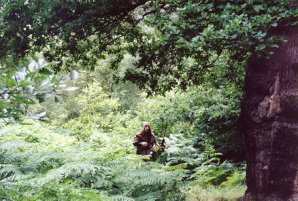
literally meant "Shire Wood." And it did cover much of the shire, around 20 miles in length and once much longer and wider. Some of the trees
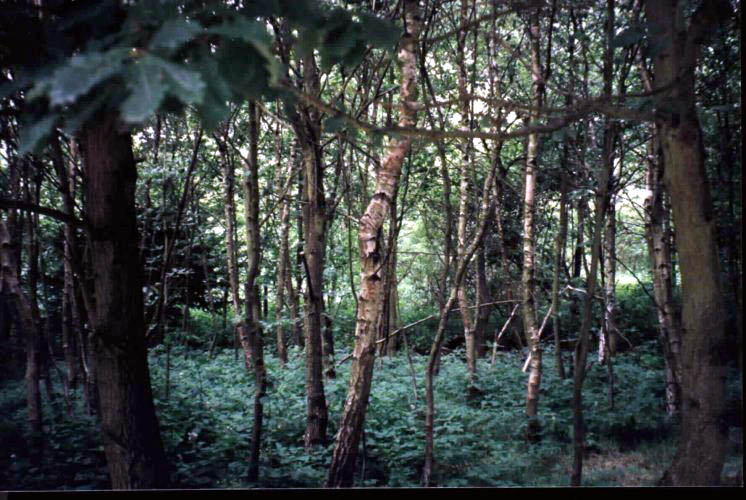
in Sherwood include oaks like the Major Oak and silver birch trees. One
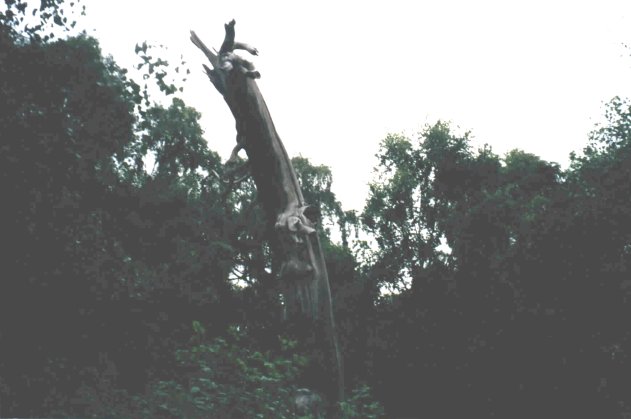
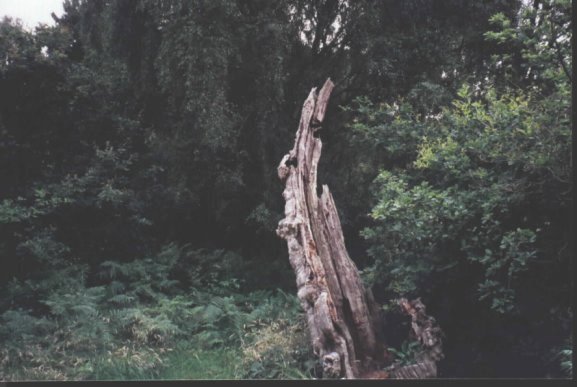
peculiar kind of oak is the "stag-headed" or
"blasted" oak. Legend has it such trees were struck by lightning. And while that's sometimes the case, the distinctive appearance often has a less flashy cause. The stag-headed shape can result from old age, wood boring insects, fungal decay and rain causing rotting of the heart wood. (Click
on the words blasted and stag-headed to see pictures of these trees.) Click
here to see another outlaw in Sherwood. And click
here to see some more trees in Sherwood Forest. Sherwood
literally meant "Shire Wood." And it did cover much of the shire, around 20 miles in length and once much longer and wider. Some of the trees
in Sherwood include oaks like the Major Oak and silver birch trees. One
peculiar kind of oak is the "stag-headed" or
"blasted" oak. Legend has it such trees were struck by lightning. And while that's sometimes the case, the distinctive appearance often has a less flashy cause. The stag-headed shape can result from old age, wood boring insects, fungal decay and rain causing rotting of the heart wood. (Click
on the words blasted and stag-headed to see pictures of these trees.) Click
here to see another outlaw in Sherwood. And click
here to see some more trees in Sherwood Forest.
After William, duke of Normandy, conquered England in 1066 and became its king, the concept of the royal forest was established. The Anglo-Saxon Chronicle had this to say of William I:
He made great protection for the game
And imposed laws for the same,
That who so slew hart or hind
Should he be made blind.
He preserved the harts and boars
And loved the stags as much
As if he were their father.
Morever, for the hares did he decree that they should go free.
Powerful men complained of it and poor men lamented it,
But so fierce was he that he cared not for the rancour of them all,
But they had to follow out the king's will entirely
If they wished to live or hold their land,
Property or estate, or his favour great.
Quoted in The Royal Forests of Medieval England by Charles R. Young, pp. 2-3.
Actually, Sherwood Forest itself is not mentioned in the 11th century survey, the Domesday Book. But certainly by the middle of the 12th century, all of Nottinghamshire north of the river Trent was under forest law, as was much of the neighbouring county of Derbyshire.
Forest law was a separate set of laws imposed on the Royal Forests -- nominally to preserve the important game animals and their habitats. There were restrictions on taking wood, building, what animals you could keep and so on. (Dogs, when not outright forbidden, had to be "lawed", with some toes trimmed so they would not chase after the deer.) It was also illegal to carry a bow in the forest.
The most notable provision was that against killing the king's deer. Late in Henry II's reign, his laws implied you would be killed on the third offence. By the time of King Richard the Lionheart (specifically 1198 AD), the penalty for killing a deer was mutilation -- where the law would remove your eyes and certain other delicate parts.
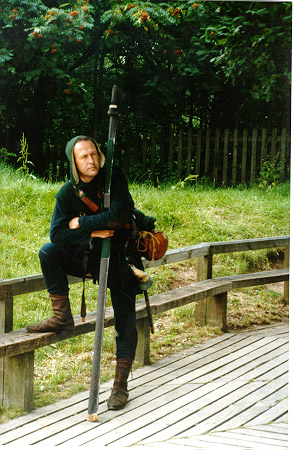
These days Robin Hood stories often feature the hero rescuing a starving peasant who killed a deer from the foresters who patrolled the forests enforcing the laws. There are reports of corruption among the foresters, although I've heard talk that some would help villagers where they could. Click here to see a picture of Blacke
Dickon, a medieval forester in Sherwood. In the Robin Hood stories, the foresters might threaten to kill the poacher or chop off his hands or fingers. One story says Robin was outlawed for killing a group of foresters. Robin is often seen to feast on the king's deer (or venison as deer meat, or originally the meat of any hunted animal, is called) - laws don't matter much to an outlaw. But other tales suggest that Robin's father, or perhaps Robin Hood himself, was once a forester.
Historically, death or mutilation was the maximum punishment -- often times, offenders were imprisoned and fined. The fines and fees were a great money maker for the crown and forest officials. And the wealthy and powerful often wanted to curb the forest laws as much as the poor did. One 12th century writer wrote "The forest has its own laws, based, it is said, not on the Common Law of the realm, but on the arbitrary legislation of the King; so that what is done in accordance with forest law is not called 'just' without qualification, but 'just', according to forest law."(quoted in Young, p. 66) Many of the barons who rebelled against King John were concerned about the forest laws.
In 1217 (the year after King John died while Henry III was still a child), a Charter of the Forest -- the little charter compared the great charter or Magna Carta -- was issued that restricted many abuses. It was reissued in 1225 with some modifications. The tenth provision of the charter was:
No one shall henceforth lose life or limb because of our venison, but if anyone has been arrested and convicted of taking venison he shall be fined heavily if he has the means; and if he has not the means, he shall lie in our prison for a year and a day; and if after a year and a day he can find pledges he may leave prison; but if not, he shall abjure the realm of England."
Also by the 1220s, the boundaries of Sherwood Forest were greatly restricted with the river Trent as the southern boundary and the river Meden as the northern one. The size of the forest on the east and west was greatly reduced. It stayed at those boundaries for the rest of the Middle Ages, but "Sherwood Forest" today is far, far smaller.
The
defining characteristic of a forest is that it was governed by forest laws.
Not all of Sherwood was not a heavily wooded area. There were large fields,
meadows and even towns inside of Sherwood.
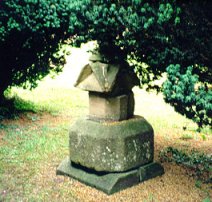 In
and around Sherwood, there are lots of wells, graves, hills, caves, barns,
meadows, larders and the like named after Robin Hood. Almost every town
and village in Nottinghamshire has some tie to the legend. Some say Friar
Tuck was from Fountain Dale, near Blidworth. Will Scarlet's grave is also
said to be in Blidworth. The folks in Mansfield, the town that was once
the very centre of Sherwood Forest, say Will Scarlet was born in their
town. (The ballad says Will hails from Maxfield, possibly in Yorkshire.)
Robin Hood would often frequent a tavern known as the Blue Boar Inn. Alan
a Dale was married in Papplewick. Another legend says Robin Hood was bedevilled
by an evil witch named Maudlin who also came from Papplewick. Yet another
version of the legend (a 1980s TV series) shows Robin and his band being very friendly to the
folks of Wickham, although you won't find that town on any Nottinghamshire
map. And some stories say Robin's birthplace of Locksley (or Loxley) was
in Sherwood. You won't find that on a map either. In
and around Sherwood, there are lots of wells, graves, hills, caves, barns,
meadows, larders and the like named after Robin Hood. Almost every town
and village in Nottinghamshire has some tie to the legend. Some say Friar
Tuck was from Fountain Dale, near Blidworth. Will Scarlet's grave is also
said to be in Blidworth. The folks in Mansfield, the town that was once
the very centre of Sherwood Forest, say Will Scarlet was born in their
town. (The ballad says Will hails from Maxfield, possibly in Yorkshire.)
Robin Hood would often frequent a tavern known as the Blue Boar Inn. Alan
a Dale was married in Papplewick. Another legend says Robin Hood was bedevilled
by an evil witch named Maudlin who also came from Papplewick. Yet another
version of the legend (a 1980s TV series) shows Robin and his band being very friendly to the
folks of Wickham, although you won't find that town on any Nottinghamshire
map. And some stories say Robin's birthplace of Locksley (or Loxley) was
in Sherwood. You won't find that on a map either.
But
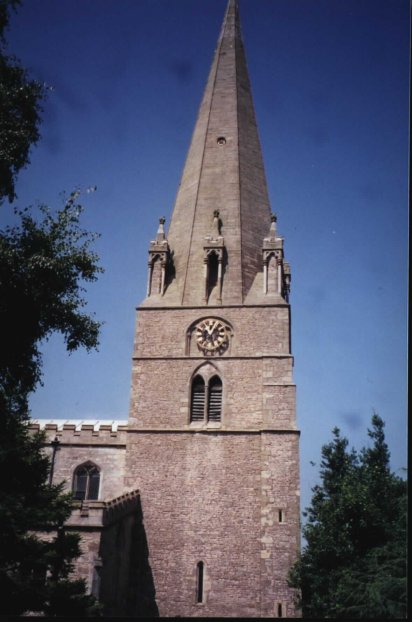
you will find Worksop and Edwinstowe -- two villages which help to promote
Robin's legend to this very day. Robin and Marian were said to have been
married at Edwinstowe. Click here to see the church
at Edwinstowe.
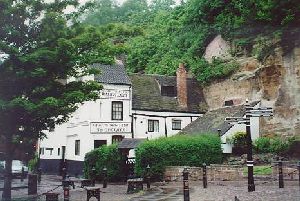 Although
it's not in Sherwood Forest, the most famous town associated with Robin
Hood is Nottingham. (It's pronounced more like NOTting-um (or -awm) than Notting-HAM
as American movies would have it. But apparently some Nottingham locals prefer to
pronounce it "Notting-gum.") Here is the home of the Sheriff of Nottingham.
Robin snuck into St. Mary's church in the old Saxon part of town to pray.
Click
here to see St. Mary's church. He'd also sneak into many Nottingham
archery tournaments, or rescue his men from the sheriff. And perhaps he'd
stop for a drink at The Trip to Jerusalem, a pub which some say was serving
alcohol as far back as Robin Hood's day. The oldest part of the pub is
carved into the castle rock itself. Although
it's not in Sherwood Forest, the most famous town associated with Robin
Hood is Nottingham. (It's pronounced more like NOTting-um (or -awm) than Notting-HAM
as American movies would have it. But apparently some Nottingham locals prefer to
pronounce it "Notting-gum.") Here is the home of the Sheriff of Nottingham.
Robin snuck into St. Mary's church in the old Saxon part of town to pray.
Click
here to see St. Mary's church. He'd also sneak into many Nottingham
archery tournaments, or rescue his men from the sheriff. And perhaps he'd
stop for a drink at The Trip to Jerusalem, a pub which some say was serving
alcohol as far back as Robin Hood's day. The oldest part of the pub is
carved into the castle rock itself.
When
King Richard left on crusade, he gave the shire of Nottinghamshire to his
brother, Count (or Prince) John. But Richard kept control of the castle
for himself. However, when Richard returned to England, the castle was
held by John's supporters. (Ralph Murdac, castellan of the castle at the time of Richard's return was once the sheriff of Nottingham.) In both Robin Hood stories and real history,
Richard took care of that. There will be more on Richard's siege of the
castle in the Kings and Princes section.
Nottingham
Castle has been a part of many historical events. Edward III's men snuck
into the castle through a network of caves. They captured those who had
imprisoned and possibly murdered the former king, Edward II. The castle
was heavily damaged during the British Civil War and was later destroyed.
A 17th century ducal palace now stands on those grounds with a gatehouse
being one of the few remaining traces of the castle which stood in Robin's
day.
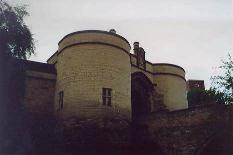 Despite
these sieges and invasions, the castle was indeed hard to break into. It
was (is) on top of a easily-defended cliff known as the castle rock. Click
here to see some of the sandstone caves around the castle rock. Despite
these sieges and invasions, the castle was indeed hard to break into. It
was (is) on top of a easily-defended cliff known as the castle rock. Click
here to see some of the sandstone caves around the castle rock.
But
many Robin Hood legends happen outside of Nottinghamshire.
For
example, the neighbouring county of Derbyshire would have been controlled
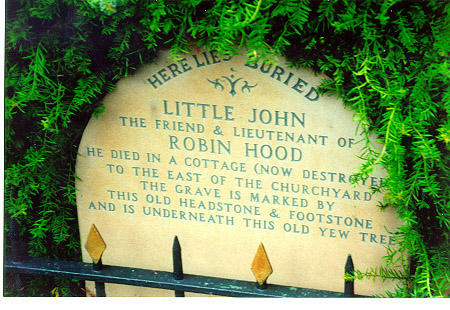
by the same sheriff. It's said that Little John was born and died in Hathersage,
Derbyshire. Click here to see Little John's tombstone.
And
the shire of Yorkshire has as strong a claim to the Robin Hood legend as
Nottinghamshire.
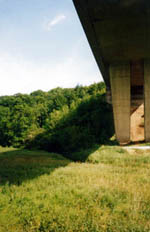 Many
legends say that Robin operated in Barnsdale, a small wooded area on the
Great North Road (known as Watling or Ermine Street) in Yorkshire. Many
travellers were on their guard against robbers like Robin and the Merry
Men. A tree known as the bishop's tree marks the spot where Robin robbed
the Bishop of Hereford. Several place names around Barnsdale, like the
Sayles Plantation, Wentbridge and Doncaster are mentioned in stories. Robin
Hood's Well is in the middle of Barnsdale and nearby a now-lost "stone of Robin Hood", one of the earliest
places named for the outlaw. Many
legends say that Robin operated in Barnsdale, a small wooded area on the
Great North Road (known as Watling or Ermine Street) in Yorkshire. Many
travellers were on their guard against robbers like Robin and the Merry
Men. A tree known as the bishop's tree marks the spot where Robin robbed
the Bishop of Hereford. Several place names around Barnsdale, like the
Sayles Plantation, Wentbridge and Doncaster are mentioned in stories. Robin
Hood's Well is in the middle of Barnsdale and nearby a now-lost "stone of Robin Hood", one of the earliest
places named for the outlaw.
However,
Barnsdale was not a royal forest and would not have been patrolled by foresters.
Also, it was 50 miles from Nottingham, quite a commute for the outlaw,
but he seems to have managed it.
 Still more well-known Robin Hood locations are in Yorkshire.
Robin's legendary home village of Loxley is in Yorkshire, near Sheffield.
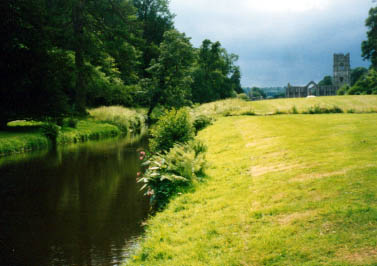
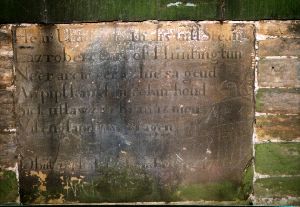
His grave is by Kirklees Priory, where he was supposedly killed. Fountains
Abbey in Yorkshire may be where Friar Tuck came from. Click to see the traditional spot of Robin and Tuck's meeting. And then, there's the story of
when Robin Hood became a fisherman in Scarborough, North Yorkshire. He
was a lousy fisherman, but ended up stopping some French pirates. Thus,
the bay in Scarborough is known as Robin Hood's Bay. Still more well-known Robin Hood locations are in Yorkshire.
Robin's legendary home village of Loxley is in Yorkshire, near Sheffield.
His grave is by Kirklees Priory, where he was supposedly killed. Fountains
Abbey in Yorkshire may be where Friar Tuck came from. Click to see the traditional spot of Robin and Tuck's meeting. And then, there's the story of
when Robin Hood became a fisherman in Scarborough, North Yorkshire. He
was a lousy fisherman, but ended up stopping some French pirates. Thus,
the bay in Scarborough is known as Robin Hood's Bay.
And
then there's Huntingdon which isn't part of Nottinghamshire or Yorkshire.
But Robin was said to be earl of Huntingdon.
Boy,
he sure gets around, doesn't he?
The Sherwood Forest of today is a lot smaller than
Robin's Sherwood. Now, there's a group called the Sherwood Forest Trust.
They are trying to save Robin Hood's most famous home.
Click
here to visit their website.
The Beginner's Guide portion of this website usually features brief looks at the Robin Hood legend as it exists today -- the result of centuries of storytelling. As this page deals with history and geography, it breaks that format somewhat. But still true historical events and less true legends -- both medieval and modern -- referenced here. While Sherwood and Nottingham are both mentioned in early ballads, the information on other villages in Nottinghamshire comes from local tradition or later writers incorporating the place names. The references to Yorkshire in the early ballads are more geographically precise.
For those looking for how the stories changed over time, visit the Wolfshead Through the Ages: The History of Robin Hood section for more details.
The Robin Hood - A Personal Journey section has more detailed information on visits to Robin Hood locations.
For a full list of Robin Hood locations including many of the wells, stones, caves and graves, check out Appendix IV of Rymes of Robyn Hood by R.B. Dobson and J. Taylor.
Chapter V: The Physical Setting of Robin Hood, Revised Edition, by J.C. Holt is another good source of information.
Much of the information on the forest comes from The Royal Forests of Medieval England by Charles R. Young. University of Pennsylvania Press, 1979. Some specific information on Sherwood Forest comes from various articles by Dr. David Crook.
Click here to see a map of Sherwood and Barnsdale from R.B. Dobson and J. Taylor's Rymes of Robyn Hood (1997 edition, Sutton Publishing.) reproduced with permission of the publisher.
Click here to see Robin Hood Locations on Google Maps. The map is interactive and allows you to zoom in, switch to satellite or Google Earth views. And if you drag the orange figure to the map, you can navigate at street level via Google's 360-degree photos. Many sites are visible from the road.
View Robin Hood Locations in a larger map
NEXT: The Enemies of Robin Hood
(C)
Text and most photos copyright -- Allen W. Wright, 1998 - 2010.
(C)
Kirklees photo by David Hepworth, courtesy of Lady Armytage.
Send
me e-mail
|