Current Spotlight
All Spotlight Reviews
Novels and Short Stories
Films and Television Shows
Plays, Poems and Ballads
Robin Hood Scholarship
Miscellaneous
Featured Spotlights
Robin Hood - Prince of Thieves
starring Kevin Costner
The Adventures of Robin Hood
starring Errol Flynn
Robin of Sherwood
starring Michael Praed and Jason Connery
The Forestwife
by Theresa Tomlinson
A Gest of Robyn Hode
(early ballad)
Robin Hood and the Friar
(16th century play)
Robin Hood Tales
(1950s comic books)
Main Sections
Main Page
Introduction & What's New
A Beginner's Guide
Robin Hood Tales
- Ballads & Stories
Wolfshead Through the Ages
- The History of Robin Hood
Search for a Robin Hood
Spotlight of the Month
Robin Hood - A Personal Journey
The Picture Gallery
Interviews in Sherwood
The Blue Boar Inn
- Message Board
Legendary Links
Pook's Hill
Information
Site Map
How to use this site
Search This Site
About the Author
My Biography
Send me an e-mail
Copyright
All text, unless otherwise noted, photos and title graphics - © copyright Allen W. Wright, 2004.
The
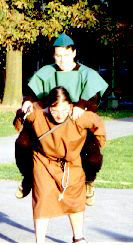
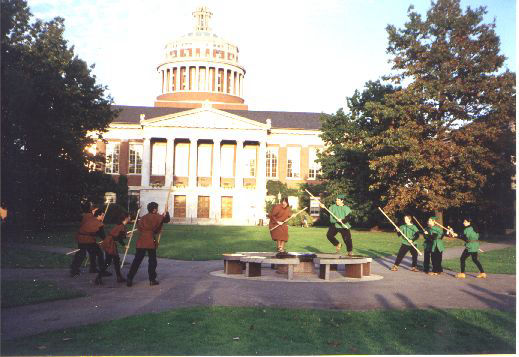
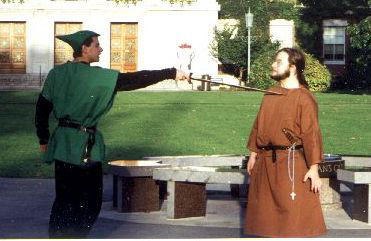
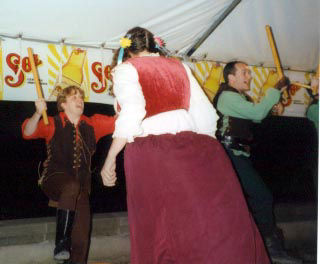
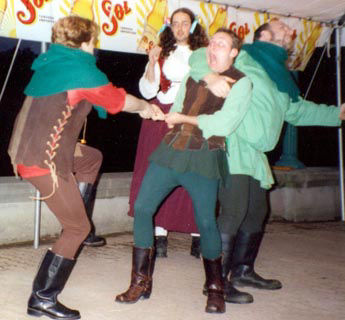
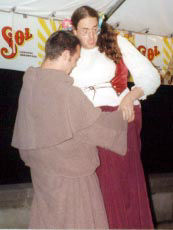
cast of the 1997 University of Rochester production of Robin Hood and the
Friar are: Eric Lichtenstein (Robin Hood), Kevin
Carboni (Friar Tuck). And some of the following, even though
not all were caught by my camera: Karen Hibbert, Richard Cassara, Cathy
Fahey, Michelle deCastro, Ann McNamara, Charli Williams, Jason Lee,
Ben Segal, Jeremy Steflik and Marianne Witgert. This version was
directed by Cathy Fahey.
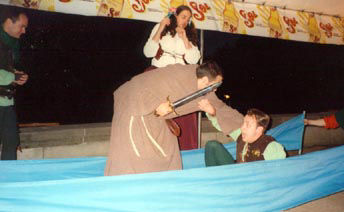
The
2001 University of Western Ontario version of Robin Hood and the Friar
was produced by the Poculi Ludique Societas (PLS). Visit
PLS's official website. Starring in the production were:
Robin Hood: Todd Campbell
Friar Tuck: S. Tyson
Little John: Rob Westgate
Maid Marion: Ty Andrassi
Merry Man 1 (Will Scarlet?): Kevin Robinson
Merry Man 2 (Arrow Boy): Matt Richardson
Crew:
Director: Daniel Levinson
Costumer/Producer: Linda Phillips
Dance Consultant: Clyde Whittam
|
August 2001
Robin
Hood and the Friar
and
Robin
Hood and the Potter
Now
stand ye forth my merry men all,
And
harke what I shall say;
Of
an adventure I shal you tell,
The
which befell this other day.
Robin
Hood forces Friar Tuck to carry him across the stream on the friar's back.
Part way across, Tuck throws Robin into the water.
This
first meeting with Tuck is very common in modern versions of the legend.
That scene appears in most children's novels about Robin Hood, it appears
in movies like The Adventures of Robin Hood starring Errol Flynn.
And the familiar image of the friar bearing Robin on his back developed
a strange new sub-text in the gay Robin Hood controversy of 1999.
While
this scene does occur in a later ballad, Robin Hood and the Curtal Friar,
the first record we have of it is in a play. In a printed copy of
the well-known early ballad The Gest of Robyn Hode, publisher William
Copland attached a play, which he said was "verye proper to be played in
Maye Games."
The
May Games were village festivals, usually held in May or June [although
not often on May 1, as some historians once felt] around Whit Sunday.
And for a couple hundred years, Robin Hood played a large part in such
games. Sometimes costumed players from one village would proceed
to another village to ask for money. Robin Hood might sell badges
(such as strips of cloth) or church ales to raise money. Often the
money would go for something like repairing the village church. Small Robin
Hood plays would be performed at this festivals, often with mock combat.
Between 1427 and the mid-1600s, we have more references to these Robin
Hood plays than any other kind of English folk drama.
Records
of the May Games (usually accounting notes on how much the costumes cost,
or how much money was raised) reveal that Maid Marian and Friar Tuck were
a common part of these games. But those characters do not appear
in any early ballads, and aside from one major adventure a piece, only
merit a couple of references in later ballads. And in Friar Tuck's case,
even that major story is questionable. In the ballad version of this
story, Robin Hood and the Curtal Friar, the friar goes unnamed.
The
first time Friar Tuck is mentioned by name as being a part of Robin Hood's
outlaw band is in a fragment of play [although Stephen Knight argues that
the play may be complete and just ends with an action scene] which survives
from 1475. The Friar Tuck in this play is an outlaw, no different
than the other Merry Men. Possibly Friar Tuck's legendary name comes
from Robert Stafford, a fugitive chaplain who employed the alias Friar
Tuck in the early 1400s.
At
any rate, nearly all the plays performed at the May Games were not written
down. So, here's a summary of this one.
Robin
Hood tells his band that he encountered a friar, they fought and the friar
managed to make off with Robin's purse. The Merry Men vow to find
the friar and make him pay. Meanwhile, Friar Tuck [Fryer Tucke, to
use the play's spelling] comes looking for Robin Hood. If Robin is
worthy, Tuck will serve him. If Tuck is the better man, he says of
Robin "By my truth my knave shall he be,/ And lead these dogges all three."
The Friar and Robin meet and trade insults. Robin climbs on the Friar's
back and forces him to carry Robin across. Tuck throws Robin into
the water. They fight. Robin says he'd like to blow his horn
to summon his favourite dog to say goodbye. Instead, the horn summons
the Merry Men. Tuck whistles for his own men [with dog-like names
Cut and Bause, and in the ballad version, they are dogs]. The fight
continues. Robin asks if the friar will join his band. He offers
Tuck not only gold, but also a "lady free". Tuck responds:
Here
is an huckle duckle,
An
inch above the buckle.
She
is a trul of trust,
To
serve a frier at his lust,
A
prycker, a prauncer, a terer of shetes,
A
wagger of ballocks when other men slepes.
Go
home, ye knaves, and lay crabbes in the fyre,
For
my lady and I will daunce in the myre,
For
veri pure joye.
The great
ballad collector, F.J. Child, omitted those lines when he printed the play,
claiming that they have "no pertinency to the traditional Robin Hood and
the Friar". No wonder Child might have been a bit shocked, if --
as Stephen Knight and Thomas Ohlgren have raised as a possibility -- the
friar was wearing a large fake phallus in this scene. Some, such
as Barrie Dobson and J. Taylor, have suggested that the "lady free" must
be Marian. Although she goes unnamed here, some old references do
give Marian a bit of a bawdy reputation.
This
portion of the play seems to conclude with a morris dance.
But
the play does not end there. It continues with an opening similar
to the first lines, where Robin tells his men of an adventure. Robin's
annoyed that a potter refuses to pay Robin a tax for travelling through
the greenwood. Little John warns Robin to be careful, because the potter
is a tough fighter. Robin and Little John bet on Robin's chance of
getting any money from the potter. Robin finds the potter's illegitimate
son, insults him and his father and smashes his pots. The father
comes by. More insults are traded. Little John joins them and
it all ends in a fight.
The
Potter story greatly resembles the first half of ballad which currently
believed to have been written down in 1468. This possibly suggests
that the Friar portion of a play may be derived from an earlier version
of Robin Hood and the Curtal Friar, although Stephen Knight says
it's also possible that the ballad was inspired by the play.
I
have seen two excellent productions of the Friar half of this play.
During
the first Robin Hood academic conference at Rochester, NY in October, 1997,
the drama students of the school staged a lively recreation of this play.
They did a superb job at bringing the old text to life. Seeing it performed
really brought home to me how fun this play could be.
Then,
at the third Robin Hood conference in June 2001 at the University of Western
Ontario, another production was staged. This time the professional
medieval Renaissance and drama group PLS adapted the play. The PLS
version was updated with some Three Stooges-like slapstick. It concluded
with a morris dance, something suggested in the original text, but that
was followed by a more modern Conga line. One of the cleverest changes
was dealing with the shortage of actors. There weren't enough actors
for both the Merry Men and the Friar's Men. So, immediately before
the big fight scene, a few Merry Men defected to the friar's side. Robin
asked why, and the former Merry Man responded "Medical, dental ... and
we don't have to wear kendal green!" [In the May Games, kendal green was
the colour most often worn by Robin Hood and his men.] Some in the
audience frowned at these changes, but I think there must have been a lot
of adaptation, slapstick humour and ad-libing in the May Games. For
me, this production captured the playful spirit of the Games.
Both
the Rochester and Western productions followed old traditions by casting
a man as the friar's "lady free". [And historical records show that men
did play this part.]
The
fights that Robin has with Tuck and the potter resemble not only the ballads
of those two characters. Many later ballads tediously are little
more than mock combats. David Wiles suggested those tales are based on
memories of the May Games. This play succeeds over the ballads about
beggars, tinkers, Scotchmen and the rest. There are some witty exchanges
between the characters, and while the combat in later ballads bores me
-- it can come to life when performed live.
This
play not only inspired elements of most modern Robin Hood stories.
It also gives us a valuable glimpse at folk festivals long past.
UPDATE: At the 2003 Robin Hood academic conference in York, Professor John Marshall delivered a very witty paper about the comedy of errors surrounding one production of the Friar play. When Ripon - near Fountains Abbey, Tuck's supposed home - celebrated the 1000th anniversary of their city charter in 1886, Master of the Revels D'Arcy Ferrers chose to recreate the classic scene of Robin and the Friar on what he believed was "the original spot". Plans to have 50 trained arrow-catching dogs, as in the ballad, had to be scrapped.
The
play of Robin
Hood and the Friar and Robin Hood and the Potter is available online
at The Robin
Hood Project of the University of Rochester. Also online at Rochester
are the original ballads of the Robin
Hood and the Potter and Robin
Hood and the Curtal Friar. All include scholary introductions
by Stephen Knight and Thomas Ohlgren.
Or
if you prefer reading books (and you really should), all these texts have
been published in:
ROBIN
HOOD AND OTHER OUTLAW TALES edited by Stephen Knight
and Thomas Ohlgren. Kalamazoo, Michigan: TEAMS - Medieval Institute Publications, 1997. It's a whopping 700 pages filled with ballads,
plays, and historical background. Much of this book is
online at The Robin Hood
Project at the University of Rochester.
Buy it on Amazon.com
Buy
it on Amazon.co.uk
and
RYMES
OF ROBYN HOOD; AN INTRODUCTION TO THE ENGLISH OUTLAW
by R.B. Dobson and J. Taylor. Gloucester, UK: Alan Sutton,
1989. Originally published by Heinemann in 1976, this
is a classic collection of ballads and poems with a wonderful
historical introduction. A new edition was released in 1997
with an updated foreword.
Buy it on
Amazon.com
Buy
it on Amazon.co.uk
Two
books that give a lot of information on the May Games are:
The
Early Plays of Robin Hood by David Wiles. D.S. Brewer: Cambridge, 1981.
Robin
Hood: The Shaping of the Legend by Jeffrey L. Singman. Greenwood Press:
Westport, Connecticut, 1998.
|