|
April 2000
Robin
Hood -- The Legend of Sherwood
"A
Romantic Adventure Play"
by
Robert Akers and Jeff Douglas Messer
This
month's Spotlight is further proof that I do take requests.
It's
also a prophetic Spotlight for as I write this page the play is nearly
a month away from opening. But the writers asked me to write about this
new play in my Spotlight section, and since they kindly sent me the script,
I've done just that.
Robin
Hood -- The Legend of Sherwood will open in Waynesville, North Carolina
on May 5, 2000. (Which is also my 30th birthday.) It is to be one of the
biggest theatrical productions in western North Carolina ever. It has the
full support of the World Wide Robin Hood Society. And the good folks in
Waynesville have created quite a celebration around Robin Hood. For example,
the mayor of Waynesville has proclaimed May 6 to be Robin Hood Day (what
a shame he didn't chose opening night. I think it would be cool if my birthday
were Robin Hood Day). There's a free festival and essay contests and more.
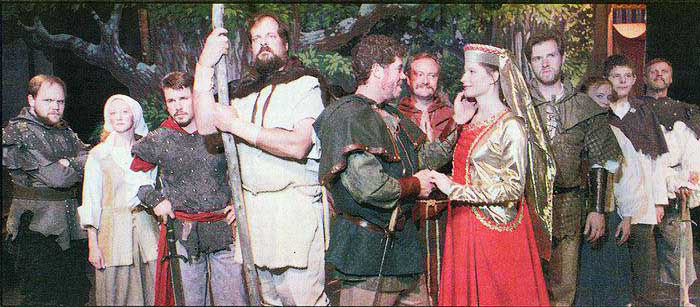
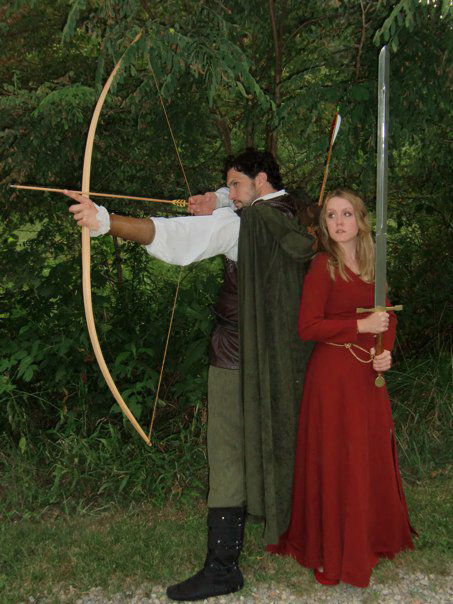
The
backdrop paintings displayed on their website look impressive, as do the
photos of the arms and armour.
I
wish I could comment more about other aspects of the production. For example,
I have no idea what the actors will be like. And a Robin Hood film or play
often succeeds on the merits of the man playing Robin Hood.
But
since the production is a month away and in another country, I can't really
give a full evaluation. Still I have the script, and that will have to
do.
Akers
and Messer have incorporated most of the elements that should be in a Robin
Hood play. There's action, danger, excitement, romance, swordfights, archery
contests, ambushes, disguises and of course, humour. There's a lot of humour
in the Robin Hood legend, and the writers realize that -- especially in
the scenes with Gisbourne's repeated attempts to travel through Sherwood.
There's also a few darker moments where the characters question their actions.
It
sounds like pleasant family entertainment.
One
of the main problems in the script is that it is too dependant on its source
material. There are moments that come a little too close for comfort to
scenes in Errol Flynn's The Adventures of Robin Hood, the Robin
of Sherwood (called just Robin Hood in the US) TV series and Robin
Hood -- Prince of Thieves. This is not to say it's wrong to have influences,
all the sources I just mentioned borrowed from earlier versions too. But
what Flynn's movie and Robin of Sherwood did was to take their sources
and create something that rose above them. Robin Hood -- The Legend
of Sherwood doesn't really seem to have anything new to say. It just
seems like a collection of things that other people have done. It's safe,
fun and reliable, but I don't think it takes enough risks to be a truly
great addition to the Robin Hood legend.
Another
problem is that a lot of the dialogue is clunky and overwritten. For example,
two of the Merry Men are killed in an attack and afterwards the Merry Men
squabble about unneccesary risks. Robin's often prone to making inspirational
speeches in books, films and other plays. But in this scene, Little John,
Will Scarlett and Robin all shout speeches at each other. The scene would
have been much more effective with some pruning. (Although then it would
have resembled an argument in "Robin Hood and The Sorcerer" that much more
closely.) Akers and Messer did reveal (through a speech, not dialogue alas)
an interesting facet of Little John's personality and history though.
The
villians are a bit too blandly evil for my tastes, but then that's part
of a tradition. It might be a tad redundant to have three incompetent bad
guys -- the Sheriff, Sir Guy and Prince John. The smartest bad guy isn't
a guy at all -- it's the sheriff's wife, Gertrude.
Marian's
the cloistered lady, acting as a spy for the outlaws, as she is in the
Flynn movie as in other sources. But Ellen, Alan a Dale's wife, is somewhat
feisty and can shoot as well as the other Merry Men. Also in the band is
Anna, a woman who has an unrequited crush on Robin.
The
script certainly has its faults, but as I said earlier it has good points
as well.
Again,
just reviewing a script is a problem. Where this play has the best chance
of succeeding are things that happen on the stage rather than the page.
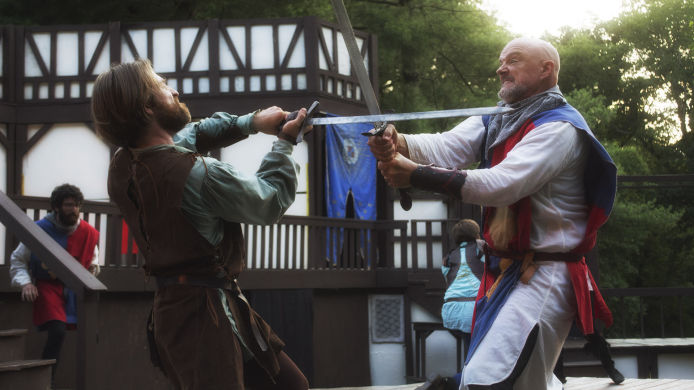
The swordfights and like will seem more fun and exciting when performed
live. The rehearsal photos of the fight choregraphy looks very promising.
Also,
if the Robin Hood is charsimatic enough the usual speeches about freedom
could come alive.
I
would be interested in seeing this play to see how it works out on stage.
And
it does my heart good to see Robin Hood getting this kind of attention.
The production ran from
May 5-14, 2000
at The Performing Arts Center at the Shelton House in Waynesville, North
Carolina.
|