Current Spotlight
All Spotlight Reviews
Novels and Short Stories
Films and Television Shows
Plays, Poems and Ballads
Robin Hood Scholarship
Miscellaneous
Featured Spotlights
Robin Hood - Prince of Thieves
starring Kevin Costner
The Adventures of Robin Hood
starring Errol Flynn
Robin of Sherwood
starring Michael Praed and Jason Connery
The Forestwife
by Theresa Tomlinson
A Gest of Robyn Hode
(early ballad)
Robin Hood and the Friar
(16th century play)
Robin Hood Tales
(1950s comic books)
Main Sections
Main Page
Introduction & What's New
A Beginner's Guide
Robin Hood Tales
- Ballads & Stories
Wolfshead Through the Ages
- The History of Robin Hood
Search for a Robin Hood
Spotlight of the Month
Robin Hood - A Personal Journey
The Picture Gallery
Interviews in Sherwood
The Blue Boar Inn
- Message Board
Legendary Links
Pook's Hill
Information
Site Map
How to use this site
Search This Site
About the Author
My Biography
Send me an e-mail
Copyright
All text, unless otherwise noted, and title graphics - © copyright Allen W. Wright, 2004.
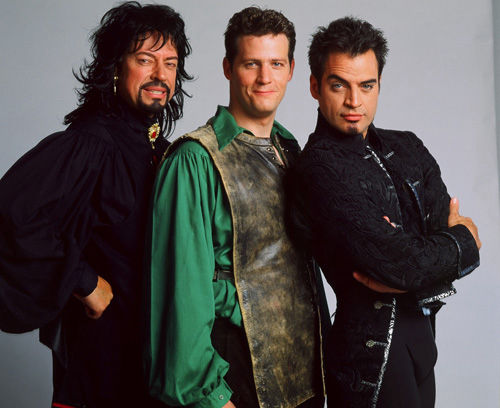
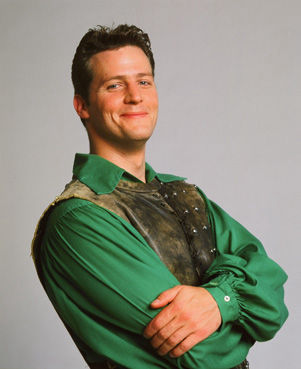
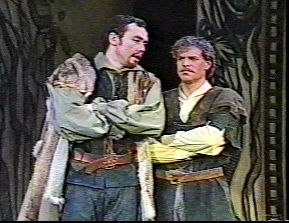
Photos, supplied by Flip! Publicity, feature Graham Abbey, Ross Petty and
Rex Harrington in Ross Petty Presents Robin Hood -- The Merry Family Musical
at the Elgin Theatre, Toronto (Dec. 3, 2002 to Jan. 5, 2003), directed by
Jim Warren. Photos by Jim Allen.
|
December 2002
Robin Hood -- The Merry Family Musical
produced by Ross Petty
Christmas seasons 1996 and 2002
Elgin Theatre, Toronto, Ontario, Canada
One of the best known English holiday traditions is that of a Christmas
pantomime -- or panto. Since 1996, actor/producer Ross Petty has made
pantos a Canadian tradition as well. For those of you who aren't familiar
with the medium, pantomimes are productions for children and their parents
that include singing, dancing, slapstick for the kids, pop culture and political
asides for the adults, and a complete shattering of the fourth wall. These
characters talk to the audience, and the audience talks back to them.
In a way, panto is responsible for this website. One of the first versions
of Robin Hood I remember was a Christmas panto, and I've been interested
in the legend ever since.
This Spotlight mainly focuses on the 2002 production, but it does also refer
to Petty's 1996 staging of Robin Hood, which became a TV special in 1997.
The plot is relatively simple, cobbled together from both panto and Robin
Hood tradition. With King Richard away from England, the evil sheriff
rules Nottingham with an iron fist. When Maid Marian and her Nurse
Tickle come to town, the sheriff plans to either kill or marry Marian to
gain her vast inheritance. Fortunately, both women have met a good
fairy and she leads them to Robin Hood, outlaw defender of the poor. Robin
and Marian fall in love. Nurse Tickle serves everyone "Oil of Bleauagh!"
Oh, there's a sword fight or two, some disguises, a couple of kindappings,
and an evil wizard who forces the Merry Men to do a Riverdance routine. (Perhaps
that explains Robin Hood's role in the movie Shrek.) And it ends with
a visit from someone who is not unfamiliar to the Robin Hood legend.
But the plot isn't the only familiar element. The songs have been recycled
from other shows. The opening number is "Robin Hood, Robin Hood, Riding
Through the Glen", the theme from the 1950s TV series starring Richard
Greene. The outlaw band performs the song three times, waiting for Robin
to arrive. (Perhaps he was waiting for the second verse, which the production
never uses.) And it appears several times afterwards. Even my fondness
of this song wore thin after a while.
Other musical numbers include "When I Fall In Love, It Will Be Forever"
(by Edward Haymans and Victor Young) and "I Talk to Trees" (from Paint Your
Wagon by Alan Jay Lerner and Frederick Loewe) as romantic numbers. The
big power ballad -- "Into the Fire" -- has been pilfered from fellow swashbuckler,
the Scarlet Pimpernel's recent musical by Frank Wildhorn and Nan Knighton.
("This is the Moment" from an earlier Wildhorn musical performed the same
function in the 1996 panto.) Most of the songs seem haphazardly thrown
together, with little apparent rhyme or reason for their inclusion other
than pantos must have songs. The most entertaining songs were snippets
played amidst the magical duels and the like -- such as "I Got You, Babe",
"Anything You Can Do, I Can Do Better" and Chicago's (the Fosse musical,
not the rock band) "Razzle Dazzle".
Mercifully, the production did not borrow any songs from Twang!!, Lionel
Bart's failed Robin Hood musical -- considered (rightly) to be one of the
worst musicals of all time. Anyone could create a better Robin
Hood musical, and it's a pity that this panto didn't attempt to include some
original songs.
Graham Abbey makes a pleasant enough Robin Hood, but really that's all
the script allows him to be. Pleasant and boy-scout heroic. Abbey did
injure his tendon before opening night performance and so he didn't have
a chance to swash his buckler as much as the script originally called for.
But then, I don't think it is truly action that this Robin Hood is lacking.
What he lacks is what Stephen Knight calls trickster vitality. True,
Robin does engage in some classic disguises (an old woman as in the ballad
Robin Hood and the Bishop and homage-named Geiser of Gisborne at the archery
contest.) But rather than a form of natural justice, Robin is merely normal
society in exile -- Uncle Robin, as this version of hero has been called.
I feel like something has been lost in the legend, but what do I know?
When asked who their favourite character was, most of the kids said Robin.
It's probably treason for a Robin Hood webmaster to admit this, but I
was really rooting for the bad guys (which in pantos take the form of boos
and hisses, not applause). This won't come as any surprise to the adults
who have been to a pantomime. The bad guys almost always steal the show. Their
comments are the most cutting, they break the fourth wall the most, and
there's a genuine sense of enjoyment from them. That tricksterish, anti-authoritarian
spirit that was once Robin's, now belongs to villains.
There are 2.5 bad guys in this production (1.5 in the 1996 version).
The head bad guy is, naturally, the Sheriff of Nottingham played by Ross Petty,
the show's producer and guiding force. Petty's sheriff borrows his dress
sense and demeanour straight from Alan Rickman's sheriff in Prince of Thieves.
(A sort of quid pro quo as Rickman was essentially playing a panto bad guy.)
In one of his first scenes, the sheriff establishes his draconian rules.
"No cellphones.... during my scenes. Make all the calls you want when someone
else is on stage." A veteran panto actor/producer, Petty knows exactly how
to get the audience to boo and hiss.
Then, there's the .5 villain, Simon Bradbury as the seemingly dimwitted
lackey Pinch. I was happy to see Bradbury mentioned in the 2002 publicity
poster, because he was my favourite part of the earlier production. His
character holds some delightful surprises -- at least, for those who haven't
seen the 1996 version. In particular, I remember the scene where the
sheriff recruits Pinch to be pretty much unchanged from the show's earlier
incarnation.
While Petty and Bradbury are veterans, a newcomer (both actor and character)
to the 2002 version is Rex Harrington, straight from the National Ballet
of Canada. As the Bad Wizard (or "Bad Fairy" as the children of the audience
quickly dubbed him, despite the cast's corrections), he dances beautifully
across the stage, but more surprisingly delivers bilious bon mots with the
best of them. There's a spark every time Harrington appears, which is not
nearly as often as he should. When asked who his character is supposed
to be, the Wizard declares "If you have to ask, you haven't been to my website
recently!"
Evil wizards may seem to be straight out of the 80s TV show, Robin of
Sherwood, but they've been popping up in Robin Hood pantos since the 1800s.
Two
more stock characters from panto tradition are the Good Fairy (like godmothers
of other pantos) and the Dame, called here Nurse Tickle. Sara Topham
plays Harrington's opposite numbers, and they duel with both magic and musical
numbers (such as "Anything You Can Do, I Can Do Better" from Annie Get Your
Gun). But there's some sizzle in these characters as they go from waltzes
to tangos. The whole "spirit of the forest" thing is a bit on the saccharine
side for this grumpy grown-up, but Topham does fairly well. (Karen
Kain -- Ross Petty's wife and former ballet partner of Harrington -- played
the role in 1996.)
As for Nurse Tickle, Nora McLellan is a surprising although entertaining
choice -- that's because she's a woman. Traditionally, the part of
the dame is played by a fella. (In the 19th century, Robin Hood, the Sheriff
and Alan a Dale were all played by women in pantos.)
After them, there's not much left for the Merry Men to do. Marian (Amy
Walsh) is, naturally, the love interest and a damsel in distress, but also
thankfully she does don the lincoln green and join the band. The other Merry
Men don't even merit mention in the show's publicity material. Tuck gets
a few more lines as the sheriff's chaplain who is more than happy to switch
sides. But Little John, Will Scarlet and Alan a Dale share only a few lines
and are not much different from generic Merry Men 1 or 2. Scarlet faired
better in the 1996 where he was portrayed by ballet dancer Frank Augustyn.
But here it is Harrington's bad wizard who supplies the dance and romantic
interaction with the good fairy.
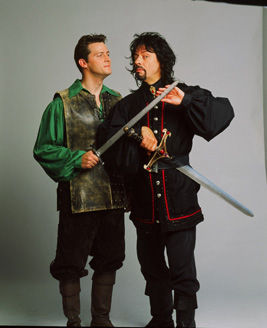
Robin Hood -- The Merry Family Musical, is like most pantos, a real mixed
bag. Some of the gags -- like the Sheriff and Pinch hiding in Nurse
Tickle's mirror -- or chase scenes are real classics for the kids (stock
elements of both panto and Scooby-Doo cartoons). Then, there are the
comments for adults -- references to Labatt's Blue (bland Canadian
beer), the premier's hair, the mayor's computer scandal, GST -- Greedy Sheriff's
Tax (medieval ancestor of our own Goods and Services Tax). There are little
asides about their well-known acting careers -- "You're chewing more scenery
here than you did at Shaw." Most of that stuff works. But at other
points, it does slow down. I can't imagine the point of the ghost in
the haunted castle -- but hey, it did get a reaction from the kids. And
I am about 25 years older than the target audience for such japes.
Although I've found the 1996 production entertaining as a TV special,
the true magic in a panto is being a part of it. Shouting "Oh no, it
isn't" or booing the sheriff or singing the Robin Hood song (and being
fully prepared to sing the next verse without the aid of any lyric sheets).
It appeals to the big kid in me, and to the little kid in the smaller
members of the audience.
Suggestions for Further Reading:
Robin Hood -- A Complete Study of the English Outlaw by Stephen Knight discusses
the panto tradition, both 19th century (pp. 192-196) and 20th century (pp.
254-258).
"Robin Hood in Cheltenham" by Gary Yershon, found in Robin Hood in Popular
Culture edited by Thomas Hahn, is the composer's account of his attempt to
create something slightly different than a Christmas panto.
|