Current Spotlight
All Spotlight Reviews
Novels and Short Stories
Films and Television Shows
Plays, Poems and Ballads
Robin Hood Scholarship
Miscellaneous
Featured Spotlights
Robin Hood - Prince of Thieves
starring Kevin Costner
The Adventures of Robin Hood
starring Errol Flynn
Robin of Sherwood
starring Michael Praed and Jason Connery
The Forestwife
by Theresa Tomlinson
A Gest of Robyn Hode
(early ballad)
Robin Hood and the Friar
(16th century play)
Robin Hood Tales
(1950s comic books)
Main Sections
Main Page
Introduction & What's New
A Beginner's Guide
Robin Hood Tales
- Ballads & Stories
Wolfshead Through the Ages
- The History of Robin Hood
Search for a Robin Hood
Spotlight of the Month
Robin Hood - A Personal Journey
The Picture Gallery
Interviews in Sherwood
The Blue Boar Inn
- Message Board
Legendary Links
Pook's Hill
Information
Site Map
How to use this site
Search This Site
About the Author
My Biography
Send me an e-mail
Copyright
All text, unless otherwise noted, and title graphics - © copyright Allen W. Wright, 2004.
Book covers and artwork used without permission, for the purpose of criticism and review. Photos from my book collection.
|
July 2002
The Adventures of Robin Hood
[Some editions are titled Robin of Sherwood]
By Major Charles Gilson
This month I explore two of the Robin Hood books that I've owned
since childhood. (The other Spotlight, covering No. 37 of the Bancroft
Classics line, can be found here
.) I'm not quite sure which of these books I read first, although
I suspect this is the second Robin Hood book that I read. I believe
it was bought at a school book sale, and I notice that my name -- minus
my trademark middle initial -- is enscribed on the inside cover in my
mother's handwriting. Fortunately, unlike that other book from my childhood,
the author's name is also printed on the book -- Major Charles Gilson.
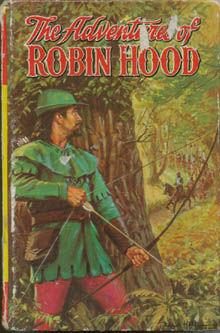
My childhood copy of the book has an impression date of 1974.
But looking at the catalogue for the International Robin Hood Exhibition,
I see that the original publication date was 1940. A few years back,
I picked up another copy of Gilson's book. Whereas the only illustration
on my 1974 edition was the front cover, this larger book had many black-and-white
illustrations and some colour plates. Although in the book Robin is described
as "Fair and bearded as a Saxon should be," the illustrations depict a
dark-haired outlaw. In the larger book, he looks suspiciously like Errol
Flynn, not surprising as the frontispiece is copied almost directly from
a photo also used as a cover on some video editions of the classic 1938
film. The version with the Flynn-like illustrations also contains some
paragraphs not found in my childhood copy. For example, it reveals that
Hereward and Robin Hood are on the same family tree.
The story begins with a brief overview of the Norman conquest and
post-conquest politics. Sir Robert de Braisse-Neuve also called "Robert
the Wolf" or "le Loup" controls most of Sherwood Forest from his mighty
fortress in Normanton. He plans to align with Prince John and seize control
of England during King Richard's absence. However, the thane Alfred of
Sherwood does not support him. So, the Wolf -- aided by fellow Norman bad
guys, Sir Stephen de Froy, Sir Geoffrey Malpert and the sheriff of Nottingham,
Master Ronald Hamnett -- attacks Alfred's castle at Newstead and kills
the thane. Alfred's daughter Marian is kidnapped and is promised in marriage
to Sir Stephen de Froy. Meanwhile, Alfred's son Robin (yes, Marian's brother
in this telling) and faithful members of the household flee to the greenwood.
As Robin Hood, the late thane's son begins his outlaw life. He
rescues the captured Little John, prevents Marian's wedding to Sir Stephen
and instead she is married to Allen-a-Dale (who from this tale hails from
Barnesdale, hence the Dale part of his name). Little John goes to Nottingham
and enters the sheriff's service. In the guise of potters, Robin and his
men rob the sheriff's household and then trick the sheriff into a forest
ambush. They also capture the Bishop of Hereford, but then protect the
bishop from the cutpurse and cutthroat Guy of Gisborne.
Then King Richard returns disguised as the Black Knight. The king
helps the outlaws retake the remains of Newstead castle, which were being
held by Sir Stephen. And then Robin becomes the king's lieutenant as
the king prepares to lay seige to the mighty fortress of Normanton. The
Wolf is defeated and killed. But although Robin has won pardon for him
and his men, he hears the call of the greenwood and does not give up his
forest ways.
The tension between Norman and Saxons has been a major theme in the
legend since Ivanhoe. And sometimes the pro-Saxon rhetoric can
seem a little ... unsettling. The first and last paragraphs help frame some
of the racial politics in the book.
When Duke William of Normandy conquered and slew King Harold at Senlac,
the England that we know to-day had even then been for centuries in the
making. For he who calls himself British may belong to a so-called mongrel
race; but it is to be remembered that the blood that flows in his veins
is that of many conquering adventurers who, one after the other, thought
these islands well worthy of winning.
And:
For thus, as we said in the beginning of our story, was our England
formed and moulded; and thus, because of the deeds of which we have now
told, does Robin Hood, even to this day, stand for something that is English.
I don't think I'd describe this book as racist, but from first paragraph
to last, there are little bits that make me uncomfortable. On the
other hand, when Thane Alfred perceives even his hounds as Saxons, it becomes
somewhat comic. It's also unusual that as King Richard is largely Norman,
he is very clearly described as the lesser of two evils. His warrior
virtues are praised, but it's hardly the ringing endorsement found in some
Robin Hood stories.
Another obvious departure from the classic Robin Hood tales is to focus
on a new Norman villain. The Bishop of Hereward is actually rescued
by Robin, and grows to respect the outlaw. The sheriff is a minor lackey.
And the "Wolf" doesn't think much of Prince John either.
Then, of course, there is Marian as Robin's brother. I'm actually
quite fond of the cross-dressing fighter Marian is for part of the book,
but she appears to fade from sight later on.
But the story does incorporate many classic tales, and it looks to the
earliest traditions by including Yorkshire locations like Barnsdale (Barnesdale)
as well as the more familiar Nottinghamshire ones.
I wouldn't call this a great book -- perhaps not even a good one --
but it was an interesting and strange experience to revisit it after so
many years.
|