Current Spotlight
All Spotlight Reviews
Novels and Short Stories
Films and Television Shows
Plays, Poems and Ballads
Robin Hood Scholarship
Miscellaneous
Featured Spotlights
Robin Hood - Prince of Thieves
starring Kevin Costner
The Adventures of Robin Hood
starring Errol Flynn
Robin of Sherwood
starring Michael Praed and Jason Connery
The Forestwife
by Theresa Tomlinson
A Gest of Robyn Hode
(early ballad)
Robin Hood and the Friar
(16th century play)
Robin Hood Tales
(1950s comic books)
Main Sections
Main Page
Introduction & What's New
A Beginner's Guide
Robin Hood Tales
- Ballads & Stories
Wolfshead Through the Ages
- The History of Robin Hood
Search for a Robin Hood
Spotlight of the Month
Robin Hood - A Personal Journey
The Picture Gallery
Interviews in Sherwood
The Blue Boar Inn
- Message Board
Legendary Links
Pook's Hill
Information
Site Map
How to use this site
Search This Site
About the Author
My Biography
Send me an e-mail
Copyright
All text, unless otherwise noted, and title graphics - © copyright Allen W. Wright, 2004.
Ace paperback edition cover by Darrell Sweet. Greenwillow cover by Alan Lee.
Cover art used without permission for the purpose of criticism and review.
|
July 2002
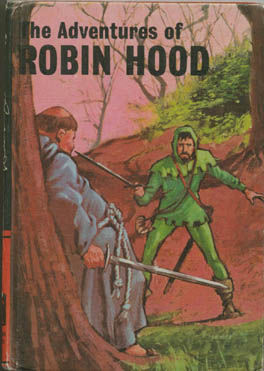
[The Adventures of] Robin Hood
Author Unknown
Bancroft Classics #37
First published in 1968; my edition is from 1974
In the last five years, I figure I've written hundreds of pages for this
website. An effort like that requires passion. And I've been passionate
about Robin Hood since my childhood. I saw a pantomime and a few movies
about Robin; Rocket Robin Hood was always on TV and I had
two Robin Hood books. Those books still have a proud place on my shelf.
One was a gift from my parents, and another slightly later one was purchased
at a school book sale. To be honest, at this point, I'm not sure which
book I read first. I think it was this one though. (
The other book, by Major Charles Gilson
, is also featured this month.)
This book (which is simply called Robin Hood everywhere but
the front cover) was number 37 in a line of Bancroft Classics which included
No. 1 Gulliver's Travels, No. 18 Ivanhoe, No. 31 Jane Eyre
and finally 48. The Pilgrim's Progress. Unfortunately, unlike
those other books, I don't know who wrote this volume. But whomever he
or she is, that person is partly responsible for the existence of this website.
So, what did I remember about this clearly formative book? Well,
Robin Hood was in it, and Marion, Little John, Friar Tuck, Will Scarlet,
Allan-A-Dale and the Sheriff of Nottingham. There was a quarterstaff
duel or two. Something about Tuck carrying Robin across the water. A
bit about Tuck being upset that a fake hermit was eating meat on a Friday
(as an inattentive Protestant, I do remember having to ask my mom about
that one). And well ... other than whole fish and Friday business, nothing
at all distinctive that wouldn't have also come from the other Robin Hood
stories I encountered back then. Hey, this was 25 years ago!
The first chapter begins with the elopement of the half-Saxon, half-Norman
William Fitzooth and Joanna, daughter of Sir George Gamwell (whose family
troubles, the great time waster of many a Robin Hood book are thankfully
not recounted here). The happy couple have a son named Robert Fitzooth,
called Robin Hood by his grandfather. Then the action jumps to Robin's adulthood.
Robin's support of King Richard and interfering ways offend Jeremy Cramp
and the Sheriff of Nottingham. So, Robin the earl of Huntingdon is outlawed
at his wedding to Marion Fitzwalter.
The newly-proclaimed outlaw heads to Sherwood Forest, along with Marion
and Will Scarlet. They assemble a band to steal from the rich tax gatherers
and give to the poor. Among those who join the Merry Men are John Little,
Friar Michael Tuck, Martin Much, Allan-A-Dale and his bride Lorna Demaine,
George-A-Green and his wife Betriss, the magician Wellenough and Rough
the Woodsman. In meeting Rough, Robin gains a magical horn to summon his
outlaw companions. Later, Robin encounters Blondel, King Richard's minstrel.
King Richard has been imprisoned in Austria and is being held for ransom.
Robin helps to raise the ransom and thwart Prince John's plans for the
throne.
Besides Prince John and the sheriff, our heroes face the evil Bishop
of Peterborough, Worman -- formerly a servant of Robin's now working for
the bishop --, a witch, Desmond of Gisborne and his worst of all, Desmond's
cousin Sir Guy of Gisborne. Gisborne leads an ambush which kills several
of the Merry Men, including Will Scarlet. In retaliation, Robin beheads
Gisborne and kills the sheriff.
Robin also participates in an archery competition at Ashby-De-La-Zouche,
where he encounters (in crossover cameos from a fellow Bancroft Classic)
Sir Wilfred of Ivanhoe, Sir Brian Bois-Gilbert and the Black Knight, who
is secretly King Richard. Richard is restored to his throne and all is
made right -- for a while. While Robin and Marion stay in England to have
five children, many of the outlaws join Richard in France. Eventually,
Richard is killed and John takes the throne. Then, as in the old ballads,
Robin is wounded and taken to Kirkleys Priory to be healed. The prioress
betrays Robin and he dies, firing a final arrow to mark his grave.
Many years later, the new king Henry III meets Friar Tuck who tells
him how Marion became the new Prioress after the evil one's death, Little
John went to Ireland and then returned to die in Hathersage. Tuck says
"There is one good thing about this old world of ours. No matter who
you lose in death, there is always somebody else coming along to be loved.
Robin's children, and now a new young King, for example." Henry promises
to visit Tuck again.
Well, you may well recognize some of those plot elements. I certainly
do. There's a lot from the old ballads, villains from the plays of Munday
and Jonson, crossover scenes with Sir Walter Scott's Ivanhoe, a
touch of Tennyson, part of Peacock and a nudge of Noyes's play. I don't
know when this book was first written (presumably 1968), but Roger Lancelyn
Green used most of the same elements and in roughly the same order in his
classic 1956 children's novel of the same title. Green's book was longer
and his style was brisker, and so there are many things missing that were
in Green -- most notably Robin's encounter with a butcher and the Sir Richard
of the Lee story from the early and influential ballad A Gest of Robyn
Hood.
But there are characters who are not in Roger Lancelyn Green's version
who appear and disappear in this book -- like Desmond of Gisborne, Wellenough
and Jeremy Cramp. I suspect that this unknown author is borrowing them
from somewhere else. If anyone has some ideas about such source material,
I'd be interested to hear them.
It's hard for me to judge the book on its own merits. Obviously I
like many of the classic stories retold here. And the style is, while
a bit long-winded, not too bad. Characters do tend to speak in exposition
though, like:
We are grateful to you for saving us from death, but it was the least
that could be done after the trick that was played on us; a trick that
nearly cost us our lives. Getting us to take false coins to the Sheriff;
and stealing our trees and the horses and dray from us! But that is over
and done with now, and the sooner the stage coach comes along, the better
we shall be pleased.
-- p.31
It's uninteresting dialogue in the extreme, but at least it's not the
tedious mock-medieval language found in Howard Pyle's book.
And unlike Pyle, Marion is present and accounted for. Unlike Green's
book, and Thomas Love Peacock before him, Robin and Marion's wedding ceremony
is completed early on and Marion goes the band from the beginning. Unfortunately,
she usually just does the cooking and cleaning. Robin even refuses to
allow her to be a decoy. Tuck assures Robin that Marion doesn't have to
be involved at all, and fellow outlaw Simon Trim disguises himself as Marian.
But towards the end of the book, Marian is trapped in a bear pit. She
wounds Prince John with a knife and attacks the new sheriff with a sword.
(As it's at odds with her portrayal elsewhere in the book, I suspect this
is another borrowing.)
One of the recurring themes in Robin Hood ballads is "Robin Hood meets
his match". But here, Robin does fairly well. A branch trips him and
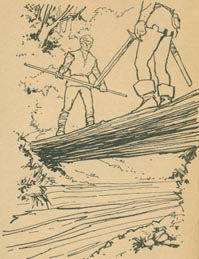
Little John in the famous quarterstaff duel. Robin throws Tuck into the
water (usually its the reverse) and they fight to a standstill. And finally
Robin beats George-A-Green. In the ballads, Robin fared a lot worse.
In the beginning, Robin seemed to play harmless tricks on people.
This book didn't use the story of him killing fifteen foresters. And I
fully expected to report that the ballad violence had been bowdlerized.
Boy, was I wrong! Robin kills quite casually here, and straight out of
the ballads, he drives a sword into Gisborne's skull and then beheads him.
In one instance, Robin tricks the Bishop of Peterborough (Green also switched
the diocese from Hereford to Peterborough) by hanging the bishop's hangmen
and then proceeds to kill the bishop's soldiers. The violence sickens
the Bishop.
The Bishop was staring about him in terror, his face livid, his eyes
flickering round as he observed the dead men that had been his own soldiers.
Then he said, "Some of these men are only young boys, and some of the
others have wives and children. I am responsible for sending them to their
deaths. All this was my idea. Oh, what have I done? Many times I have
been behind the Sheriff and his schemes, but I never realised until now
what such a battle could be like. All this death! Oh, God forgive me."
Robin motioned to his escort, and they turned and left the Bishop with
his dead ... and his conscience.
-- p. 66
Hang on. What about Robin Hood's conscience? After all, he killed
those men -- sometimes unnecessarily. Beheadings, arrows in the back, knives
in the heart, hangmen "as dead as mutton". I wonder if my mother knew what
violence she was exposing her son to.
Oh, and there's something else. Now, I know all too well about the
demon that is a typo. But there's a typo in this book worth pointing out.
"As you may have guessed by now," said Blondel with a smile, I have
come to bed for money; the ransom money."
-- p.76
I assume that the writer meant "beg". At least I hope so.
I think I'll not mention that typo and the gratuitous violence to my
mom. She seemed shocked and guilty enough recently when I told her that
she bought the book that helped to start my Robin Hood obsession.
|