Most Recent Interview
All Interviews
Novelists and Short Story Writers
Actors, Writers and Directors of
Film, Television and Theatre
Robin Hood Scholars
Officials from Robin Hood Country
Featured Interviews
Richard Carpenter
Creator of Robin of Sherwood
Mark Ryan
Nasir from Robin of Sherwood
Tony Robinson
Creator of and Actor from Maid Marian and Her Merry Men
Also host of Time Team and Baldrick in Blackadder
Theresa Tomlinson
Author of the Forestwife Trilogy
Robin McKinley
Author of The Outlaws of Sherwood
Clayton Emery
Author of The Beast of Sherwood and Robin and Marian mysteries
Professor Stephen Knight
Author of Robin Hood - A Mythic Biography and other Robin Hood scholarship
Professor Barrie Dobson
Co-author of Rymes of Robyn Hood
Main Sections
Main Page
Introduction & What's New
A Beginner's Guide
Robin Hood Tales
- Ballads & Stories
Wolfshead Through the Ages
- The History of Robin Hood
Search for a Robin Hood
Spotlight of the Month
Robin Hood - A Personal Journey
The Picture Gallery
Interviews in Sherwood
The Blue Boar Inn
- Message Board
Legendary Links
Pook's Hill
Information
Site Map
How to use this site
Search This Site
About the Author
My Biography
Send me an e-mail
Copyright
All text, unless otherwise noted, and title graphics - © copyright Allen W. Wright, 2004.
|
CLAYTON
EMERY
Conducted
and transcribed by Allen W. Wright
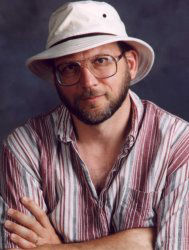
Clayton
Emery is an American novelist and short story writer. Some of his non-Robin
Hood books include Card Master and some novels in the Magic:
The Gathering series. His series of Joseph Fisher, colonial American
mysteries have been published in Ellery Queen.
Clayton's
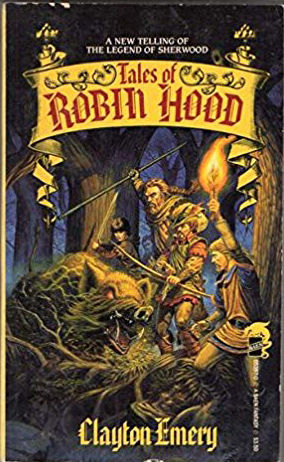
forays into the Robin Hood legend include the 1988 novel, Tales of Robin
Hood (later republished as The Beast of Sherwood), the short story "Robin Hood's Treasure" in the anthology The
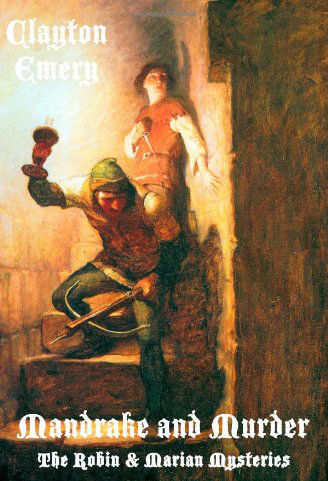
Fantastic Adventures of Robin Hood and a series of "Robin and Marian"
mysteries that are published in Ellery Queen's Mystery Magazine.
Among the recent Robin and Marian mysteries are "Fathoming the Fortune"
in the July 2000 issue, and "Plucking the Mandrake" in the anthology Murder
Most Medieval edited by Martin H. Greenberg and John Helfers.
He
is currently finishing the first "Robin & Marian" mystery novel, Royal
Hunt, wherein the outlaws are treed by the Wild Huntsman and his Hellhounds.
His
favorite book is The Wind in the Willows, and for some wonderful
historical reading he recommends Kenneth Roberts' Northwest Passage,
Arundel,
Rabble in Arms, and Oliver Wiswell; also James Clavell's
Shogun and Larry McMurtry's Lonesome Dove.
You
can learn more about Clayton and read several of his stories at his website,
www.claytonemery.com.
This
interview was conducted in e-mail conversations during September, 1997.
AWW:
When and why did you first become interested in Robin Hood?
CE:
When I was 8 or so (c. 1962), our family moved to the deep-woods state
of Maine. Sitting in motel room on a dreary rainy day, I watched
a scratchy black and white show on a small grainy TV. In those days,
there were lots of half-hour shows where cops and cowboys shot and punched
the hell out of each other. Then came this show about Robin Hood.
I forget what the plot was, but at the end, RH had just ambushed a bunch
of soldiers about to ambush his men. Holding them prisoner, he needed
to notify his oncoming men. Now, he could have just yelled for them,
or blown his horn. Instead, he ordered the soldiers, "Sing."
"Eh?" "Sing!" "Uh, whatcha want us to sing?" "Oh, `Summer
is A'Coming In'". So the men sing in droning basses. And the Merry
Men find them singing, and laugh.
Now, as mentioned, in those days, there was incredible violence on television:
fistfights, punchings, slappings, gunshots, etc. But THIS show featured
a hero who OUTSMARTED the bad guys AND used a screwball sense of humor!
Something different! (And might I add, my favorite cartoon character
is Bugs Bunny, who also sets up and outsmarts bad guys with humor.)
Anyway, from then on RH was my favorite hero. As kids, living on
the edge of endless open pine woods, we played Robin Hood many times.
(And War, since all our dads were military folk.)
I followed the legend off and on, reading or watching anything RH that
came my way. Eventually I began collecting RH books, which were plentiful
and cheap, but all the same (see below). And then...
AWW:
Why did you decide to write a Robin Hood novel?
CE:
I was reading THE SWORD IN THE STONE, and came across the 30-page adventure
Wart has with RH. Here, TH White used a combination of nitty-gritty
realism and nitty-gritty fantasy. He describes a war arrow in detail,
lists Marian's abilities, goes into detail about bird calls they use.
Then they attack a fairy castle, and the details continue. "A griffin
is eight times the size of a lion." "Fays can't abide iron, so the
iron swords of the invading Romans sent them underground."
And I thought, "This is great. Why hasn't anyone ever written a full-length
RH novel with this sort of detail and exciting adventure?" A short
while later, I saw the movie "Robin & Marian", which opened with that
wonderful scene where Richard is sloppily sieging a castle to get a gold
statue that turns out to be a stone. LJ is laconic, RH is intense
if unfocused and -- important! -- the Middle Ages are ALIVE! So again,
I wondered, "Why doesn't someone write a RH novel like this? Everyone
loves RH!"
Well, as they say, "I kept waiting for someone to do something. Then
I realized *I* was someone."
[Continued
in another e-mail]
CE:
As mentioned before, I decided to write a novel because no one else was,
and I thought there'd be a market for it (there's no sense in writing a
novel no one will buy), and because the Robin Hood *deserved* to have new
adventures.
Let me explain: I was collecting RH novels and reading them in libraries.
There are hundreds of RH titles. The "Local Studies" branch of the
Nottinghamshire Library has an entire wall of RH books that only date back
to 1850: *hundreds* of books, and these were mostly the English editions,
no American ones, which would be hundreds more. All these editions
exist because 1) RH is one of the most readily recognizable characters
in the world: show any child or foreigner a profile of a guy with a RH
hat shooting a bow, and they'll say, "Robin Hood". 2) The character
is in the public domain, so anyone can write about him. 3) The character
is popular. Wynken De Worde recognized that in 1495 when printing the first
books in England: first he printed the Bible, second Pilgrim's Progress,
and third, a RH compilation [the Gest], which because a best seller.
BUT -- no one was writing new adventures of RH. Almost no one.
Of 200 books I've seen and looked at, maybe *six* had new adventures.
All the rest have the same stories in the same format drawn from the ballads.
Chapter 1 is always "How R Became an Outlaw". Chapter 2 is always
"How RH Met Little John". And so on. A very few books had new
adventures, or partly new: Robin Hood's Arrow, Son of Robin Hood,
Good
News from Sherwood, and some others.
(Side bar: There are new adventures of RH being written all the time, but
as movies. Nice, but not like real books.)
So, I set out to write some NEW adventures of Robin Hood. These adventures
would incorporate all the stock elements, and add new ones. I think
of my "Tales of Robin Hood" series as doing for RH what "The Once and Future
King" did for King Arthur.
Of course, I was immediately blindsided by an editor, who bought my first
book of NEW adventures, then added at the last second at the top of the
cover, "A New Retelling of the Legend of Sherwood". *Sigh*.
AWW:
In The Tales of Robin Hood, you don't use a lot of the classic stories
like the archery competition. Why did you move away from that?
CE:
I didn't. I just didn't get around to telling some of the elements
thus far. I'm still working on RH's life, and so far concentrating
on the new things, though in the third book (drafted), he slays Guy of
Gisbourne and dons the horsehide. He'll do the archery shoot (with
an Emeryian twist), meet Little John (ditto), slay the Sheriff of Nottingham
for trying to hang Will Stutly, and eventually die ("The Long Road"), etc.
He'll also see that Prince John keeps his appointment at Runnymede, chases
Genghis Khan across India, fights in the Holy Land, meets Dracula (he already
met Sinbad), loses Marian to the land of faery, braces a Cornish giant,
slaughters Moslem pirates, and more. Meanwhile, Robin and Marian
and the occasional Merry Man will solve medieval mysteries, because there's
a market and they're fun to write. How do I resolve the nitty-gritty
mysteries with the high-flying fantasies? So far I haven't.
But life is for learning.
AWW:
Wow! You really have Robin's life mapped out. How much of this was planned
when you wrote Tales?
CE:
A lot. Once I start thinking about a topic, I come up with all SORTS
of stuff. (People who know me are AMAZED I get paid to think!)
Like 12 books' worth of RH's life ought to cover it.
AWW:
How do you go about researching the history of your Robin Hood stories?
And what is your approach to using history in a story?
CE:
The way writers work, as I see it, is that they gather facts, then organize
them into a readable format. Most any writing works this way.
So it's the same whether you're reporting on a traffic accident where you
interviewed all the participants, or writing a technical manual where you
interviewed all the developers about the software, or whether you dug through
many nonfiction books to learn about a medieval topic and peoples' reactions
to it.
In other words, I don't so much make things up as I gather facts and synthesize
them. In some cases, sections I'm passing off as fiction are in fact
gobs of strung-together history.
For example: In my first/latest R&M novel, I have RH talk to a girl
who dislikes being innured in a nunnery. When she finally breaks
down, she wails out her list of complaints. The abbess pulls off
the nun's wimples and slaps them and calls them harlot. The abbess
has pawned the abbey's silver and bought a gilt crucifix. Etc.
Then the girl cries she hates being a nun. "I rot behind a convent
grill in the flower of my life! I curse the weaver who wove my habit!
I curse the scissors that cut my beautiful
hair!" And so on. These laments are all part of the larger
story -- how R&M spring the girl from the nunnery -- but the laments
are all "borrowed" from history: complaints made to bishops, excerpts from
Nun's laments" (songs) in French, and other sources. (MANY sources:
I read like eight books on Medieval English Nunneries to find this stuff.)
The part about R&M springing the girl is equally drawn from history.
Another time, I wondered what it would be like for Robin Hood to get hauled
into a church court. So I started researching. The first thing
I learned at the reference desk is that such courts are called "ecclesiastical
courts", which was the first fact I wrote down. Reading many sources,
juggling oddities and facts, I assembled a story that reflects history
but is exciting and intriguing and fun. When I had the plot elements
out, I dumped them on the Internet's Medieval History file, asking if
anyone (mostly college history professors) could find fault with the progression.
No,
replied one guy, everything there is historically accurate AND intriguing.
He, it turns out, was the head of a medieval history and law department!
And editor then bought the story, so it succeeds on two fronts: is historical
and is interesting.
For my Robin Hood adventures, I again try to use all the "historical" facts
of the legend, but it's pretty thin so needs a lot of padding. So
I read a LOT of medieval books to learn what ELSE went on in England and
forests and the world that might impact Robin Hood. Fortunately,
LOTS happened, so I have a pretty wide palette to draw on. For instance,
Genghis Khan invaded eastern Europe in 1220 or so, when my Robin Hood would
be 50ish. Thus, Marian is kidnapped and carried off by Mongols, and
RH sets out to get her back, in a novel yet to be written.
Basically, I would find it impossible NOT to crib from history for many
reasons. Like 1) Why try to make stuff up when you can consult hundreds
of books and find thousands of intriguing true facts? 2) The stuff
you find will be far more interesting than anything you can make up in
a million years. 3) By gleaning history, you're learning more about
the time and thus better able to write about it. 4) Your books have
more credibility with editors and critics, because often you have to defend
a character's actions, which is easy if you can cite the historical occurrence.
On a subtler note, the more you read about the period, the more you can
THINK in medieval terms. One flaw with many "historical" novels is
the writer makes the characters think like 20th century people. But
when you've immersed yourself in it, and make the characters think like
medieval folk -- often making seemingly-illogical but actually period-correct
decisions -- you're really cooking with gas. And so far my readers
are impressed, so I must be doing something right.
AWW:
You tap into a lot of myth and magic in your book with figures like Puck,
Herne, the boar and witches. What do you think of the role of the supernatural
in the Robin Hood legend?
CE
Easy. There isn't any. The legends are solidly rooted in fact.
So solid that they sometimes give correct directions and views: Little
John stands on this bridge and faces this direction and sees this town
(obviously I forget details). The closest to mysticism is Guy of
Gisbourne wearing the horsehide, and that story is incomplete and patched,
so we don't know if there's any significance to the horsehide: Is it just
leather armor, or does it have some Celtic/evil/unChristian significance?
Ignoring that question, there are no supernatural elements.
So I inserted some.
Why? To flesh out the legend. Yes, one can write an infinite
number of stories around robbing from the rich and giving to the poor and
not getting nailed by the sheriff. They wrote 108 really neat such
stories for the 1950's Adventures of Robin Hood TV show. But I
wanted something mysterious, lurking behind the scenes, supernaturally
influenced just ... because.
But not just ANY magic, as in, "Magic can do anything." I use magic
as people THOUGHT magic worked: anthropological magic, as it were.
And I use British legends that would have been attributed to Sherwood Forest
and elsewhere. Like a witch, Puck, Oberon, will of the wisp, Herne,
Celtic ghosts, a golem, tar men, a sorceror, skull fairies and demons,
black dogs, and so forth -- all things that people thought were real back
then.
The supernatural impinges on RH's life tangentially, so far. For
instance, why does he have a miraculous ability with a bow? And when
he was a child, Young Robert kept wandering to the woods, once disappearing
for days at a time (tended by Puck, we learn later). Upon returning,
his frantic mother nicknamed him "Robin" for a name of protection: it has
five letters, a witch can assume any shape but a robin because a robin
got its redbreast from the blood of Jesus when it tried to pluck thorns
from his brow, seeing the first robin of spring is good luck, and I forget
what else. As such, RH owes Puck favors, and tries to repay when
he can, but often doesn't understand all the situation, like the time he
rescued Oberon(?) from the hobyas(?) invasion(?).
[Here
is Clayton's explanation on why he put the question marks there.]
-----------
Sorry, I'm unclear. In my Sherwood, *Robin* is never certain what
his relationship with the fay folk is. Robin occasionally leaves
gifts for the fairies. Puck occasionally shows up and pantomimes
(he doesn't talk) some need or warning, which is never clear and sometimes
unfathomable. In the unpublished story "Robin Hood and the Hobyas",
Puck delivers an older chewed-up fairy (Oberon?) who needs rescuing from
hobyas, which seem to be evil toothy fairy invaders. Or at war?
Robin gets much-chewed in the rescue, but never fully grasps what's going
on in fairy-land.
Actually, like every other superstitious medieval man, Robin is ALWAYS
confused when he's blindsided by fairies, ghosts, spirits, and so on.
Nor does he ever try to learn more. His much-vaunted curiosity ends
at the edge of "man's world". He just considers himself lucky to
come through relatively unscathed.
------------
And too, there's the question of why Herne (god? spirit? wizard? fake?)
keeps one eye on RH and talks vaguely of the guardian of Sherwood.
In short, supernaturalism = mystery and intrigue.
AWW:
In your book you create a lot of new members for the Merry Men, particularly
women like Bold Jane Downey. Why the additions?
CE:
I haven't created a LOT of new characters, I don't think. When I
began, I gleaned the legend for named Merry Men: Little John, Friar Tuck,
David of Doncaster, Will Scarlett, Will Stutly, Gilbert of the White Hand,
Much the Miller's Son, Arthur A'Bland, Allan A'Dale and Elaine, Maid Marian.
Note that's quite a few men. These were all mentioned in at least
two places. Early on I also missed a couple: George O'Green and Hard-Hitting
Brand. Reading here and there, I'd gotten glimpses of the characters and
fleshed them out. Gilbert Whitehand, for instance, either had soft
white hands like a girl, or one bad hand for no given reason. Will
Stutly was older, some authors thought, so I made him Robin's entor, his
father's seneschal. Will Scarlett is actually Will Gamwell, Robin's cousin
from a ballad, and something of a scatterbrain, so I made him Robin's opposite:
irresponsible, irreverant, etc. Arthur A'Bland was LJ's cousin from
a ballad. And so on. Then I created a few more, including a VERY
few women who emulate Marian, who I think is the first liberated woman
of English Literature, since she can do everything a man can. My
creations are Red Tom, Ben Barrel, Black Bart, Grace, Bold Jane Downey,
and some others in passing. Many of the men are married with wives,
because SOMEONE had to cook, and Marian sure as hell wasn't going to.
So Robin Hood has "yeomen" (fighters) and "cooks" (civilians). There
are a few children too, because anywhere you have husbands and wives you
get kids. And Will Scarlett has his son Tam as a foil.
One problem with colorful groups is sometimes EVERYONE is wildly colorful,
so the place looks like a circus: see for instance Star Trek: Voyager,
Sgt Rock's Easy Company [a classic DC comic book set in World War II],
and other groups. While some of my Merry Men are colorful, many are
lackluster peasants devoted to Robin and not big thinkers. If anything,
Robin sometimes despairs they follow orders TOO well.
This is the largest the Merry Men have ever been -- almost 30 peoples --
and it's almost unworkable trying to house and feed this many folks in
the depths of Sherwood: ie, without a support network or logistics line.
Also, by having many Merry Men, I can kill one now and then. Necessary
because being an outlaw is a dangerous profession. And unlike Sgt
Rock, where you have a core of "unkillables" and unnamed guys on the outskirts
getting whacked, I established in my first RH book that ANYONE can die
by killing a well-known Merry Man. And in my London book, next in
the series (sort of), I kill another one. And of course, in my last
book, I kill Robin.
AWW:
How did you come up with the idea of using Robin and Marian as detectives?
AWW:
Did you think Robin lends himself to the mystery genre?
CE:
As noted elsewhere, I was writing RH adventures and not selling them, and
writing modern amateur detectives stories and not selling them. So,
sitting staring at the terminal, I thought (which is what I really get
paid to do), and noted the Brother Cadfael series was selling well, and
would soon be on TV. And after decades of private eye stories, amateur
detective stories were popular: sewer inspectors, untrained investigators,
and so on. So I wondered if I could write a RH medieval mystery.
So, checking the market, I bought copies of Ellery Queen and Alfred
Hitchcock Mystery Magazines, which are the only two major mags, and
read them, got a sense of what they wanted. The mags are actually
sold mostly by subscription to older readers, for instance. So you
can't use gore or hard language or even unpleasant topics, but more old-fashioned
cerebral thinker-mysteries.
Anyway, then I came up with two different medieval ideas and mooshed 'em
together. This "mooshing" is how I've written all the stories so
far. In the first, I read (and read and read and read) medieval histories,
anecdotes, tales, etc and found the dowser angle. In medieval Paris,
a dowser tracked a murderer across the city to his door and found a bloody
knife: a true story, so the legend goes. Okay, how could you REALLY
do that? With a dog no one notices because the dowser wear colorful
clothing and acts like a clown. The second angle was a locked-room
mystery, the door sealed, the chimney full of smoke, etc. How to do that?
Note they are not "Robin Hood" mysteries, but rather "Robin & Marian"
mysteries. Working like a "Moonlighting" team, Robin figures out
the mechanical aspects and Marian figures out the emotional aspects.
And both are very intelligent, and curiosity is a sign of high intellect,
and they have common sense. And both are too stubborn to quit a "case"
once they begin. In the dowsing case, Robin figures out the door
bar was held up with beeswax, and when the door was slammed shut, the bar
dropped. But MARIAN figured out why the elderly couple inside opened
the door to a murderer: because their SON asked them to open up, then sicced
a murderer on them.
In every case, Robin and Marian ply their strengths and rely on each other
to solve mysteries. They actually use a combination of logic, common
sense, observation, pure superstition, and folklore. Marian, for
instance, rushes to look in the dead couples' eyes because "The image of
a murderer lingers in the victim's eyes." But their son had pushed
ahead and closed their eyelids, pretending grief. So Robin and Marian
are a team, and I doubt either could solve a case alone. (And wouldn't
their adventures make a colorful and fun series on the Mystery Channel
on television!)
AWW:
Who is Robin Hood for you? How does he act? What does he stand for?
CE:
Good question. Robin Hood is perhaps the best example of the "wrongful"
hero, in that rather than uphold the law, support the establishment, fight
for king and country, he's an outlaw who fights corrupt authority.
There have been other heroes who fought wicked kings and such, but RH is
almost unique in that he dispenses HIS brand of justice in a world ruled
by injustice.
The legends became popular, of course, when common people were upset with
the status quo. Many parts of the church were corrupt, in that they
collected tons of money while lauding poverty. Kings were not necessarily
good, being either absent, too heavy-handed with taxation, or lax in letting
villains ride roughshod over commoners. So of "God's Sacred Triangle"
(or whatever it was called) where nobles defend the body, clerics defend
the soul, and peasants work to support everyone, most peasants could clearly
see that other two sides of the triangle were screwing them. Furthermore,
even God wasn't doing His job. Beginning about 1375, the Black Plague
swept through Europe, and continued to do so in waves for like a hundred
years. People thought they were being punished by God (priests said
so), so they reformed, prayed, sacrificed, even whipped themselves. Nothing
worked, and the plagues continued to kill by the thousands. So some
peasants thought even God was shirking his duties.
Meanwhile, there were stories of this guy, a commoner, hiding the depths
of Sherwood who took money away from corrupt clerics, humiliated
the local sheriffs, enraged nobles, and rewarded honest people of all stripes
with some of his stolen booty. What a concept! A hero of the
people and for the people who does what's RIGHT, not what's legal.
And of course, he's (usually) gentle about it. He doesn't slaughter
his enemies, he strips them and ties them to a horse backwards and sends
them back to suffer embarrassment. Or robs them, leaving them poor
as the people they robbed. RH is the guy who comes along and thrashes
the local schoolyard bully. He doesn't war to destroy an enemy, he
only seeks to bring back the proper balance, where average folks can work
and enjoy life without fear.
Of course, this "the outsider hero is the only honest man" image has been
repeated over many years. Prince Valiant vowing to destroy an evil
city. Dashing highwaymen robbing with a gun and a grin. Lone cowboy
shooting up corrupt towns. Lone private detective shooting up corrupt
town. Country singers Willie Nelson and Johnny Cash forming a group
called The Outlaws. Outlaw Bikers magazine. Pretty Boy Floyd the
Outlaw, hiding out in the hills of Oklahoma, begging a meal from down-home
folks, then leaving a $100 bill under his plate. Bonnie and Clyde
robbing banks that had conveniently folded and stolen working peoples'
wages.
Nothing sickens common people more than hearing some politician say, "We
did nothing illegal," when in fact he's legally robbed us blind.
Or Woody Guthrie's song goes, "As you travel through this country, You'll
see lots of funny men. Some will rob you with a six-gun, and some
with a fountain pen." Or Dylan's "to live outside the law you have
to be honest."
And Robin Hood has been tweaked for writers' own purposes. A Jewish
television producer is blackballed in 1950s Hollywood, so goes to England
and makes The Adventures of Robin Hood TV show where RH tweaks authority.
RH as hippie. RH as youthful leader rebelling against older entrenched
authoritarians. RH fighting Nazis. RH as a Socialist redistributor
of wealth. Marian as real leader of drunken outlaws. Marian
as feminist freedom fighter. And so on.
So really, Robin Hood as a rebellious hero rebels against whatever large
organization is exploiting common people. Yes, he's a plug-and-play
hero because he does what's RIGHT at a visceral level that people can identify
with. What more do you need in a hero?
AWW:
What were some of your major influences?
CE:
Ummmm, for what? You mean, what do I like to read? Or who am
I trying to copy when I write. ("At one time in this country, there
were only two types of writers: those trying to write like Hemingway, and
those trying not to.") If it's "What do I read?" the answer is all
kinds of adventure, westerns, comic books, mysteries, historical novels,
some classics, etc. (Don't get me started on what a "classic" should be.)
If it's "Who am I trying to write like?", the answer is nobody, or myself.
A long time back I learned that if I tried to write anything fancy, it
turned gloppy real fast. So my "secret" for "finding a style" is
to write as simply and clearly as possible. Any extras (what Twain
called "his little darlings") just get in the way of the story.
And that's what this profession really is -- storytelling. Whether
you're a caveman sitting around a campfire, a professional storyteller
in a Moroccan bazaar, or a "writer" beating on a keyboard. THE oldest
profession.
AWW:
Who is your favourite character from the book?
CE:
All of them. I like Robin Hood, who is a fully faceted person even
in the scanty legend. He displays humor, a quick temper, steadfastness,
kindness, and many other emotions. He's one of the most clearly drawn
characters of legend, if not the most. I like Little John for his
steadfast loyalty, and I've always liked giants (Paul Bunyan, Stumbo, Stormalong,
and others). I like Marian, who's plucky and tough yet feminine.
And all the others, whether they existed before or I created them.
AWW:
What problems have you encountered in writing Robin Hood stories?
CE:
None. I get to read a lot of history and make up adventures.
It's more fun than work, though there's a lot of typing involved.
(Dorothy Parker: "I love writing, it's the paperwork I can't stand!")
ROBIN HOOD AND THE BEASTS OF SHERWOOD by Clayton
Emery (formerly published as The Tales of Robin Hood). New adventures
of Robin Hood, with much use of magic and English folklore.
Buy it on Amazon.com
Buy
it on Amazon.co.uk
Please ask for permission if you plan to quote more than a small segment of the interview.
|